
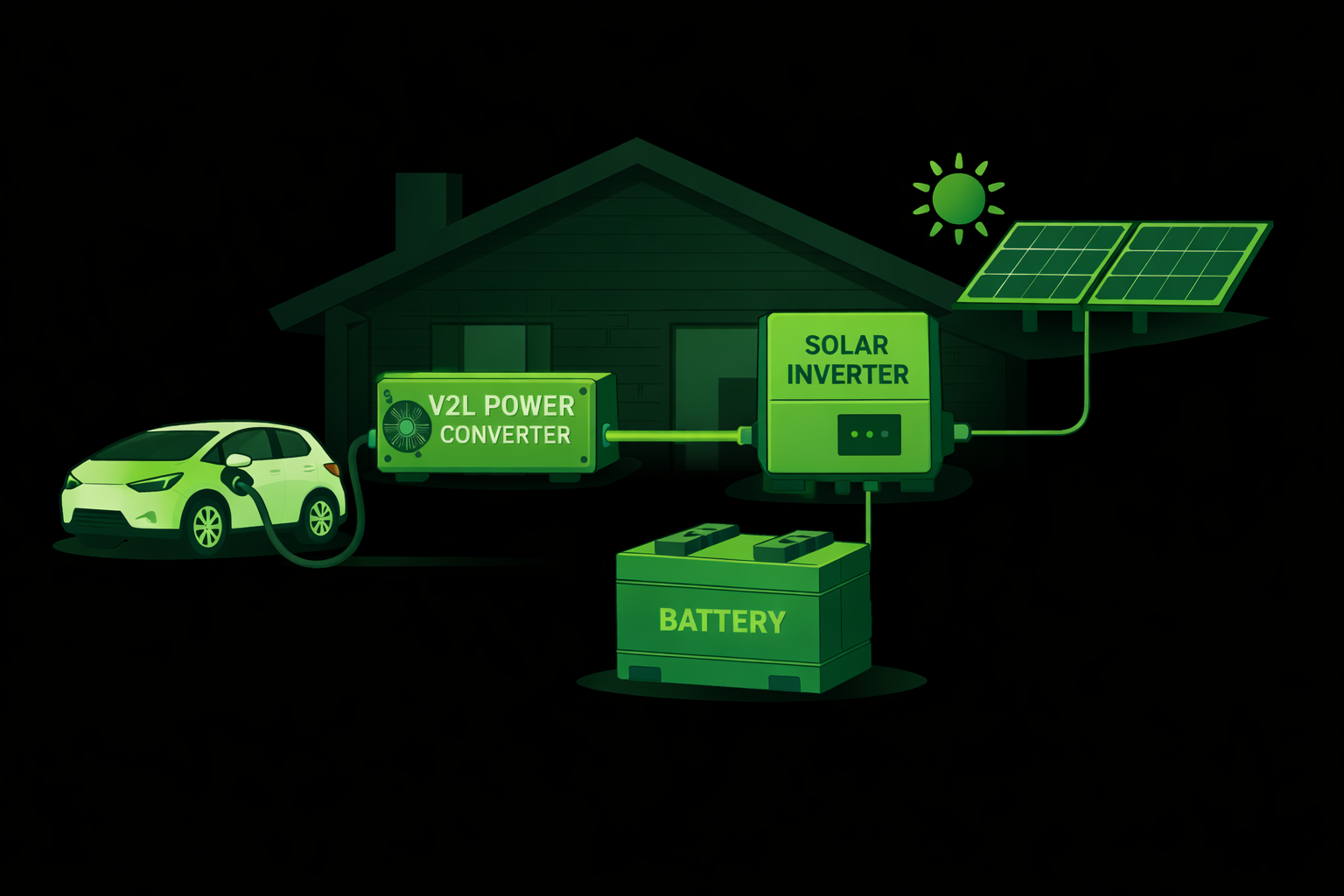
Car to house with V2L: Use your electric car as power for your home (and save during those expensive hours)
Many modern electric cars can deliver 230V power directly from the car via V2L (Vehicle-to-Load). With the right setup, you can use the car as a flexible and green power source to the home.
It is especially interesting if you want to:
- Reduce your consumption from the electricity grid during the most expensive hours
- Utilize the power in the car battery more actively
- Have an extra buffer for homework, heat pump and general everyday consumption
- Combine with solar cells and/or home battery
The smart thing about our solution: Use your existing solar inverter
Our car-to-home solution is built around a existing, approved solar inverter at home.
In practice, this means that we use the inverter you already have (or choose) as the central “hub” of the installation. This provides a solution that is easy to integrate into a home with solar panels and/or batteries.
We upgrade V2L to V2H via the solar inverter
V2L is basically “power out to consumption”. With our setup, the V2L function in the car becomes upgraded to V2H, because the electricity is fed into the home system through the solar inverter.
In short: The car supplies power, and the solar inverter ensures that it is integrated into the house's electrical setup in a way that fits into the existing electrical and solar installation.
How does it work in practice?
In short: You connect the car to your solution, and the car delivers power, which is fed into the house via a controlled setup.
It's about getting the right components together so that it's stable, safe and easy to use in everyday life.
Does your car not have V2L from the factory? The external box can add V2L functionality
Not all electric cars come with V2L as standard. In those cases, our external box used for add V2L functionality, so that the car can deliver power to external consumption (V2L) — and thus also be included in our car-to-home (V2H) solution via the solar inverter.
This means that you are not necessarily locked into what the car came with from the factory. With the right setup, the car can still become an active part of your home power supply.
Read more about the external box here: https://v2lpower.com/product/v2l-power-5-kw-ekstern-omformer-3/
Example 1: Commuter – and want to save electricity at home
Imagine you work outside the house and come home in the afternoon. When you get home, you connect the car to the house via the V2L solution and let the car supply power to the home until bedtime.
In a typical scenario, you can deliver about 21 kWh in a day – which may correspond to about 630 kWh in a month depending on your consumption and habits.
Result: You can save up against a significant amount per month – especially if you use the car as a power source during the hours when electricity prices and charges are typically highest (often in the late afternoon and evening).
Example 2: You work from home and have solar panels
If you have solar panels, you can charge your car during the day with excess electricity. When the sun goes down, you can use the car as a power source for your home.
It provides a really good "bridge" from day to evening and can be a smart way to better utilize your own production - especially during periods when the solar cells do not otherwise cover evening consumption.
What does it require?
To use a car-to-home solution, you typically need:
- One electric car with V2L function (or the possibility of add V2L functionality via external box)
- One solar inverter with available MC4 connectors (or equivalent connection option)
- A complete solution made for the purpose (cable, converter and correct insertion into the housing)
What does a complete “car to house” package include?
A completed solution typically consists of:
- V2L adapter cable adapted to your car model and the distance from car to house (with CE blue wall mount plug)
- Converter that converts the power from the car into solar power (can be customized up to 3000W)
- CE wall socket + cable to bring electricity into the house
- Solar cable with cable lugs to connect the converter to the solar inverter (e.g. Deye 12 kW)
- User manual (Danish/English)
The system may be tested and optimized for a specific inverter (e.g. Deye 12 kW hybrid inverter), but may also work with other models with MC4 connections.
What do you get out of it?
Once the setup suits your needs, you can:
- Cover part of the house's electricity consumption with the car battery
- Supplement the solar cells during periods of low production
- Cut down on consumption from the electricity grid during expensive hours
- Charge a home battery via the car (depending on setup)
Next step: Choose your car and see the options
The right solution depends on the car model and your installation at home.
- Choose your electric car here: https://v2lpower.com/vaelg-din-elbil/
- Read more about the car-to-home solution here: https://v2lpower.com/bil-til-hus/
FAQ
- Can all electric cars supply power to the house?No, the car must support V2L. The options vary from model to model.
- Is it the same as V2H?Yes, with our setup we upgrade V2L to V2H by feeding the power into the home system through the solar inverter.
- Should I have solar panels?Not necessarily, but solar cells can make the solution even more interesting because you can charge the car with surplus electricity.
- What if my car doesn't have V2L from the factory?In some cases, an external box can add V2L functionality so that the car can deliver power for consumption and be part of a car-to-home solution.
 Danish
  English
  Swedish
  German
  Dutch
Dutch  Norwegian
  Chinese
  French
  Polish
  Italian
  Greek
Greek  Finnish
  Spanish
  Turkish
  Bulgarian
  Czech
Czech  Portuguese
  Bosnian
  Slovak
  Slovenian
  Romanian
  Hungarian
  Lithuanian
  Latvian
  Estonian
  Serbian
  Ukrainian