
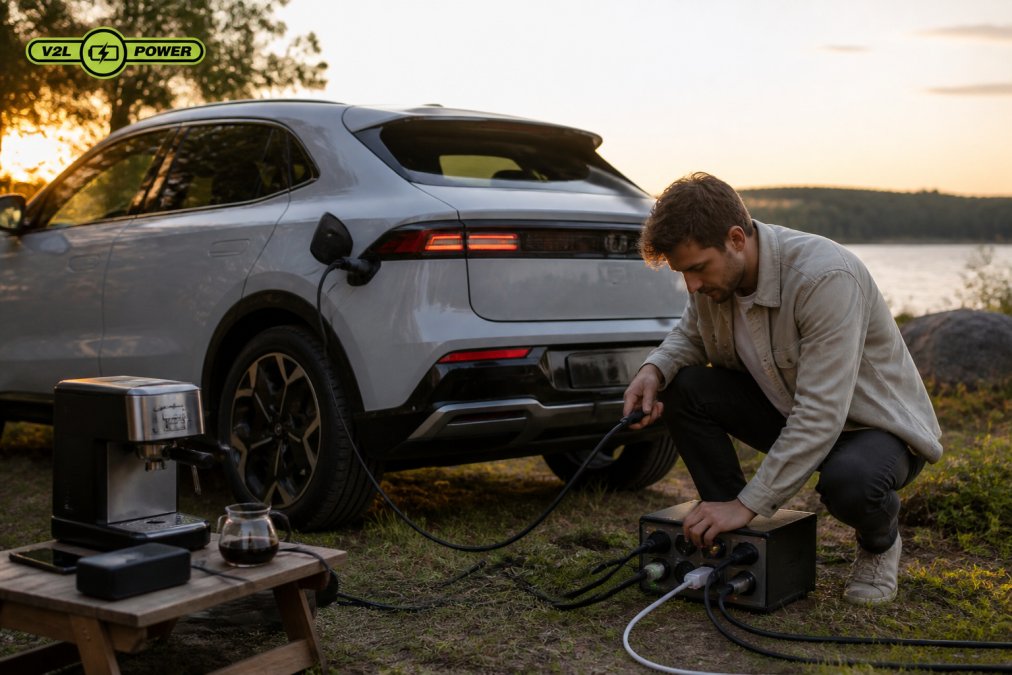
How V2L works in electric cars: Practical guide
Table of contents
- What is V2L (Vehicle-to-Load)?
- How V2L technology works: Power from electric car to external devices
- Electric cars with V2L: Which models support the feature?
- V2L adapter type 2: How to connect devices safely
- Power from electric car to house: V2H and V2L compared
- V2L vs V2H difference: What should you choose?
- Safety and battery degradation when using V2L
- Practical uses: Camping, emergency power and business
What is V2L (Vehicle-to-Load)?
Vehicle-to-Load (V2L) is the technology that makes it possible to draw power directly from your electric car to external electrical devices. Instead of charging your car from the grid, V2L works the other way around: power flows from the car's battery to your devices. This means your electric car becomes a mobile power source.
V2L is fundamentally different from regular EV charging. When you use V2L, your car supplies power for camping gear, tools, household appliances or emergency power. It’s a practical solution for people who need power away from home – or to supplement their home during power outages.
V2L requires three things: an electric car with V2L capability, a [certified adapter or converter](/product/v2lpower-p12-aflader-fra-kar-til-hus/), and compatible devices designed to receive this type of power. Not all electric cars support V2L yet, so check your car model first.
This technology is particularly relevant in Denmark, where many electric car owners are looking for flexible power solutions for camping, business and backup power. V2LPower specializes in precisely these solutions – from adapters to Type 2 converters – and helps Danes get the most out of their electric car as a power source.
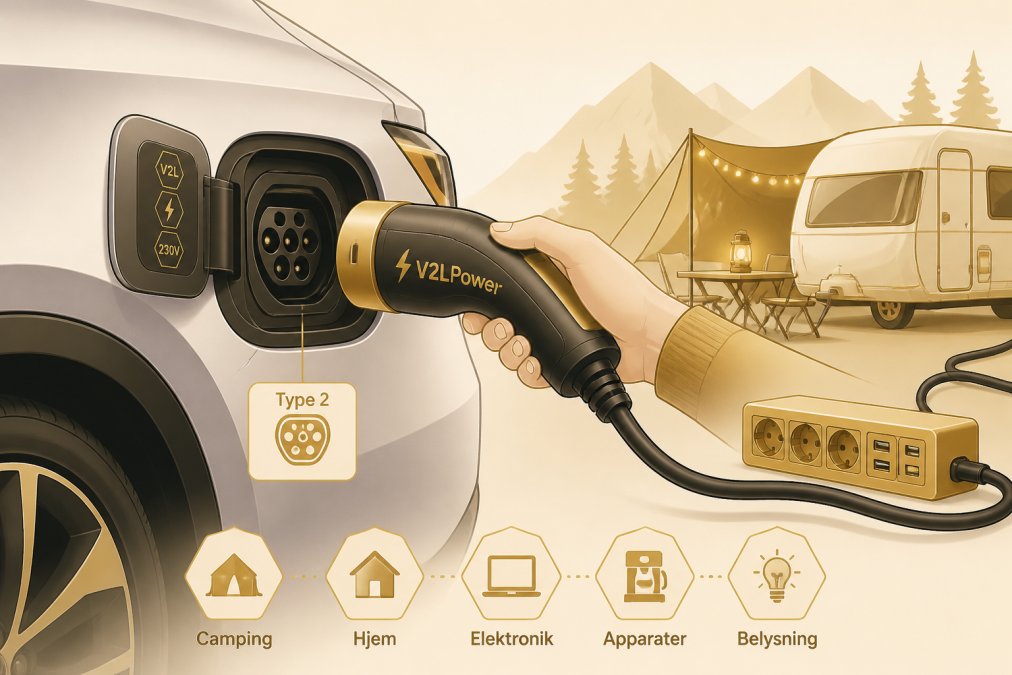
How V2L technology works: Power from electric car to external devices
The V2L system works by converting the energy from the car's high-voltage battery into a form that external devices can use. The process is more complex than it sounds, but the most important thing to understand is that power flows from the electric car's battery to your devices – never the other way around.
Here's the basic flow: Your car's battery stores energy as direct current (DC). When you plug a V2L adapter into the Type 2 port, the inverter inside your car or in the adapter itself is activated. This inverter converts the direct current (DC) to alternating current (AC), which is the same format as the power from your home outlets. You can then plug in regular appliances.
DC to AC: The role of the inverter
The inverter is the heart of the V2L system. It takes the car's DC power and converts it into AC power – a transformation that is absolutely necessary because most household appliances, camping equipment and tools require AC power to function.
An important point: not all inverters are created equal. A cheap inverter can introduce noise into the power supply or deliver unstable voltage, which can damage sensitive electronics. Certified V2L converters from suppliers like V2LPower are designed to deliver clean, stable power with built-in safety features. They constantly monitor voltage and automatically shut off if problems arise.
When using V2L, you will typically see 230V output voltage – the same as a normal socket at home. This means you can use almost any common Danish electrical appliance.
Battery capacity and power output
How much power can you draw from your electric car? It depends on two factors: the size of the car's battery and the maximum power of the inverter.
A typical modern electric car has a battery size of 50-100 kWh. That sounds like a lot, but remember that the car’s engine uses this energy to drive. If you use V2L, you’re drawing from the same pool. An average V2L inverter can deliver around 3-11 kW of power – enough to power camping coolers, heaters, tools and smaller household appliances.
The most important limitation is not the battery size alone, but State of Charge (SOC) – how much battery is left. Most car manufacturers set a lower limit, typically around 20-30% SOC, where V2L no longer works. This is a safety measure to protect the battery and ensure you can still drive the car.
The V2L inverter converts DC to AC, and the car's software controls how much power is allowed to be delivered. You can't just draw unlimited power - the system has built-in limits to protect both the car and your equipment.
Electric cars with V2L: Which models support the feature?
Not all electric cars have V2L functionality – this is important to know. The technology is most prevalent among newer models from manufacturers such as Hyundai, Kia, Volkswagen and BMW. Some older models or cheaper segments do not have it.
The most popular V2L electric cars in Denmark include the Hyundai Ioniq 5 and Ioniq 6, Kia EV6, Volkswagen ID. Buzz and ID.5, and BMW i5 and i7. These models have built-in V2L functionality, which means that the power conversion is handled by the car's own system.
If your car doesn't have built-in V2L, you can still use an external V2L converter. This connects via a Type 2 adapter to the car's charging port and handles the conversion outside the car. This offers greater flexibility, although it does require additional equipment.
Before investing in V2L solutions, check your specific car model. V2LPower offers detailed compatibility guides for different brands and models – it's worth reading to ensure your setup works perfectly.
V2L adapter type 2: How to connect devices safely
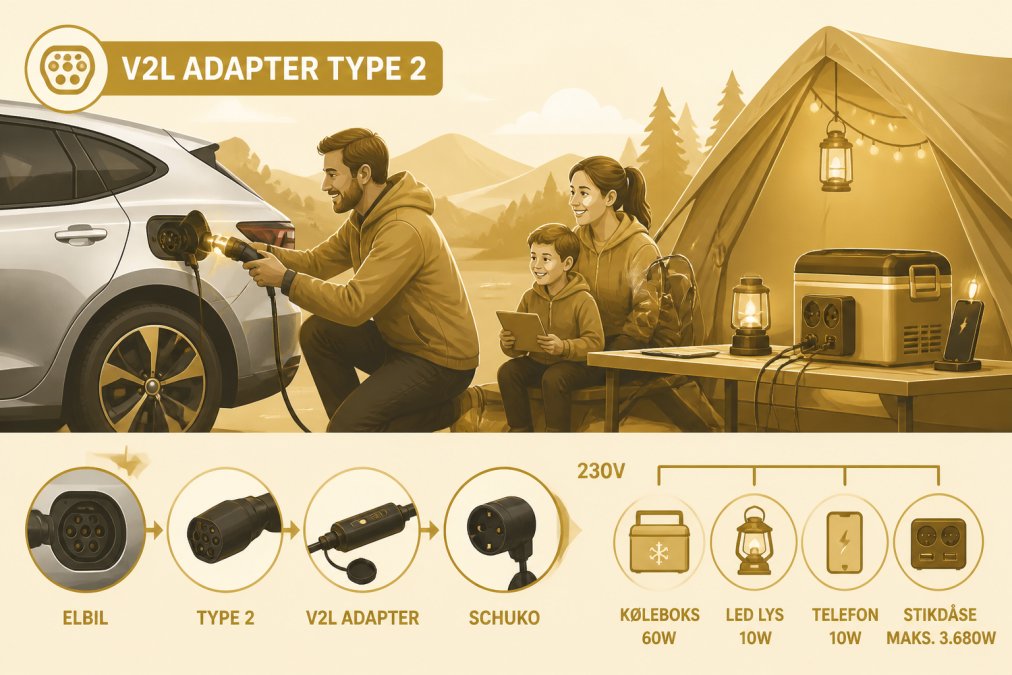
A V2L Type 2 adapter is the physical interface between your electric car's charging port and your external devices. It must be certified and designed specifically for V2L – not a regular charging adapter.
Type 2 is the standard for electric vehicle charging ports in Europe, including Denmark. A V2L adapter uses this same Type 2 connector, but instead of charging the car, it directs power out of the car. This requires both the right hardware and the car's software to allow outgoing power.
Step-by-step setup for beginners
If you're new to V2L, the process can seem overwhelming. Here's a handy step-by-step setup:
-
Check your car's compatibility. Check your car model in the V2LPower compatibility list or your car's manual. Make sure V2L is enabled in your car's settings.
-
Buy the right adapter or converter. If your car has built-in V2L, you only need a simple Type 2 adapter. If not, purchase an external V2L converter designed for your car model.
-
Connect the adapter to the car's Type 2 port. This port is usually on the side or back of the car. Insert the Type 2 connector firmly – it should be fully seated.
-
Turn on the V2L function in the car's menu. Most cars require you to manually enable V2L through the infotainment system. Please refer to your car's manual for exact steps.
-
Connect your devices. When V2L is active, you can plug appliances into the sockets on the adapter or converter. Start with smaller loads and work your way up.
-
Monitor the battery condition. Check your car's battery SOC regularly. When it reaches around 20-30%, V2L will stop automatically.
Never connect appliances with a higher power requirement than the inverter can deliver. A typical V2L inverter of 3-11 kW cannot operate an electric heater at full power. Overloading can damage both the inverter and your equipment.
Safety is essential. Certified inverters from V2LPower have built-in overload protection, fault detection and temperature monitoring. Cheap alternatives often lack these features and can pose a risk.
Power from electric car to house: V2H and V2L compared
Here's where it gets interesting: V2H (Vehicle-to-Home) and V2L (Vehicle-to-Load) sound similar, but they are fundamentally different solutions.
V2L is what we have been discussing: power from your electric car to portable or temporary loads. You can take the adapter camping, use it for tool on construction site, or to power household appliances during a power outage. It is flexible and requires no permanent installation.
V2H (Vehicle-to-Home) is a permanent installation that connects your electric car to your home electrical system. A V2H solution requires a dedicated charging station and electrician installation. It can deliver significantly more power than V2L – typically 7-22 kW – and can power your entire home for extended periods. V2H is ideal for homeowners who want car-to-home backup or want to optimize their energy flow at home.
The most important difference? V2L is mobile and simple. V2H is stationary and requires installation.
V2L vs V2H difference: What should you choose?
The choice between V2L and V2H depends on your needs. Here is a comparison:
| Aspect | V2L | V2H |
|---|---|---|
| Installation | None – plug and play | Requires electrician and permanent charging station |
| Mobility | Full – take it anywhere | Stationary – only at home |
| Effect | 3-11 kW typical | 7-22 kW typical |
| Costs | Lower – adapter/converter only | Higher – installation + equipment |
| Best for | Camping, tools, emergency power | Home backup, energy optimization |
| Duration | Hours to a few days | Days to weeks |
If you camp frequently, work on construction sites, or want simple emergency power without installation, V2L is the clear choice. If you want a permanent backup solution for your entire house and are willing to invest in installation, V2H is better.
V2L is flexible and simple; V2H is powerful and permanent. The choice comes down to what you primarily use the power for.
Safety and battery degradation when using V2L
A key concern for many electric car owners is: Does V2L damage my battery? It's a legitimate question, and it deserves an honest answer.
V2L actually has less of an impact on your battery than regular driving. When you drive, the battery discharges quickly and under high load. V2L is a more controlled discharge – the system carefully manages the current to minimize stress. Car manufacturers have designed V2L specifically to be safe over the long term.
The most important thing is to follow some simple rules: Never discharge the battery below 20% SOC when using V2L. Avoid recharging to 100% every day if you use V2L regularly. Let the battery rest between intensive V2L sessions.
How V2L affects battery life
Modern electric vehicle batteries are designed to last 8-10 years or more. V2L use does not significantly reduce this lifespan if used wisely. In fact, data shows that controlled discharge through V2L is less harmful than frequent fast charging.
Car manufacturers set limits on V2L usage (like the 20-30% SOC limit) precisely to protect the battery. These limits are based on extensive testing and engineering. If you respect them, you minimize the risk.
It's worth noting: if you're using the V2L as backup power during a power outage, it's short-term and won't negatively impact the battery. Longer-term use—like running your entire house for weeks—requires more attention, but the V2H (not the V2L) is designed for that scenario.
Legal and insurance aspects in Denmark
This is where things get more complicated. Denmark has not yet established a clear legal framework specifically for V2L use in private homes. This means you are in a gray area.
From an insurance perspective, you should contact your car insurance company and inform them that you are using V2L. Some insurance companies will accept it without a problem; others may have conditions or require additional documentation. It is important to be transparent – if you are using V2L and have not informed your insurance, it could potentially affect a claim.
For home backup power, similar logic applies. If you are installing V2H or using V2L to supplement your home, you should inform both your utility company and your home insurance. They will likely require that the system be certified and installed properly.
Legally speaking, V2L use for camping and mobile power is without any problems. It's when it comes to permanent or home integration that you need to be careful.
Always contact your insurance company before installing V2H or using V2L as backup power for your house. Missing information can have consequences in the event of a claim.
Practical uses: Camping, emergency power and business
V2L is not just theory – it solves real problems for real people. Here are the most practical applications:
Camping and autocamping: This is V2L's strongest area. A V2L adapter gives you power for coolers, LED lights, phone chargers, small heaters and even small coffee makers. You can camp without being dependent on campsite power or battery power. A typical camper weekend uses just 5-10% of your car battery's capacity.
Emergency power during power outages: When the network goes down, V2L can provide power to essential appliances – routers, lights, refrigerators, or medicine coolers. It’s not a permanent solution (that’s what V2H is for), but it can be life-saving for hours or a few days.
Commercial use: Tradesmen, service technicians and small businesses use V2L to power tools on construction sites, at home or in the field. A V2L inverter can power drilling machines, grinders, and other tools without being dependent on gasoline generators or power cables.
Outdoor events: If you organize smaller parties, markets or outdoor events, V2L can supply power for music equipment, lighting and small kitchen appliances.
V2LPower has helped many Danes implement V2L for exactly these purposes. Their range of adapters and converters are designed to be safe, reliable and easy to use – whether you are a beginner or an experienced user.
Frequently Asked Questions
How exactly does V2L work in my electric car?
V2L works by tapping energy from the car's battery capacity and converting it from direct current to alternating current via an inverter. This power can then be used to power external devices through a 230V socket. The process is controlled by the car's software, which ensures safe discharge and protects the battery from overload.
Which electric cars with V2L can I buy in Denmark?
Several brands offer V2L functionality, including Hyundai, Kia, Volkswagen and others. It is important to check that your specific model and year supports V2L, as the feature is not available on all variants. Contact your car dealer or refer to your car's manual to confirm compatibility.
What is the difference between V2L, V2H and V2G?
V2L (Vehicle-to-Load) provides power from the car to external devices. V2H (Vehicle-to-Home) connects the car to the house's electrical system to power the entire house. V2G (Vehicle-to-Grid) allows the car to send power back to the grid. V2L is the simplest and most direct solution, while V2H and V2G require more complex installation.
Can V2L use damage my electric car battery?
V2L does not negatively impact the battery when used properly. The car's software protects the battery by setting charging limits and controlling the discharge rate. Regular V2L use at normal levels has minimal impact on battery life compared to normal daily charging and discharging.
V2L is one of the most convenient features on modern electric cars, but it requires the right equipment and knowledge to use safely. A certified V2L solution from V2LPower ensures that you get stable, safe power from your car with built-in protection against overload and faults. Whether you are camping, needing emergency power, or using it for business, V2L gives you the freedom to use your electric car as a true mobile power source.
This article was written using GrandRanker


 Danish
  English
  Swedish
  German
  Dutch
Dutch  Norwegian
  Chinese
  French
  Polish
  Italian
  Greek
Greek  Finnish
  Spanish
  Turkish
  Bulgarian
  Czech
Czech  Portuguese
  Bosnian
  Slovak
  Slovenian
  Romanian
  Hungarian
  Lithuanian
  Latvian
  Estonian
  Serbian
  Ukrainian