
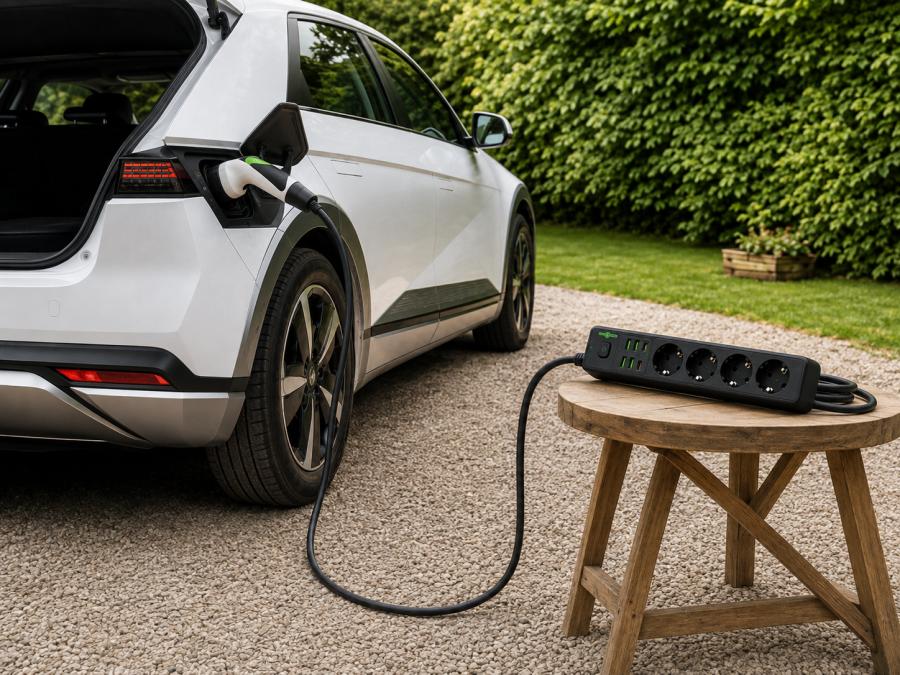
Safe V2L adapter for electric car: The complete guide 2026
Table of contents
- What is a secure V2L adapter for electric cars and how does the technology work?
- Compatible electric and hybrid cars: which models support V2L?
- Technical specifications: power output, plug connection and IP rating
- V2L adapter legislation and insurance in Denmark
- How to install and use your V2L electric car adapter step by step
- Battery degradation and power management: what you need to know
- V2L adapter test and safety check: how to choose the right one in Denmark
- Conclusion: the safe way to mobile power from your electric car
Last updated: August 2, 2026
Many electric car owners buy the first V2L adapter they find online. It's a mistake that can be costly. A safe V2L adapter for electric car must match your specific car model, comply with European product legislation and handle the electrical load without compromising the car's battery. Below we review everything you need to know, from technology and compatibility to legislation and battery degradation.
The most underestimated issue is compatibility. An adapter that doesn’t communicate properly with the car’s operating system will trigger the error message “V2L conditions not met” and will not deliver any power.
What is a secure V2L adapter for electric cars and how does the technology work?
Vehicle-to-Load enables an electric car to supply alternating current from the car's battery to external electrical appliances via a dedicated adapter. A V2L adapter is the physical link between the car's charging port and a standard 230V schuko plug.
What separates a safe adapter from a cheap copy is the built-in communication protocol: the adapter must speak the car's own language to enable the V2L feature. Without proper protocol management, the car will not deliver power, no matter how good the adapter looks.
Alternating current from the car's battery: this is how the inverter works
The car battery stores direct current. To power common household appliances, this must be converted to 230V alternating current via an integrated inverter in the car, which is activated when a compatible adapter is connected.
The inverter is factory-integrated and designed for the vehicle's specific voltage level and battery capacity. The power output typically ranges from 1.8 kW to 3.6 kW depending on the vehicle model. The Kia EV6 and Hyundai IONIQ 5 deliver up to 3.6 kW, which is sufficient for most household appliances.
V2L vs. V2H and V2G: what's the difference?
|
Technology |
Full designation |
Application |
Requires separate installation |
|---|---|---|---|
|
V2L |
Vehicle-to-Load |
Directly to devices via adapter |
No |
|
V2H |
Vehicle-to-Home |
Backup power for the entire house circuit |
Yes, certified electrician |
|
V2G |
Vehicle-to-Grid |
Export to the electricity grid |
Yes, grid company and approved equipment |
V2L is the simplest solution and does not require a fixed installation. V2H and V2G, on the other hand, require a fixed installation and involve the Danish electricity grid, which entails requirements from Danish Energy Agency on technical requirements for connection to the electricity grid.
Compatible electric and hybrid cars: which models support V2L?
Compatibility is the critical issue. There are three fundamentally different types of V2L implementation on the market, and they require three different adapter types.
The three types of V2L implementation
Type 1: Internal converter with CCS protocol (the most widespread) The car has a factory-integrated converter that is activated via a specific communication protocol over the CCS Combo 2 charging port. The adapter must send the correct signal for the car to supply power.
Models with this implementation include:
- Hyundai i30 (model year 2022-2026)
- Kia EV6 (model year 2022-2026)
- Kia EV9 (model year 2024+)
- Genesis GV60, GV70 EV and G80 EV (model year 2022+)
Type 2: External converter via Type 2 charging cable The car can supply DC power via a Type 2 connection to an external inverter that converts to 230V AC. The power output is typically lower.
Models: BYD Atto 3, BYD Seal, MG4 and MG5 (model year 2022+)
Type 3: Factory-fitted 230V outlet Some models have a separate 230V socket fitted as a factory option. Ford Mustang Mach-E (certain configurations) and Volkswagen ID.4 and ID.5 does not support V2L via charging port in standard configuration.
Critical model year pitfalls
The same car brand can have widely varying V2L support depending on model year and software version. Hyundai i10 did not support V2L at launch, but was enabled via software update from the 2023 model year. Kia Niro EV does not support V2L, despite the fact that EV6 does. BYD models only recommend their own approved accessory products.
Most plug-in hybrid vehicles do not support V2L via charging port as PHEV batteries are not designed for this discharge load.
How to verify your car's compatibility
- Find your car's exact model year and software version in the instrument panel's system info menu.
- Search the car manufacturer's official owner's manual for “V2L” or “Vehicle-to-Load.”.
- Contact the authorized dealer and request written confirmation of V2L support.
- Verify the adapter's compatibility list, a serious supplier indicates compatibility per car model and model year.
Technical specifications: power output, plug connection and IP rating
The most important specifications to check:
- Power output: Typically 1.8 kW or 3.6 kW, limited by the car's inverter.
- Plug connection: Schuko plugs for 230V appliances are standard in Denmark.
- Maximum load: Never exceed the maximum specified by the car manufacturer.
- Adapter type: Must match the car's charging port (CCS, CHAdeMO or Type 2).
- Power management: Quality adapters have overload protection and short circuit protection.
Weather resistance and IP rating for outdoor use
IP54 is the minimum standard for outdoor use in Danish weather. An adapter with an IP54 rating is protected against dust ingress and water splashes from all angles. IP65 or higher provides full dust tightness and protection against jets of water.
V2L adapter legislation and insurance in Denmark
The legal and insurance consequences of using an incorrect or uncertified adapter can be significant.
CE certification: what the documentation must contain
All electrical products marketed in Denmark and the EU must comply with the Product Safety Directive. For V2L adapters the following applies:
- Low Voltage Directive (2014/35/EU): Electrical equipment intended for voltages between 50V and 1000V alternating current.
- EMC Directive (2014/30/EU): Electromagnetic compatibility.
- RoHS Directive (2011/65/EU): Restriction of hazardous substances.
A properly certified adapter must be accompanied by:
- EU Declaration of Conformity: Document stating which directives the product complies with.
- Technical documentation: Test reports and risk assessment.
- Importer identification: The EU-based importer must be identified.
According to the Danish Safety Technology Authority on market surveillance and product safety, the importer and distributor are legally responsible for ensuring that products marketed in Denmark meet the requirements.
When can car insurance deny coverage?
Danish car insurance may refuse compensation for damage caused by:
- Use of non-approved accessories: If the damage occurs as a direct result of an unapproved adapter.
- Intentional or negligent overloading: Are you connecting devices that exceed the car's maximum V2L power?.
- Use contrary to the vehicle manufacturer's instructions: Most manuals state that only approved accessories may be used.
A specific scenario: A non-certified adapter causes a short circuit that damages the car's CCS charging port and control unit. The repair cost can amount to DKK 15,000-40,000. If the insurance company can document that the adapter was not CE certified, they have grounds to deny coverage.
Commercial use: special requirements and responsibilities
If you use the V2L function commercially, additional requirements apply. The Danish Working Environment Authority on electrical safety and the use of electrical equipment in the workplace requires that electrical equipment in a workplace is fit for purpose. As an employer or self-employed person, you are responsible for ensuring that the adapter is CE certified, cables are in good condition, and there is no risk of electric shock or fire.
Also check whether your business insurance covers damage caused by equipment operated via V2L.
Practical checklist: protect yourself legally and in terms of insurance
- The adapter is CE certified with an accompanying EU declaration of conformity.
- The adapter is explicitly approved for your car model and model year.
- You have received written confirmation from your insurance company about comprehensive coverage for V2L use.
- You do not exceed the car manufacturer's maximum power output
- For commercial use: you have verified that your commercial insurance covers
- You keep the EU declaration of conformity available
How to install and use your V2L electric car adapter step by step
Installation is typically simple, but the order is important.
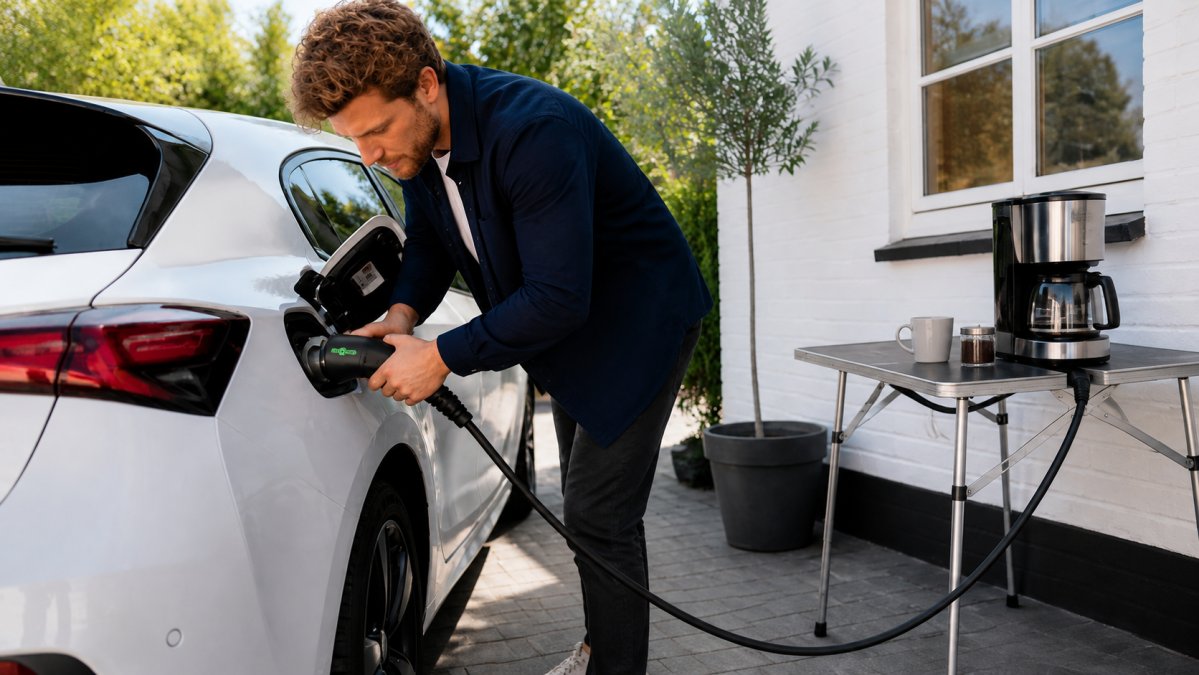
Person carefully connecting a V2L adapter to the CCS connector of the charging port on a parked white electric car in a sunny driveway, with an orange extension cord and a coffee maker visible on a camping table behind
Step 1: Park the car and turn off the drive-ready mode. V2L is only activated in parked mode.
Step 2: Connect the adapter to the car's charging port. You should hear or feel a click confirming proper connection.
Step 3: Activate the V2L function in the car's menu via the infotainment system.
Step 4: Only connect devices that do not exceed the vehicle's maximum power output in total.
Step 5: Monitor battery capacity. Most cars automatically stop V2L delivery when the battery reaches a preset minimum.
Which devices can be connected and what is the maximum load?
|
Apparatus |
Typical power consumption |
Possible with 1.8 kW |
Possible with 3.6 kW |
|---|---|---|---|
|
Coffee machine |
800-1200W |
Yes |
Yes |
|
Refrigerator |
100-200W |
Yes |
Yes |
|
Power tools |
500-1500W |
Partially |
Yes |
|
Electric kettle |
2000-3000W |
No |
Partially |
|
Laptop |
45-100W |
Yes |
Yes |
|
Air pump |
150-300W |
Yes |
Yes |
Maximum load is the car manufacturer's limit, not the adapter's.
Battery degradation and power management: what you need to know
Repeated use of V2L will affect the battery over time. Lithium-ion batteries degrade with frequent deep discharge cycles. Regularly discharging the battery from 80% to 15% via V2L will reduce the overall battery capacity.
Practical advice: use V2L with care and avoid discharging the battery below 20% with regular V2L use. Many cars have an adjustable minimum limit for this purpose.
Treat V2L usage as an occasional resource, not a daily power supply. Your battery will thank you in the long run.
V2L adapter test and safety check: how to choose the right one in Denmark
The market for V2L adapters is confusing and the price differences are large. According to The Danish Consumer Council Think about product safety and online purchases Products purchased from unknown online platforms are far more frequently involved in product safety cases. For V2L adapters, the consequences of a faulty product are potentially serious.
How to evaluate an adapter before buying:
- CE certification: Require declaration of conformity and technical documentation.
- Car-specific compatibility: The adapter should explicitly state compatibility with your car model and model year.
- IP rating: Minimum IP54 for outdoor use.
- Power rating: Clear indication of maximum load in watts or kW.
- Support and warranty: Possibility of Danish or European language support in case of errors.
V2LPower offers adapters that are specifically tested and documented for compatibility with the most common electric car models on the Danish market. The range includes instructions and video tests for specific car brands. Current prices and availability can be found directly on V2LPower's website.
Conclusion the safe way to mobile power from your electric car
Choosing the right V2L solution is about three things: compatibility with your specific car, certification that meets Danish and European product legislation, and a power output that matches your needs. The safe V2L adapter for electric cars is the product that is documented compatible, properly certified, and backed by real technical support.
Frequently Asked Questions
What is a V2L adapter and how does it work safely with an electric car?
A V2L adapter plugs into the charging port of your electric car and converts the car's DC power into 230V AC power via an integrated converter. This gives you a Schuko plug that you can use for electrical appliances. To be safe, the adapter must fit your car model exactly, as incorrect compatibility can trigger error messages or, in the worst case, damage the car's electrical system. Always choose a CE-certified solution designed for your specific electric car.
What safety standards must a V2L adapter comply with in Denmark?
In Denmark, a V2L adapter must be at least CE certified and comply with the EU Product Safety Regulation (EU) 2023/988. The adapter should also have the relevant IP rating if used outdoors in Danish weather. Make sure that the product has been tested to the maximum load it states and that the plug connection is approved for active power supply and V2L function on your specific car model.
Can using V2L degrade my electric car battery faster?
V2L draws power from the vehicle's battery, but the process itself does not cause abnormal degradation as long as the battery capacity is not repeatedly drained completely. Most electric vehicles with V2L functionality have built-in power management that stops the discharge at a certain minimum level. Avoid discharging below 20 percent on a regular basis, and use V2L in a parked state as recommended by the vehicle manufacturer to minimize wear.
How do I ensure that my V2L adapter is compatible with my electric car before purchasing?
Compatibility depends on the car make, model and year of manufacture, as the charging port protocol and connector type vary. Always check the manufacturer's compatibility list before ordering. At V2LPower you can specify your specific car model and have it confirmed whether the adapter works with your vehicle before purchasing. This eliminates the risk of the 'V2L conditions not met' error message, which typically occurs with the wrong adapter type.
What can I connect to a V2L adapter and what is the maximum load?
Most V2L systems deliver between 1.8 and 3.6 kW at 230V, depending on the car model. This is enough to power a coffee maker, refrigerator, power tools, laptop and small household appliances. Avoid appliances with high starting current such as heat pumps or large cookers that require more than the maximum power output of the adapter. Always check the power consumption of the appliance in watts against the adapter specifications and never exceed the maximum load stated.
This article was written using GrandRanker


 Danish
  English
  Swedish
  German
  Dutch
Dutch  Norwegian
  Chinese
  French
  Polish
  Italian
  Greek
Greek  Finnish
  Spanish
  Turkish
  Bulgarian
  Czech
Czech  Portuguese
  Bosnian
  Slovak
  Slovenian
  Romanian
  Hungarian
  Lithuanian
  Latvian
  Estonian
  Serbian
  Ukrainian