
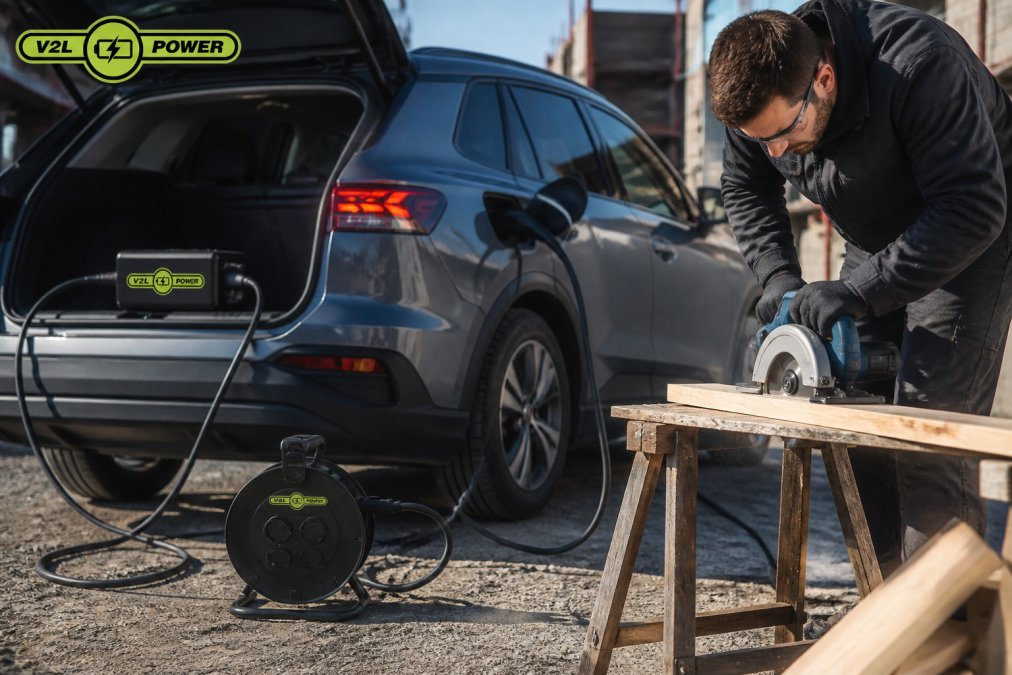
Charging tools from an electric car: The complete guide
Table of contents
- Three methods for charging tools from electric cars
- Power from Type 2 plug with V2L adapter for electric car
- V2L adapter for electric car: Choose the right equipment
- Inverter for electric car 230V: When does it make sense?
- Wattage calculation: How much power does your tool use?
- Charging batteries in vans: Practical guide for tradesmen
- Safety when charging tools from an electric car
- Conclusion: Find the best solution for your situation
Last updated: August 4, 2026
Charging tools from an electric car is no longer reserved for those with a generator in the van. Electric cars with V2L function can now deliver 230V power directly to power tools, charging racks and other equipment. Below you will find a complete technical guide to all three methods, including calculating wattage consumption and safety aspects you should not overlook.
Here's what most guides forget: there's a big difference between drawing 60W from a 12V socket and powering a 1,200W circular saw from your electric car's high-voltage battery via V2L. The choice of method is determined by your actual consumption.
Three methods for charging tools from electric cars
Three methods for charging tools from an electric vehicle will be available to tradesmen and electric vehicle owners in 2026: the 12V socket in the cabin, a DC-AC inverter mounted on the 12V or 48V system, and V2L via the electric vehicle's Type 2Each method has its place, but they differ significantly in effect, installation, and suitability for professional use.
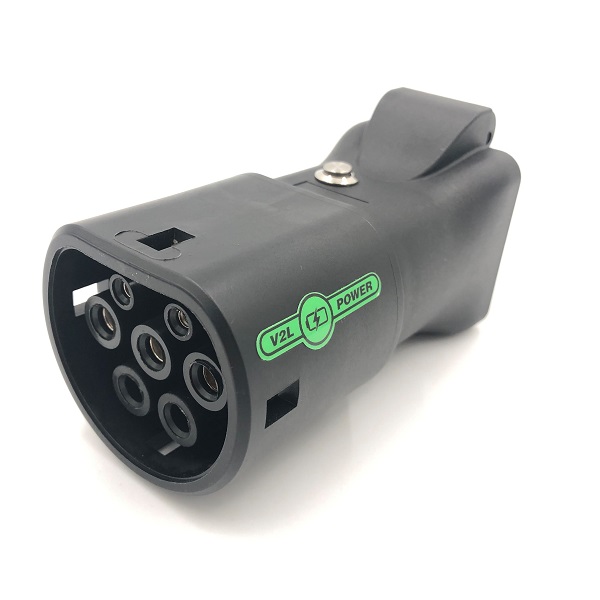
Charging via 12V socket in the car
The 12V socket is the simplest input. It is standard in all electric vehicles and can typically deliver 10-20A, equivalent to 120-240W at 12V. This is enough to charge phones, smaller lighting and low-power charging adapters for low-capacity battery tools.
The problem is the power management. The 12V system in an electric car is separate from the high-voltage battery and is powered via a DC-DC converter. If you overload the connector, the fuse group is activated. Many craftsmen experience this when trying to charge two battery packs at the same time. The solution is simple: charge one pack at a time and choose a charging adapter with low power consumption.
Never use a 12V inverter to directly power motorized power tools. The inrush current at startup can be 3-5 times the rated power and will blow the fuse instantly.
Using a DC-AC inverter (converter) for 230V
A DC-AC inverter converts the car's 12V direct current to 230V alternating current and provides access to mains voltage from the cabin. Inverters for electric cars 230V are available in sizes from 150W to 3,000W, but the capacity is actually limited by the amperage of the 12V system.
A 1,000W inverter requires approximately 90A from the 12V system. The 12V fuse group of most electric cars does not allow that load continuously. The result is either a blown fuse or overheating. Inverters for electric cars 230V make sense in vans where an additional leisure battery bank is installed and connected directly to the inverter. Here you can achieve stable 230V power for lighter tradesmen's tools such as drills and jigsaws.
The conversion loss in a typical sine wave inverter is 10-15%. This means that a 500W load effectively draws 550-575W from the battery.
V2L: Power directly from the electric car's battery
V2L is the technically superior solution for professional use. Vehicle-to-Load (V2L) is a feature where the electric car's high-voltage battery supplies power to external equipment via a dedicated connector, typically the Type 2 charging connector or a built-in connector in the trunk. The power always flows from the car to the equipment, never the other way around.
An electric car with V2L can deliver 3.6 kW to 7.4 kW depending on the model. That's enough to power an angle grinder, a compressor or a complete charging station for battery tools. This is where charging tools from an electric car really starts to make sense as a professional solution.
Power from Type 2 plug with V2L adapter for electric car
Power from the Type 2 socket via a V2L adapter is the most direct method of getting high power from the electric car without additional installation. The adapter is plugged into the car's Type 2 charging socket, and the car automatically activates the V2L function, after which 230V power is available in the Schuko socket on the adapter.
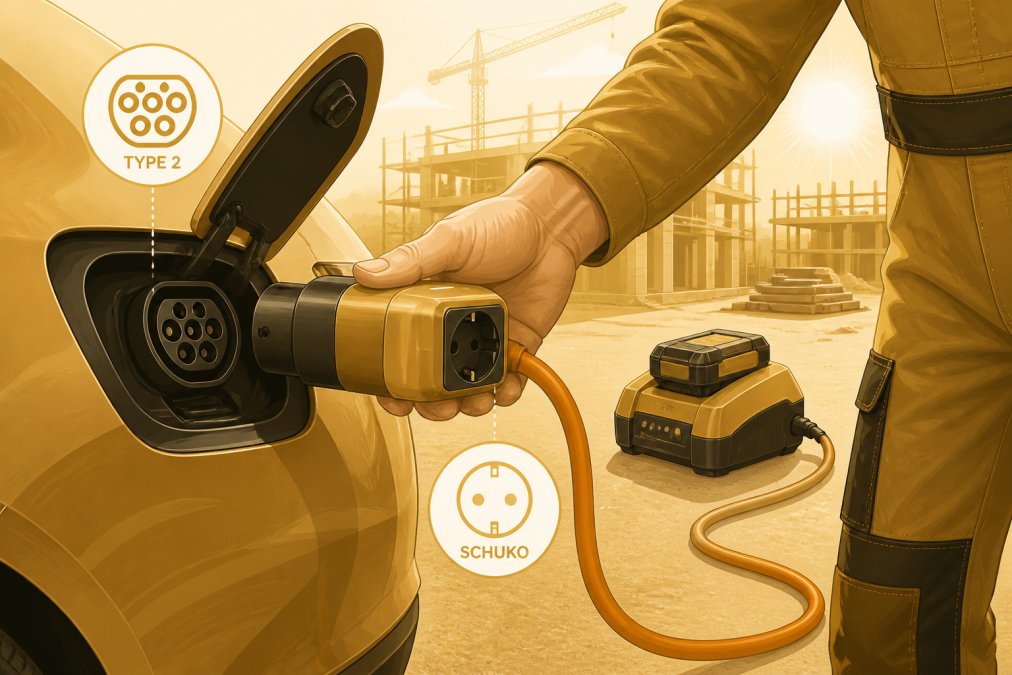
How a Type 2 to Schuko adapter works
A Type 2 to Schuko adapter is a compact device that translates the electric car's V2L signal into a standard 230V Schuko socket. The adapter does not contain any active electronics for conversion; the car itself handles the DC-AC conversion internally and already supplies 230V AC power via the Type 2 plug.
The process looks like this:
- Plug the adapter into the car's Type 2 charging socket
- Activate the V2L function via the car's infotainment system or a dedicated button
- Wait for the car to confirm V2L status (typically 5-15 seconds)
- Connect your equipment to the Schuko socket on the adapter
- Monitor power consumption via the car's display
V2LPower's Type 2 to Schuko adapters are model-specific and certified, eliminating the well-known problem of the "V2L conditions not met" error message that occurs with generic adapters that do not communicate correctly with the car's control system.
Which electric cars support V2L via Type 2?
Not all electric vehicles support V2L via the Type 2 connector. The feature requires specific firmware and hardware in the vehicle's charging system. Models that widely support V2L via Type 2 include the Hyundai IONIQ 5 and IONIQ 6, Kia EV6 and EV9, BYD Atto 3 and BYD Seal, as well as certain configurations of the Genesis GV60. According to the European Automobile Manufacturers' Association's overview of V2L-compatible electric vehicles, the number of V2L-compatible models is growing significantly each year as the standard matures.
Tesla models do not support V2L via the Type 2 connector, but can use an external V2L converter connected to the car's 12V or CCS system, depending on configuration.
V2L adapter for electric car: Choose the right equipment
This is where most people make the most expensive mistake: they buy a generic adapter without verifying compatibility with their specific car model and firmware version. An incorrect adapter will not communicate properly with the car's pilot signal and result in the V2L feature refusing to activate.
| Solution | Effect | Suitable for | Price (approx.) |
|---|---|---|---|
| 12V plug | Up to 240W | Phone charging, low-power charging adapters | Included in the car |
| DC-AC inverter (12V) | 150-1,000W | Light craftsman tool with leisure battery | 500-2,000 kr. |
| V2L Type 2 adapter | 3,600-7,400W | Professional power tools, compressors, charging stands | From 639 kr. |
| Built-in V2L connector | 3,600W | Direct use in the trunk | Included with some models |
V2LPower's Type 2 to Schuko adapters start from The V2LPower P06 adapter (P06 model) for DKK 639.20 and The P10 model (P10), V2LPower – Adapter TYPE 2 for schuko (P11) and V2LPower – Adapter TYPE 2 for schuko (P12) for 799 DKK. The models are optimized for specific car brands and verified compatible with the car's control system. This is the crucial difference from cheap universal adapters: correct pilot signal handling ensures that V2L is activated the first time without error messages.
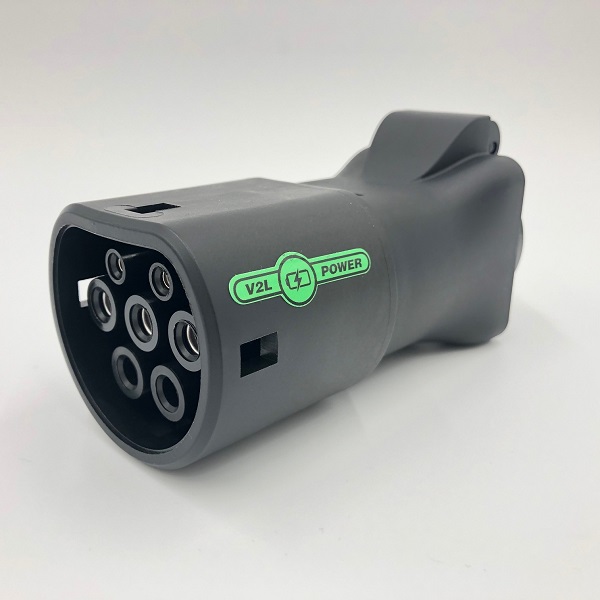
Always check your car's current firmware version before purchasing a V2L adapter. Some firmware updates change the V2L protocol, and an adapter that worked in 2024 may not work optimally after an OTA update in 2026.
Inverter for electric car 230V: When does it make sense?
An inverter for electric cars 230V primarily makes sense in one scenario: vans and specially adapted vehicles with a separate leisure battery installation. It is not a solution for spontaneous use in a random parking lot.
The practical limit for a 12V-based inverter in an electric vehicle is approximately 300-400W at continuous load. Above that limit, you risk thermal overload of the DC-DC converter that supplies the 12V system. Manufacturers such as Victron Energy and Renogy produce quality inverters with overload protection and pure sine wave output, which is critical for electronically sensitive charging adapters for lithium-ion battery packs.
Pure sine wave is not a luxury choice. Modified sine wave inverters can damage professional cordless tool charging adapters and reduce battery capacity over time. Always choose pure sine wave for charging purposes.
Wattage calculation: How much power does your tool use?
Calculating wattage is the step most people skip, and it's exactly why they either run out of power or blow a fuse. The formula is simple: Watts = Volts x Amps. The answer determines which solution you should choose.
Typical power consumption for craftsman tools
Power consumption varies significantly across tool types. Here is a handy overview:
| Tool type | Nominal power | Starting power (peak) | Recommended solution |
|---|---|---|---|
| Drill charger (18V) | 50-80W | 80-120W | 12V plug or V2L |
| Circular saw charger (54V) | 100-150W | 150-200W | V2L recommended |
| Angle grinder | 800-1,500W | 2,000-4,000W | V2L mandatory |
| Compressor (small) | 700-1,100W | 2,000-3,500W | V2L mandatory |
| Jigsaw | 400-700W | 800-1,400W | V2L recommended |
How to calculate how long your battery will last
The formula for operating time is: Operating time (hours) = Battery capacity (kWh) x Efficiency / Power consumption (kW).
A practical example: An electric car with a 60 kWh battery, V2L efficiency of 90%, and a total charging equipment consumption of 600W:
60 kWh x 0.90 / 0.6 kW = 90 hours of operation time
In practice, it is never recommended to drain the battery below 20% for reasons of battery health and driving range home. This leaves 48 kWh available, equivalent to approximately 72 hours of continuous charging of battery tools at 600W consumption. For a normal working day, this is more than sufficient.
V2L from a modern electric car with a 60+ kWh battery can power a craftsman's complete charging station for a full working day without compromising the driving range home, provided that V2L consumption is kept below 1.5 kW.
Charging batteries in vans: Practical guide for tradesmen
Van layout is an underrated element of professional workplace power management. A well-thought-out van layout with dedicated charging racks, cable management, and a clear power plan makes the difference between chaos and efficiency.
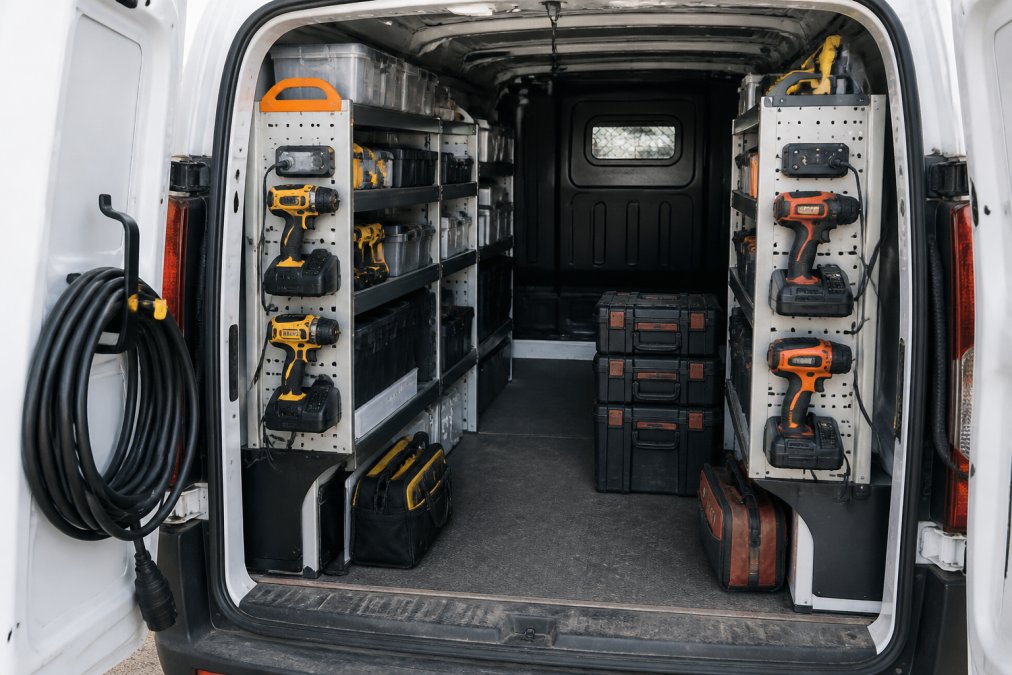
Van interior design and power management at the workplace
The most efficient setup for charging batteries in a van combines a V2L adapter for the Type 2 socket with an external extension cable and a charging system mounted inside the van. The power is supplied from the EV’s high-voltage battery via the V2L, runs through an overload-protected distribution block and is distributed to the individual charging adapters.
Three principles for good power management in the van:
- Calculate the total electrical load from all charging adapters running simultaneously and keep it below the maximum charging power of the V2L system
- Install an overload protector (earth fault circuit interrupter, 30mA) between the V2L connector and the distribution block
- Use cables with the correct cross-section.: at 3,600W and 230V the current is approximately 16A, which requires a minimum of 1.5 mm² cable, but 2.5 mm² is recommended for fixed installation
Electrical installation in vans is regulated in Denmark by the High Voltage Executive Order and must be carried out or approved by an authorized electrical installer. According to the Danish Safety Technology Authority's guidance on electrical installations in vehicles, the same requirements apply to fixed electrical installations in vehicles as in buildings.
Safety when charging tools from an electric car
Safety is not a checklist item. It is the foundation of the entire system. Charging tools from an electric vehicle involves high current levels, lithium-ion batteries and mobile installations that all require respect.
Lithium-ion battery safety and overload protection
Lithium-ion batteries in power tools and electric vehicles are stable under normal operating conditions, but react strongly to overcharging, mechanical damage and excessive temperature. The critical safety distance from flammable material during the charging process is a minimum of 0.5 meters.
Overload protection is not optional. A V2L system without a ground fault circuit interrupter and thermal fuse is a fire and shock hazard. All V2LPower adapters are certified and comply with applicable CE requirements, ensuring that the electrical load is handled correctly.
According to the DS/EN IEC 62955 standard for residual current circuit breakers in charging equipment, charging equipment for electric vehicles and V2L systems for mobile applications must include specified residual current protection.
Practical safety rules:
- Never charge cordless tools unattended in enclosed spaces without ventilation.
- Check cable insulation regularly for wear, especially at the plug connections.
- Never use damaged charging adapters.
- Never activate V2L in heavy rain without waterproof protection of the connector.
Battery tool maintenance and charging cycle
Proper maintenance significantly extends battery capacity. Lithium-ion batteries in professional power tools typically have a lifespan of 500-1,000 charge cycles, but improper charging practices halve that number.
Three rules for optimal charging cycle:
- Avoid full discharge to 0%. Charge at 20-30% residual capacity to protect the cell structure
- Avoid full charging to 100% for long-term storage. 50-80% is the optimal storage capacity
- Keep the temperature during charging between 10°C and 40°C. Charging below freezing will permanently damage the cells
Battery maintenance is particularly relevant for tradespeople who charge from their electric vehicle on cold winter days. Many modern charging adapters for professional battery tools have built-in temperature monitoring, but it is wise to verify this before purchasing.
Summary: Find the best solution for your situation
The choice of method for charging tools from an electric car depends on three factors: your actual wattage consumption, your car's V2L compatibility and whether you are working from a van or directly from the car's charging socket. For light charging of battery packs, the 12V socket is sufficient. For professional use, V2L via the Type 2 socket is the only solution that delivers sufficient power without compromise.
Read our technical V2L guides for specific car models and find the right adapter for your electric car: V2LPower's complete guide to V2L technology and compatible electric cars
Frequently Asked Questions
What is V2L and how does it work for charging tools?
V2L stands for Vehicle-to-Load (V2L) and means that your electric car sends power out to external equipment, such as handyman tools. The power flows from the car's battery out through a dedicated outlet or a V2L adapter mounted on the Type 2 charging socket. You then connect a Schuko adapter and can use normal 230V equipment. This requires that your electric car model supports the V2L function and that you use compatible accessories.
What equipment do I need to charge tools from my electric car?
To charge tools from an electric car via a V2L EV adapter, you will need a Type 2 to Schuko adapter that is compatible with your specific car model. Alternatively, you can use a DC-AC inverter connected to the 12V socket, but this solution is limited to lower power, typically under 300W. A V2L adapter provides access to up to 3.6 kW or more depending on the car.
Is it safe to draw power from the electric car battery for tools?
Yes, provided you use certified equipment and stay within the vehicle's specified maximum power limit. Electric cars with V2L functionality have built-in overload protection that cuts off power in the event of a fault. Never use cheap, unregulated inverters directly on the high-voltage system. Choose adapters with CE marking and documented compatibility with your car model to avoid error messages and potential damage.
Can I use an electric car inverter for 230V if my car does not have V2L?
Yes. A DC-AC inverter connected to the 12V socket in the car converts the car's 12V DC power to 230V AC power. This solution is practical for low-power equipment such as the battery charger for lithium-ion battery tools, but the capacity is limited. Most 12V inverters for electric cars handle 150-300W without overloading the fuse. For more powerful tools, a V2L solution via Type 2 plug is the better option.
Which electric cars support charging tools via V2L?
Several popular electric car models support V2L, including the Hyundai IONIQ 5, Kia EV6, BYD Atto 3 and several others. However, the feature is model-specific and depends on the equipment version. It is important to use an adapter that is specifically compatible with your car model, as a generic adapter may trigger the error message 'V2L conditions not met'. Check the compatibility list with your adapter supplier before purchasing.
How much power do typical craftsman tools use, and does this greatly affect the range of an electric car?
An angle grinder typically uses 700-1200W, a circular saw 1200-1800W and a drill 500-900W. An electric car with a 60 kWh battery can theoretically power a 1000W machine for up to 50-60 hours, but in practice you should never discharge the battery below 20%. For shorter workdays of e.g. 2-4 hours with light to medium-heavy tools, battery consumption is modest and affects the range minimally.
Many tradesmen and electric car owners waste time and money on solutions that do not match their actual needs. V2LPower specializes in exactly this: matching the right V2L solution to your specific electric car model with certified adapters, free email support and free shipping throughout Europe. Use your electric car battery as the mobile power source it was designed to be.
This article was written using GrandRanker

 Danish
  English
  Swedish
  German
  Dutch
Dutch  Norwegian
  Chinese
  French
  Polish
  Italian
  Greek
Greek  Finnish
  Spanish
  Turkish
  Bulgarian
  Czech
Czech  Portuguese
  Bosnian
  Slovak
  Slovenian
  Romanian
  Hungarian
  Lithuanian
  Latvian
  Estonian
  Serbian
  Ukrainian