
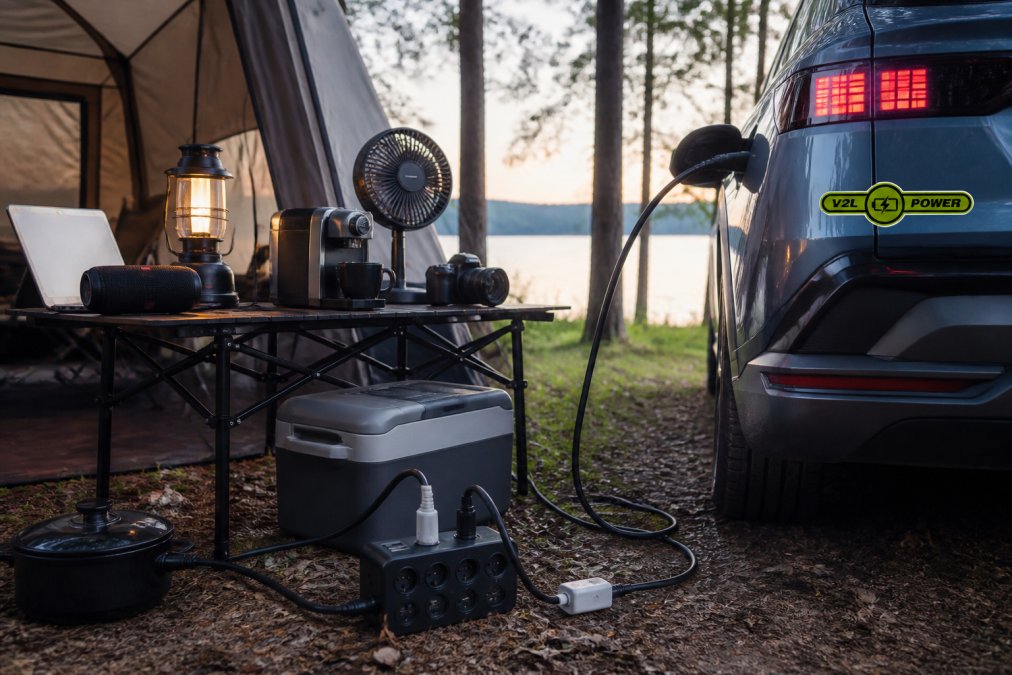
Which appliances can electric car V2L drive
Table of contents
- What is Vehicle-to-Load (V2L)?
- How does the V2L technology work?
- V2L adapter for electric cars – what you need to know
- Which devices can electric car V2L power – practical examples
- V2L limitations – wattage and capacity
- Electric cars with V2L support
- Troubleshooting and typical challenges
- V2L vs. inverter – what should you choose?
Last updated: August 16, 2026
What is Vehicle-to-Load (V2L)?
Vehicle-to-Load (V2L) is the technology that allows you to draw electrical power directly from your electric car to power external appliances and equipment. Instead of relying on traditional power sources, you can use your vehicle's battery as a mobile power source, anywhere, anytime.
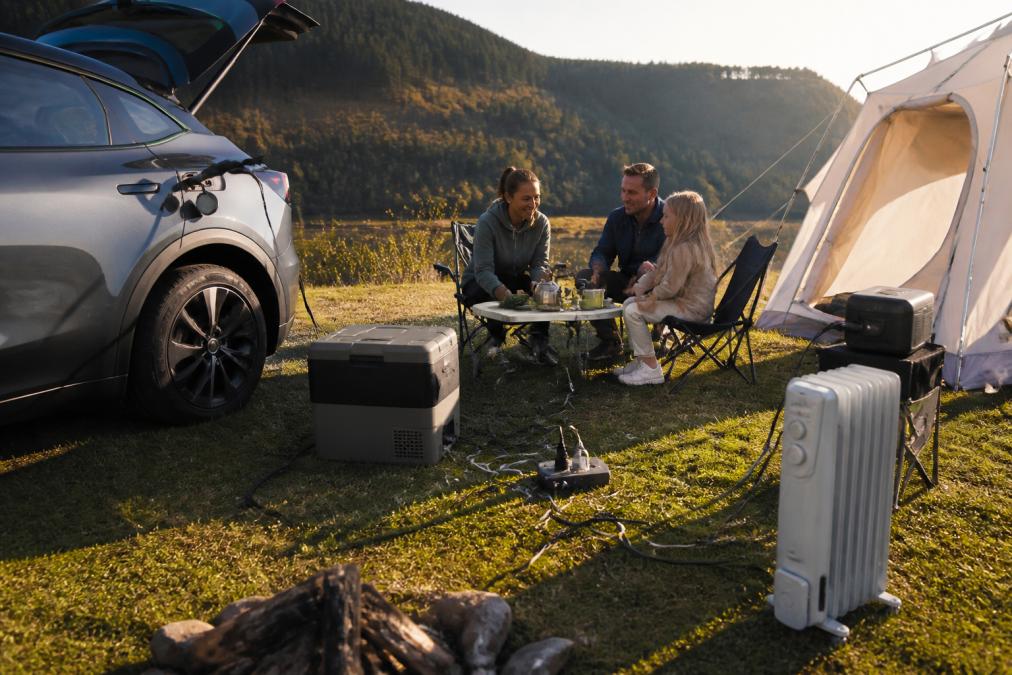
V2L works by converting DC power from your car battery to AC power (230V), which is the same power you use at home. This means that most common household appliances, camping equipment and tools can be plugged directly into a V2L adapter or socket.
V2L is not the same as charging your electric car. With V2L, power flows from the car to your devices, not the other way around. It is important to understand this direction in order to use technology safely.
This technology opens up completely new possibilities for electric car owners. Whether you're camping, needing backup power during power outages, or working on construction sites, V2L can transform your electric car into a flexible power source.
How does the V2L technology work?
The V2L system consists of three important components: the car battery, an inverter, and an adapter. When you connect a V2L adapter for your vehicle's charging port, starts an electronic process that allows the car's energy to be utilized.
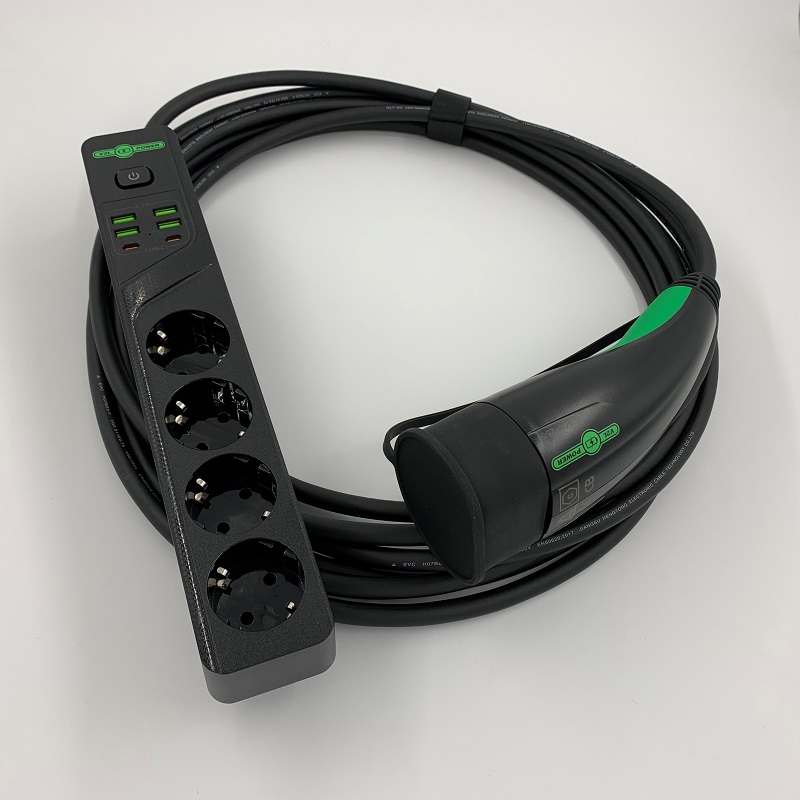
The car battery supplies direct current (DC). The inverter converts this DC current into alternating current (AC) of 230V, exactly the same as your sockets at home. A built-in electronic controller ensures that the power is delivered safely and stably and that the car's electrical system is not overloaded.
When you connect a device to the V2L socket, it receives power from the car's battery. The system continuously monitors power consumption and ensures that it does not exceed the car's maximum capacity. If you try to connect too many powerful devices at once, the system will automatically limit the power or disconnect to protect the battery.
V2L is a controlled, safe way to get power from your electric car. The car's software controls the entire process and prevents overloading - you can't "break" the system by connecting the wrong device.
Most importantly, the V2L system always prioritizes the car's own function. If your battery drops to a critically low level, the system will automatically shut down the V2L function to ensure you can still drive the car safely.
V2L adapter for electric cars – what you need to know
A V2L adapter is the physical interface between your electric car and your devices. There are several types, and the most important thing is to choose the right one for your car model.
Type 2 adapter is the most common type in Europe. It plugs directly into your car's Type 2 charging port and gives you access to 230V AC power. Some adapters have a single Schuko socket, while others have multiple outlets plus USB ports for smaller devices.
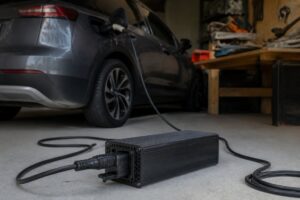
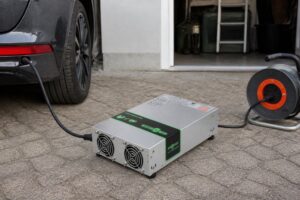
External V2L converters are larger devices that plug into your car's charging port and offer more options. They may have more outlets, USB ports, and some models offer higher power than standard adapters.
When choosing an adapter, check compatibility with your specific car model, maximum power (watts), number and type of sockets, cable length, and safety with CE marking and safety certificates.
V2LPower offers specialized V2L adapters designed for different car brands and models. Each adapter is tested for compatibility with specific car models, so you know exactly what works with your car.
Which devices can electric car V2L power – practical examples
This is the most important question for most electric car owners: what can I actually use V2L for? The answer depends on which adapter you have, how much power it delivers, and how long you need the power for.
Camping and outdoor equipment
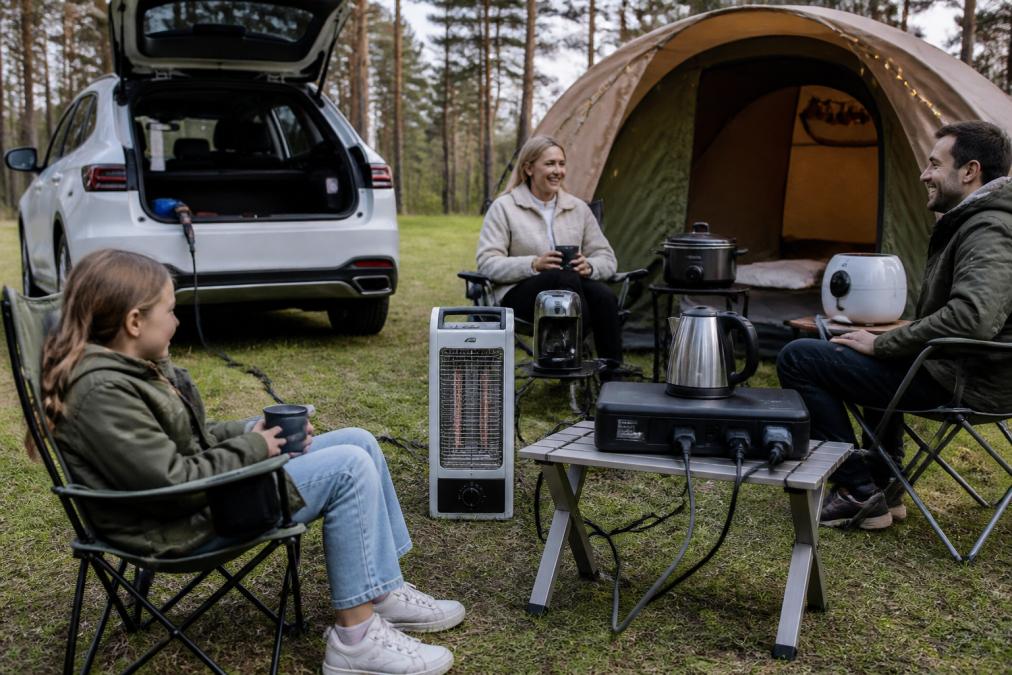
Camping is one of the most popular V2L use cases. A typical camping trip might include electric coolers (40-60W), electric air mattresses (around 100W when inflated), camping lamps and LED lights (5-20W), portable fans (30-50W), USB charging for phones and tablets, and small kitchen appliances (400-600W).
A typical camping setup with a coolbox, lights and USB charging uses around 100-150W on average. With a 60 kWh electric car battery, you could theoretically run this for several days without significantly affecting your driving ability.
Household appliances
Many EV owners use V2L for backup power at home or to supplement their power consumption: refrigerator (150-200W continuous), freezer (200-300W continuous), TV and entertainment (100-150W), computer and workstations (200-400W), small dishwashers (1,500-2,000W during operation), and washing machine (1,500-2,000W during operation).
Small appliances like refrigerators and TVs can run without any problems. However, larger household appliances like dishwashers and washing machines require high starting current, which can overload your V2L system.
Tools and business equipment
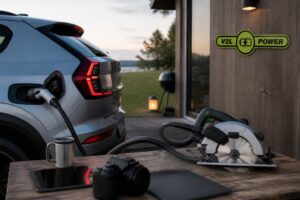
For tradesmen and small businesses, V2L is a cutting-edge: electric drills (500-1,000W), grinders (1,000-2,000W), jigsaws (500-800W), handheld compressor (1,000-1,500W), work lights and LED spotlights (100-300W), and power tool chargers (500-1,500W).
Many smaller tools can run on V2L without any problems. This means you can work on construction sites, in gardens or in more remote locations without relying on traditional power sources.
V2L limitations – wattage and capacity
V2L has real limits, and you need to understand them to use the system effectively. The most important thing is to learn how to calculate how long you can run your devices before the battery gets too low.
Maximum power – what can your V2L system deliver?
Most V2L systems deliver between 1,000W and 3,600W (1-3.6 kW). This is significantly less than what your home typically uses. Your V2L adapter has a maximum power rating, which is listed in watts. If you connect devices that together use more than this maximum power, the system will automatically disconnect to protect itself.
Example: If your adapter can deliver 2,000W maximum, and you connect a 1,500W dishwasher and a 600W lamp, you are using 2,100W combined – more than the system can deliver. The system will disconnect.
Calculate your own V2L operating time – practical guide
Here is a simple method to calculate how long you can run an appliance on V2L:
Step 1: Find your car's battery capacity (kWh). Examples: Hyundai Ioniq 5 (58 or 84 kWh), Kia EV6 (58 or 84 kWh), Tesla Model 3 (54 or 75 kWh), BMW i4 (81 or 111 kWh).
Step 2: Determine how much battery you can use for V2L. You should never let the battery drop below 10-15 % to maintain the car's drivability. So if you have a 60 kWh battery, you can probably use around 45-50 kWh for V2L.
Step 3: Find the appliance's wattage. This is usually stated on the device itself or in the manual.
Step 4: Calculate runtime with this formula:
Hours = (Available battery in kWh × 1,000) ÷ Appliance watts
Practical examples:
Example 1: Electric cooler at a campsite
- Battery: 60 kWh, available for V2L: 45 kWh
- Cool box consumption: 50W
- Calculation: (45 × 1,000) ÷ 50 = 900 hours
- Result: You can run the cooler for about 37 days without charging the car.
Example 2: Work lights on a construction site
- Battery: 60 kWh, available for V2L: 45 kWh
- Work light consumption: 200W
- Calculation: (45 × 1,000) ÷ 200 = 225 hours
- Result: You can run the work light for about 9 days continuously.
Example 3: Dishwasher at home
- Battery: 60 kWh, available for V2L: 45 kWh
- Dishwasher consumption: 1,500W
- Calculation: (45 × 1,000) ÷ 1,500 = 30 hours
- Result: You can do about 15 washing cycles (2 hours each).
Example 4: Portable blender
- Battery: 60 kWh, available for V2L: 45 kWh
- Blender consumption: 500W (only runs 2-3 minutes at a time)
- Calculation: (45 × 1,000) ÷ 500 = 90 hours
- Result: You can make about 1,800 smoothies before the battery is drained.
Starting current – the invisible limit
Peak power is not the same as continuous power. Many appliances require high starting current when they are first turned on. A dishwasher may require 2,500W in the first second, even though it only uses 1,500W during normal operation. If your V2L system can only deliver 2,000W maximum, it will not be able to start the dishwasher.
Devices with high starting current: Washing machines (1,500-2,500W), dishwashers (1,500-2,500W), compressors (1,000-2,000W), power tools (500-1,500W), air conditioners (2,000-5,000W).
Devices with low starting current: Lamps and LEDs, USB chargers, TV and computer equipment, coolers.
Battery discharge and range impact
Every watt-hour you use through V2L is one watt-hour less to drive the car. An average electric car uses around 150-180 Wh per kilometer. This means: 1 kWh = around 5.5-6.5 km range, 500W for 1 hour = around 3-3.5 km less range, 1,500W for 4 hours = around 33-39 km less range.
For most everyday use, this impact is minimal. However, if you use V2L intensively (e.g. 2,000W for 8 hours = 16 kWh), it could cost you around 85-105 km of range.
Temperature affects V2L performance
In cold weather, the efficiency of the car battery is reduced. In warm weather, the system may be more limited to protect the battery.
In cold weather (below 0 °C): The V2L system can deliver around 80-90 % of its normal maximum power. The runtime should be reduced by around 15-20 %.
In hot weather (above 35°C): The V2L system may be limited to around 70-85 % of its normal maximum power. Runtime should be reduced by around 20-30 %.
In moderate weather (10-25 °C): The V2L system delivers its full capacity.
Practical boundaries – what you shouldn’t do
Do not attempt to run these appliances on V2L. They typically require more power than V2L can provide: electric ovens (3,000-5,000W), tumble dryers (3,000-5,000W), fan heaters (2,000-5,000W), large air conditioners (2,000-5,000W), industrial tools (2,000-10,000W+).
Electric cars with V2L support
Not all electric cars have V2L functionality. It is important to check if your car supports it before investing in an adapter.
Some of the electric cars that have V2L support include the Hyundai Ioniq 5 and Ioniq 6, Kia EV6 and EV9, BYD Yuan Plus, BMW iX xDrive50, Mercedes-Benz EQE and EQS, and Nissan Leaf (newer models).
The technology is becoming more common and more manufacturers are adding V2L to their new models. Always check your car's manual or contact the manufacturer to confirm V2L support. V2LPower also offers compatibility guides for specific car makes and models.
Troubleshooting and typical challenges
Although V2L is relatively simple to use, problems can occur. Here are the most common errors and solutions.
""V2L conditions not met" – the classic error message
This means that the car's software blocks the V2L function. Battery too low: Most electric cars disable V2L when the battery drops below 20 mAh. Solution: charge the car to at least 20 mAh before using V2L.
Temperature problems: If the battery is too cold (below 0°C) or too hot (above 45°C), V2L will be deactivated. Solution: park the car in a cooler or warmer location, or wait until the temperature stabilizes.
The car is not in "Power" mode: Some electric cars require you to turn on the "Power" function without starting the engine. Solution: press the start button without pressing the brake, or consult your car's manual.
Software version does not support V2L: Solution: contact your car manufacturer and ask if a software update is available.
Adapter not working – connection and compatibility issues
Adapter is not compatible with your car model: V2L adapters are designed for specific car brands. Solution: always check the compatibility list before purchasing.
The contacts are dirty or corroded: Solution: Gently clean the contacts on both the adapter and the car charging port with a dry cloth.
The adapter is not fully inserted: Some V2L adapters require you to twist or lock them in place. Solution: Follow the instructions for your specific adapter carefully.
The car's software does not recognize the adapter: Solution: try the adapter on another electric car of the same brand, if possible. If it still doesn't work, the adapter is probably defective.
Power suddenly drops out – starting current and overload
You plug in an appliance and it works for a few seconds, but then the power goes out. This is almost always due to inrush current. When you turn on an electrical appliance, it often requires a much higher current in the first second than during normal operation. If your V2L system cannot handle this inrush current, the system will automatically disconnect.
Solution: start with smaller appliances first. If you need to use larger appliances, either get a V2L adapter with a higher wattage capacity or avoid connecting multiple appliances at the same time.
Adapter gets hot – thermal overload
If the adapter gets hot during operation, it means it is operating near or above its maximum capacity. The converter inside the adapter converts DC power to AC power. About 85-95% of the energy is converted into power, and the rest is converted into heat.
Solution: reduce power consumption by removing some devices. Allow the adapter to cool down for 15-20 minutes. If the adapter continues to get hot even with low consumption, ensure good air circulation around it.
Important warning: If the adapter becomes so hot that you cannot hold it in your hand, turn it off immediately and let it cool down.
The car displays a low battery warning during V2L use
V2L uses energy from your vehicle's battery, just like driving. If you use V2L for a long time, your battery will drain faster than normal. A rule of thumb: 500W for 1 hour = approximately 0.5 kWh used = approximately 2-3 km less range, 1,500W for 1 hour = approximately 1.5 kWh used = approximately 6-9 km less range, 2,000W for 4 hours = approximately 8 kWh used = approximately 30-40 km less range.
Solution: plan your V2L sessions so that you don't run out of power to drive. If you need to use V2L for a longer period of time, you will either need a larger electric car with a larger battery, or you will need to charge the car more often.
Adapter works on some devices but not others
This is usually because some devices have higher starting current than others, or they use more power than the adapter can continuously deliver. Solution: test the devices one by one. Start with small, low-power devices (lamps, USB chargers) and work your way up to larger ones. Note which devices work and which don't.
When nothing works – contact support
If you have tried all of the above solutions and V2L still does not work, there may be a problem with the car's electronics, the adapter, or the charging port's electronics. Contact your car manufacturer or the V2L adapter manufacturer for technical support.
V2L vs. inverter – what should you choose?
One inverter is a separate device that plugs into the car's 12V power system. It converts direct current to alternating current, just like the V2L does. But there are crucial differences:
V2L benefits: Uses the entire car's high-voltage battery (much more power available), integrated safety through the car's software, no installation required, higher power (typically 1,000-3,600W), more stable power.
Inverter advantages: Works on almost all electric cars (even without V2L support), smaller and more portable, cheaper initial investment, can run all the time.
Inverter Disadvantages: Only uses the 12V system, which has much less capacity, can only deliver about 100-500W continuously, can overload the car's 12V battery, less safety.
For most EV owners, V2L is the better choice if your car supports it. You get much more power, better safety, and the system is designed for this purpose. An inverter is better for older EVs that don't have V2L, or if you only need a small amount of power.
V2L transforms the way you use your electric car. From camping to backup power to mobile tools, the possibilities are endless once you understand what the system can do. V2LPower specializes in making V2L accessible and safe for Danish electric car owners, with adapters designed specifically for popular car models and full technical support. Start by checking if your car has V2L support, then explore which solutions fit your needs.
Frequently Asked Questions
Which electric cars have V2L technology?
V2L technology is available on many modern electric vehicles, especially from Hyundai, Kia, and BYD. Not all models have it, so it’s important to check your specific car model. Contact your car manufacturer or dealer to confirm if your electric vehicle supports V2L. Some older electric vehicles lack this feature altogether, while it’s standard on newer models.
Can you operate an electric kettle or coffee maker with V2L?
A typical electric kettle uses around 2000-3000 watts, while a coffee maker uses 800-1500 watts. Most V2L systems cannot handle this consumption due to limitations in the car's system. However, you can use smaller appliances such as a USB charger, a small fan or LED lights without any problems. Always check the wattage consumption of your appliance against the maximum capacity of your V2L solution.
How much power can be drawn via V2L?
Typically, V2L systems can deliver between 1500 and 3600 watts, depending on your electric car model and your V2L adapter. Most solutions are limited to around 2300 watts on 230 volts AC power. This means you can power smaller appliances like camping lights, small refrigerators, portable fans and chargers. Larger appliances like kettles, stoves or air conditioners cannot be powered.
What is the difference between V2L, V2H and V2G?
V2L (Vehicle-to-Load) means that power flows from your electric car to external devices through an adapter. V2H (Vehicle-to-Home) means that your car can provide power to your house during power outages or as a backup. V2G (Vehicle-to-Grid) means that your car can send power back to the grid. V2L is the most basic and widely available, while V2H and V2G require more advanced equipment and are not available on all electric cars.
How is a V2L adapter used in practice?
First, make sure your electric car supports V2L. Connect the adapter to your car's Type 2 charging socket (or DC charger, depending on your system). Turn on the V2L function in your car's menu. Then connect your devices to the socket on the adapter. The car's software will check the power flow and ensure that it is not overloaded. If errors such as 'V2L conditions not met' occur, this may be due to excessive power consumption or the car's safety system.
Are there any restrictions on which devices can be connected?
Yes, there are clear limitations. Appliances with high starting current (such as refrigerators or pumps) may trigger the safety system. Appliances with more than 2300 watts cannot be operated. Some appliances with electronic control systems may also be problematic. In general, simple equipment works best: LED lights, USB chargers, small fans, portable refrigerators and camping equipment. Avoid appliances with motors or high current draw.
What should I do if I get the error message 'V2L conditions not met'?
This error usually means that the car's system has detected a problem. First, check that you don't have too many devices connected at the same time - reduce the load and try again. Make sure the battery has sufficient charge (usually at least 20-30%). Check that the adapter is connected correctly. If the problem persists, it may be a software error - try restarting the car's system or contact your car manufacturer.
This article was written using GrandRanker
 Danish
  English
  Swedish
  German
  Dutch
Dutch  Norwegian
  Chinese
  French
  Polish
  Italian
  Greek
Greek  Finnish
  Spanish
  Turkish
  Bulgarian
  Czech
Czech  Portuguese
  Bosnian
  Slovak
  Slovenian
  Romanian
  Hungarian
  Lithuanian
  Latvian
  Estonian
  Serbian
  Ukrainian