
V2L solutions for European electric cars: Guide 2026
Table of contents
- What is V2L and how does it work?
- V2L adapter Type 2: The most compatible solution
- Safety when using V2L: Important factors
- Practical uses: From camping to emergency power
- Comparison of V2L solutions for European electric cars
- Legal and insurance aspects
- Battery Life and V2L: What You Need to Know
- V2L vs. Powerbanks: When to choose which?
Last updated: August 29, 2026
What is V2L and how does it work?
Vehicle-to-Load (V2L) is the technology that allows you to draw electrical power directly from your electric car to external devices. Unlike V2H (Vehicle-to-Home) or V2G (Vehicle-to-Grid), which require a fixed installation, V2L solutions for European electric cars can operate with simple adapters and are completely mobile. The power flows from the car's battery through the charging port's Type 2 connector out to your devices, never into the car.
V2LPower specializes in making this technology accessible and safe for Danish and European electric car owners. How does it work exactly? Your electric car has a built-in converter and protection system (HPFI), which regulates the power output. When you connect a certified V2L adapter, you activate the car's factory-built V2L function. The power is converted from direct current (DC) to alternating current (AC) of 230 V, just like a regular socket at home.
The main difference from other solutions: V2L uses your car's existing safety system. The car manufacturer has built in protection to ensure that the battery is not overloaded. This means you don't risk damaging your expensive electric car battery because the car itself monitors the load.
The Type 2 adapter is the key. It activates the car's built-in V2L function without requiring an electrician or installation. Plug and play, almost.
V2L adapter Type 2: The most compatible solution
How the Type 2 adapter works
The Type 2 adapter is the most widely used tool for V2L in Europe. It plugs directly into the car's charging port, the same port you use to charge your car. The adapter has three important tasks: to enable the V2L function in the car, to convert power from DC to AC, and to ensure that the power is stable and safe.
When you plug in the adapter, it sends a signal to the car's onboard computer. The computer then checks whether V2L is allowed at that time. If the battery is too cold, if the charge level is too low, or if the car has other priorities, it may refuse to supply power. This is the car's way of protecting itself.
The Type 2 adapter from V2LPower uses professional connectors that match the standard EV charging plug. This means strong, waterproof connections, not cheap two-pin connections that you find on cheap solutions online. Quality matters when you're working with 230V power and expensive batteries.
Cheap adapters with weak connections can overheat under load. If the connection becomes loose, it can damage both the adapter and the car's charging port. Buy certified equipment.
Compatibility with European electric car brands
Not all electric cars support V2L, yet. The Kia EV3, EV6, EV9, and Niro EV have it. The Hyundai IONIQ 5 and 6 too. The BYD Yuan Plus, Volkswagen ID.4, and ID.5 are on the list. The Tesla, Nissan Leaf, and most older models don't.
Before buying, please check your car's manual or the manufacturer's official list. V2LPower has made car brand-specific guides, because compatibility is not something you should guess at. An adapter that works perfectly on a Kia may be useless on a BYD.
The good news: if your car supports V2L, a certified Type 2 adapter from V2LPower will work. Certification means the adapter has been tested and approved for safe operation. The CE mark on the adapter tells you that it meets European safety standards.
Safety when using V2L: Important factors
Battery protection and software management
Your electric car battery is expensive. It should last 8-10 years or longer. V2L does affect the battery, but far less than you might think if you use it correctly.
Your car's HPFI software is your most important protection. It regulates how much current is allowed to flow out, and under what conditions. If you connect an inverter that draws more current than your car can deliver, the HPFI automatically restarts and disconnects. It's inconvenient, but it protects the battery.
The biggest risk: running V2L while the battery is cold. Cold batteries can't deliver power efficiently. If you force it, you stress the cells. That's why all car manufacturers recommend waiting until the battery has warmed up before using V2L. In Denmark, this means you shouldn't use it during the winter months unless the car has been running for 15-20 minutes first.
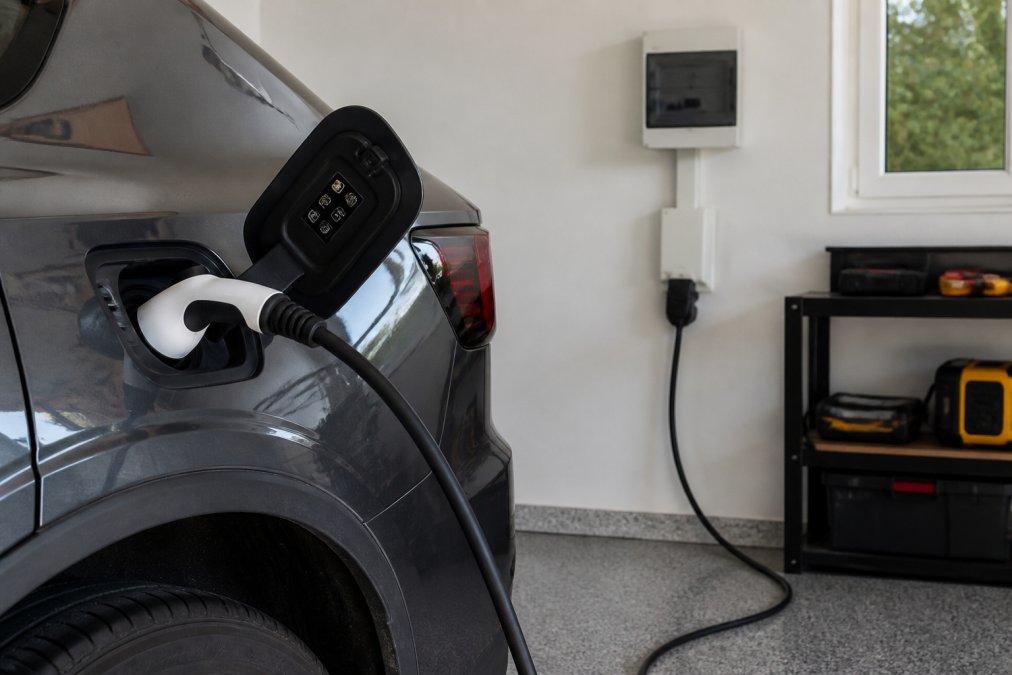
Battery wear from [V2L is](/en/v2l-cheaper-than-the-electricity-grid-v2l-cheaper-than-the-electricity-grid/) minimal if you use certified equipment and respect the vehicle's limitations. The vehicle's own safety system is designed to protect the battery during the warranty period.
Choosing certified equipment
Certification means more than you might think. A CE approved adapter has been tested for:
- Electrical safety (insulation, voltage, current)
- Mechanical strength (connections hold under load)
- Thermal control (adapter does not overheat)
- Electromagnetic compatibility (it does not interfere with other systems)
Cheap, uncertified adapters aren't tested for any of that. They might work for a week and then fail. Worse: they could damage your car or house.
V2LPower's inverters come with a 5 year manufacturer's warranty. This means that if something goes wrong, it's their problem, not yours. Cheap solutions come with no warranty and no support.
Practical uses: From camping to emergency power
V2L solutions for European electric cars open up completely new ways to use your car.
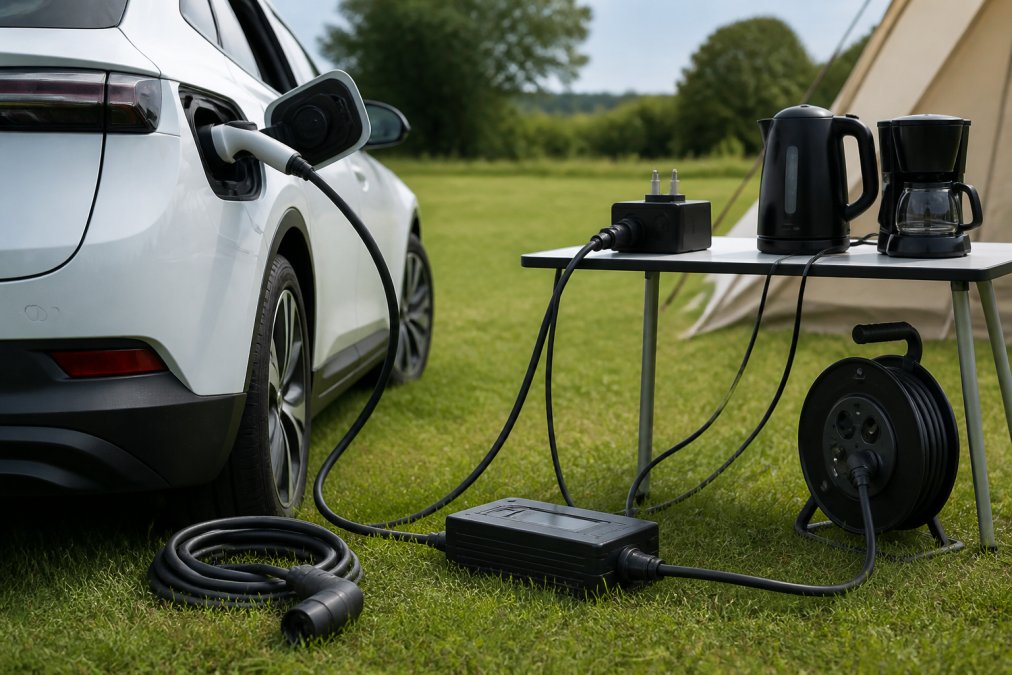
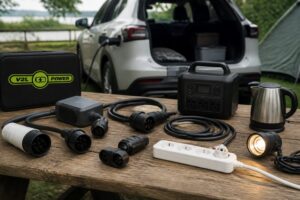
Camping and outdoor activities: A camping trip without an outlet is a thing of the past. With V2L you can run an electric kettle, charge your laptop, turn on LED lights and run a small cooler, all from your car's battery. A typical electric car has a 50-80 kWh battery. A three-day camping trip might use 10-15 kWh. You'll have plenty to spare.

Emergency power at home: If the power goes out, your electric car can be your backup. With V2LPower's car-to-home converter you can supply important appliances, refrigerator, freezer, router, lights, for several hours. In Denmark, power outages are rare, but when they happen, they are often planned maintenance work. An electric car gives you peace of mind.
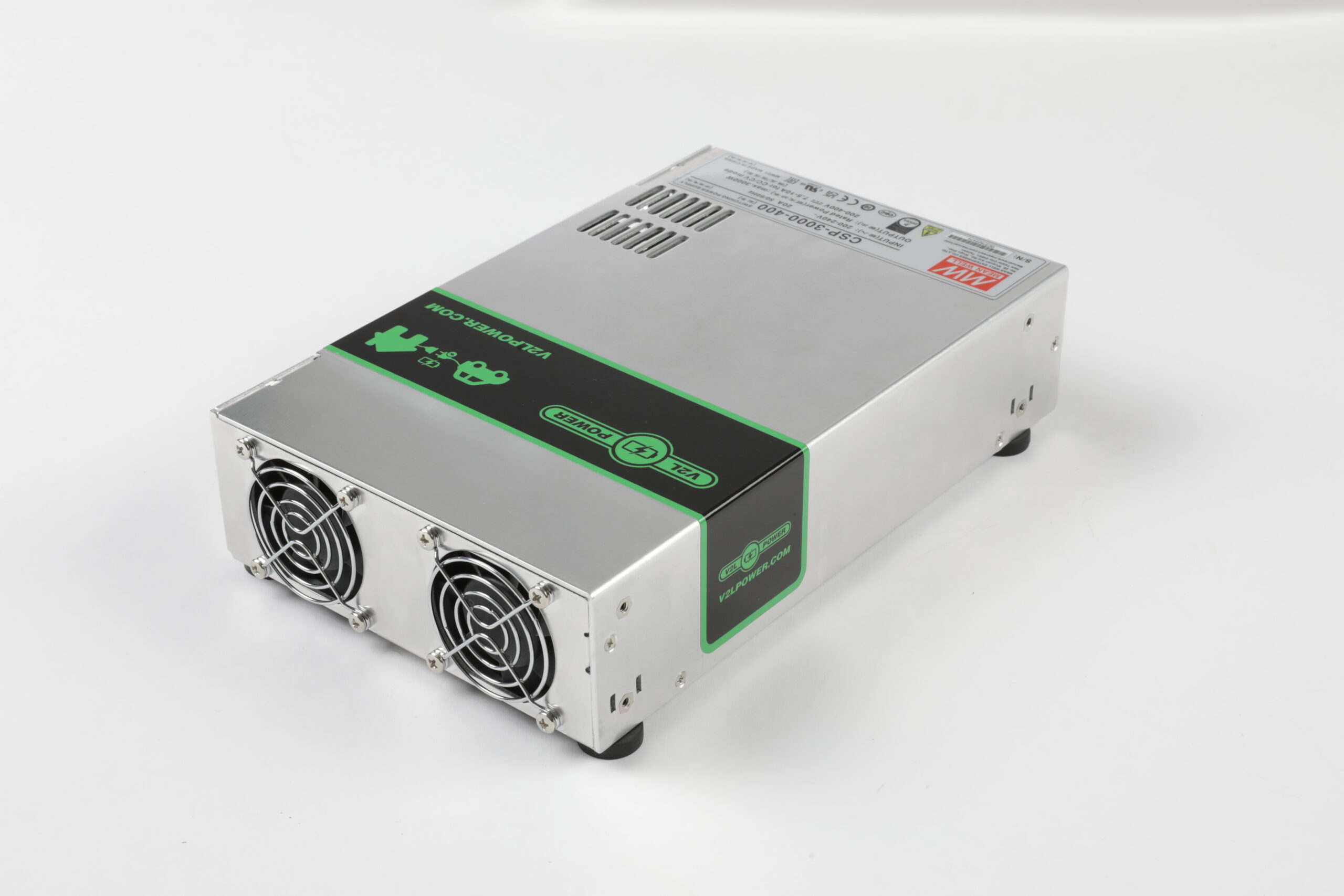
Crafts and professions: Electricians, carpenters and service technicians can run power tools directly from the car. A V2L inverter can deliver up to 3000 W, enough for drills, grinders and other standard power tools. No generator, no petrol, no noise.
Charging other electric cars: With the right adapter, you can charge another electric car if it also supports V2L. It's slow, about 2-3 km of range per hour, but it can save a stranded electric car driver on a long trip.
Comparison of V2L solutions for European electric cars
| Solution | Price | Best for | Installation time | Power output |
|---|---|---|---|---|
| Type 2 Schuko adapter | From 639 kr. | Testing V2L, camping, emergency power | 2 minutes | Up to 2.3 kW |
| Car-to-home converter | From DKK 10,396. | Permanent home installation, high power | 30-60 minutes | Up to 3kW |
| Professional V2H solution | 15,000+ kr. | Daily backup for the entire house | Timer (electrician) | Up to 7kW |
Type 2 Schuko adapter: Simple and affordable
V2LPower's Type 2 to Schuko adapter is the cheapest and simplest entry-level product. It costs from 639 kroner and does exactly what it promises: it converts the Type 2 plug to a regular Danish socket.
Pros: cheap, easy to use, perfect for camping and smaller appliances. You can take it on vacation without worrying.
Cons: it can only deliver around 2.3 kW of power, not enough for large appliances like a fan heater or stove. If you need to use the V2L daily or for professional work, it will quickly become too slow.
Who should buy it? Campers who want to try V2L without spending thousands of dollars. People who want backup power for smaller appliances. Craftsmen who need power for small tools.
Car-to-home inverters: Professional solution
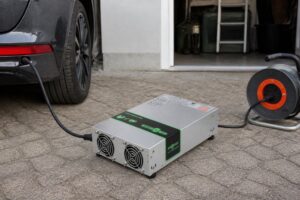
V2LPower's car-to-home inverters start at 10,396 kroner. It's in a whole different league. The inverter connects to your solar inverter or directly to your home's electrical system. It can deliver up to 3000 W, enough to run a stove, refrigerator and multiple appliances at the same time.
Advantages: high power, permanent installation, professional quality with 5 years warranty. If you want to use your electric car as a real backup power or daily power source, this is the place to be.
Disadvantages: installation takes time. You need to have electrical outlets installed or connected to your solar inverter. It doesn't require electrician work, but it does require planning. And the price is significantly higher than a simple adapter.
Who should buy it? Homeowners with solar panels who want to use the electric car as a backup. People who regularly need high power at home or at work. Businesses that use V2L for daily operations.
Car-to-home inverters are best suited for people who have high power needs or want a permanent installation. If you only need to use V2L on vacation, a simple adapter is better.
Legal and insurance aspects
V2L is legal in Denmark, but there are some important things to know.
Electricity charges: If you use V2L at home, the electricity from your car counts as consumption. It is not registered in the same way as electricity from the grid, so you do not pay the same tax. This means that V2L is cheaper than buying electricity from the electricity company, but it is not completely free.
Insurance: Contact your insurance company. Most Danish insurance companies cover V2L as long as you use certified equipment. If you use cheap, useless equipment and it damages your house, the insurance company may refuse to cover it.
Guarantees: Using V2L does not affect your car's factory warranty. The car manufacturer has approved the feature. However, if you use non-certified equipment and it damages the battery, the warranty may be voided.
Neighborhood relations: If you live in a condominium, you may need permission from the property's board of directors to install an inverter at home. Check your bylaws.
Battery Life and V2L: What You Need to Know
An electric car battery is made up of thousands of tiny cells. Every time electricity flows through them, a chemical reaction occurs. Over time, the battery becomes less capable. It is normal, even without V2L, batteries lose 2-3% of capacity per year.
V2L affects this process, but much less than you might think. When you use V2L, you are taking energy from the battery. It is the same as driving the car. The battery does not know the difference.
The most important factor in battery wear is temperature. If the battery is too hot or too cold when using V2L, it will be stressed more. That's why all car manufacturers recommend using V2L when the battery is at normal temperature, around 20-25 degrees Celsius.
Another factor is depth of discharge. If you discharged the battery completely every day, it would wear out faster. However, if you use V2L sensibly, as a backup or on vacation, it has minimal impact on the battery.
Figures from car manufacturers suggest that V2L use does not lead to measurable additional wear over 5-10 years. The battery will remain under warranty regardless.
Avoid using V2L when the battery is below 20% charge or above 80% charge. These ranges stress the battery more. Use V2L in the “green range”, 20-80%, for minimal impact.
V2L vs. Powerbanks: When to choose which?
Powerbanks are small, portable batteries. They are convenient for charging your phone on the go. But they are no competition to V2L.
A typical power bank has 20,000-50,000 mAh capacity, around 75-185 Wh. That's enough to charge a smartphone 2-3 times. An electric car has a 50,000-100,000 Wh battery. That's 200-500 times more energy.
Power banks are also expensive per kilowatt hour. A 50,000 mAh power bank costs around 300-500 kroner and gives you around 150 Wh. That's around 2-3 kroner per Wh. An electric car that you already own gives you around 0.2-0.5 kroner per Wh (depending on electricity prices). So V2L is 5-10 times cheaper.
When should you choose a power bank?
- You need to charge a smartphone or tablet
- You need electricity without having an electric car.
- You want something small and easy to carry
When should you choose V2L?
- You need to supply larger appliances, coolers, lamps, tools
- You have an electric car and want to use it as a power source
- You want backup power at home
- You are camping and need power for a longer period of time.
V2L and power banks solve completely different problems. Power banks are for mobility. V2L is for power.
V2L solutions for European electric cars give you control over your own power. With the right adapter or converter, you can use your electric car as a mobile power source, camping, at home or at work. V2LPower specializes in making this technology safe, certified and accessible. Our Type 2 adapters start from 639 kroner, and our professional car-to-home converters from 10,396 kroner. All products come with Danish support and European delivery. Read our V2L guide for your specific car model and get help choosing the right solution.
Frequently Asked Questions
Which European electric cars support V2L technology?
V2L solutions for European electric vehicles include the Hyundai Ioniq 5 and 6, Kia EV6, EV9 and EV3, BYD Yuan Plus and several other models. Compatibility depends on the vehicle's charging port and factory-fitted V2L output. Before purchasing a V2L Type 2 adapter or converter, you should confirm that your specific vehicle model supports the V2L feature. Many newer European electric vehicles have this feature as standard, but it varies by manufacturer and model year.
What is the difference between V2L, V2H and V2G?
V2L (Vehicle-to-Load) means that power from the car goes to external devices such as camping equipment or tools. V2H (Vehicle-to-Home) means that the car supplies the entire house with power through a fixed installation. V2G (Vehicle-to-Grid) means that the car can send power back to the electricity grid. V2L solutions for European electric cars are the most accessible, as they do not require permanent installation.
Are V2L adapters safe to use for household appliances?
Yes, when using certified V2L equipment. Safety when using V2L depends on the converter and adapter being CE approved and designed for continuous operation. The car's own HPFI software protects the battery by limiting the current output if the load becomes too high. Avoid cheap adapters with weak connections and always use professional equipment for daily use or high loads.
How much power can you extract from an electric car with V2L?
Most V2L solutions for European electric cars can deliver up to 3000 watts (3 kilowatts) at 230 volts. This is sufficient for most household appliances, camping equipment and power tools. Exact power output varies by car model and inverter. The car's software automatically limits the output if it is exceeded, so you are protected from overload.
Can I use V2L adapter Type 2 on all European electric cars?
Type 2 is the standard charging port type in Europe, but not all electric cars have the V2L feature enabled by default. You should confirm that your car model supports V2L before purchasing. Some manufacturers require a software update to enable V2L. Contact your car manufacturer or a V2L specialist to verify compatibility with your specific model.
This article was written using GrandRanker
 Danish
  English
  Swedish
  German
  Dutch
Dutch  Norwegian
  Chinese
  French
  Polish
  Italian
  Greek
Greek  Finnish
  Spanish
  Turkish
  Bulgarian
  Czech
Czech  Portuguese
  Bosnian
  Slovak
  Slovenian
  Romanian
  Hungarian
  Lithuanian
  Latvian
  Estonian
  Serbian
  Ukrainian