
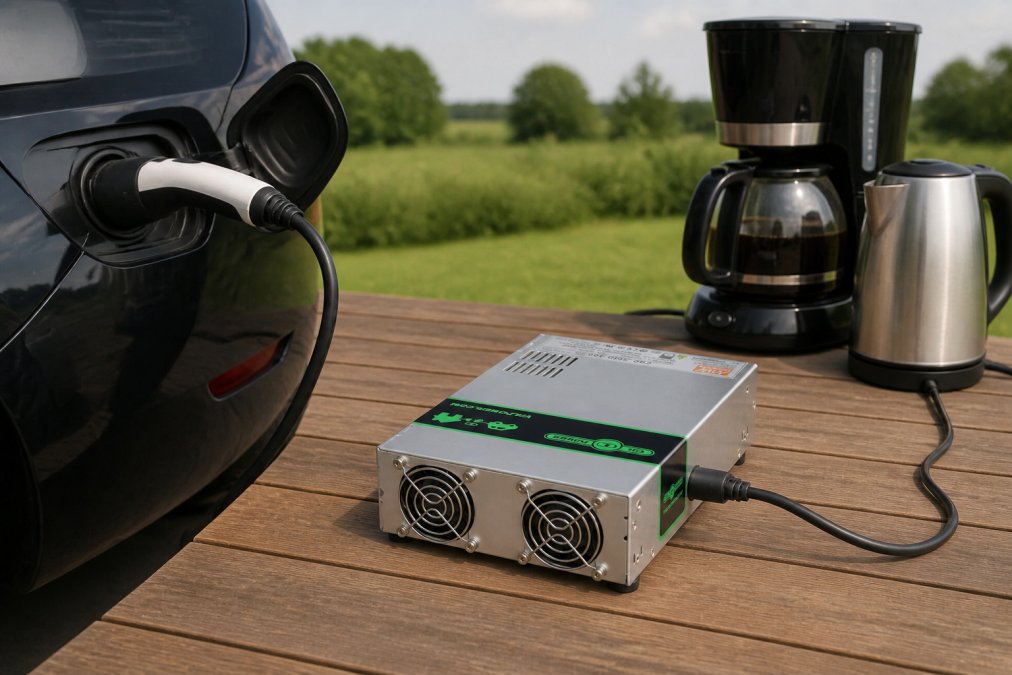
V2L adapter compatibility: Ultimate guide 2026
Table of contents
- What is V2L adapter compatibility?
- How does a V2L adapter work?
- Electric cars with V2L support
- Safety when using V2L equipment
- V2L adapter compatibility: Practical guide to selection
- Practical applications and winter use
- Conclusion
Last updated: August 20, 2026
What is V2L adapter compatibility? 🔌
V2L adapter compatibility means that your electric car can supply power to external devices through an adapter designed for your exact car model and battery type. When you connect a V2L adapter to your electric car's Type 2 charging port, power flows from the car's battery to camping equipment, tools or home heating.
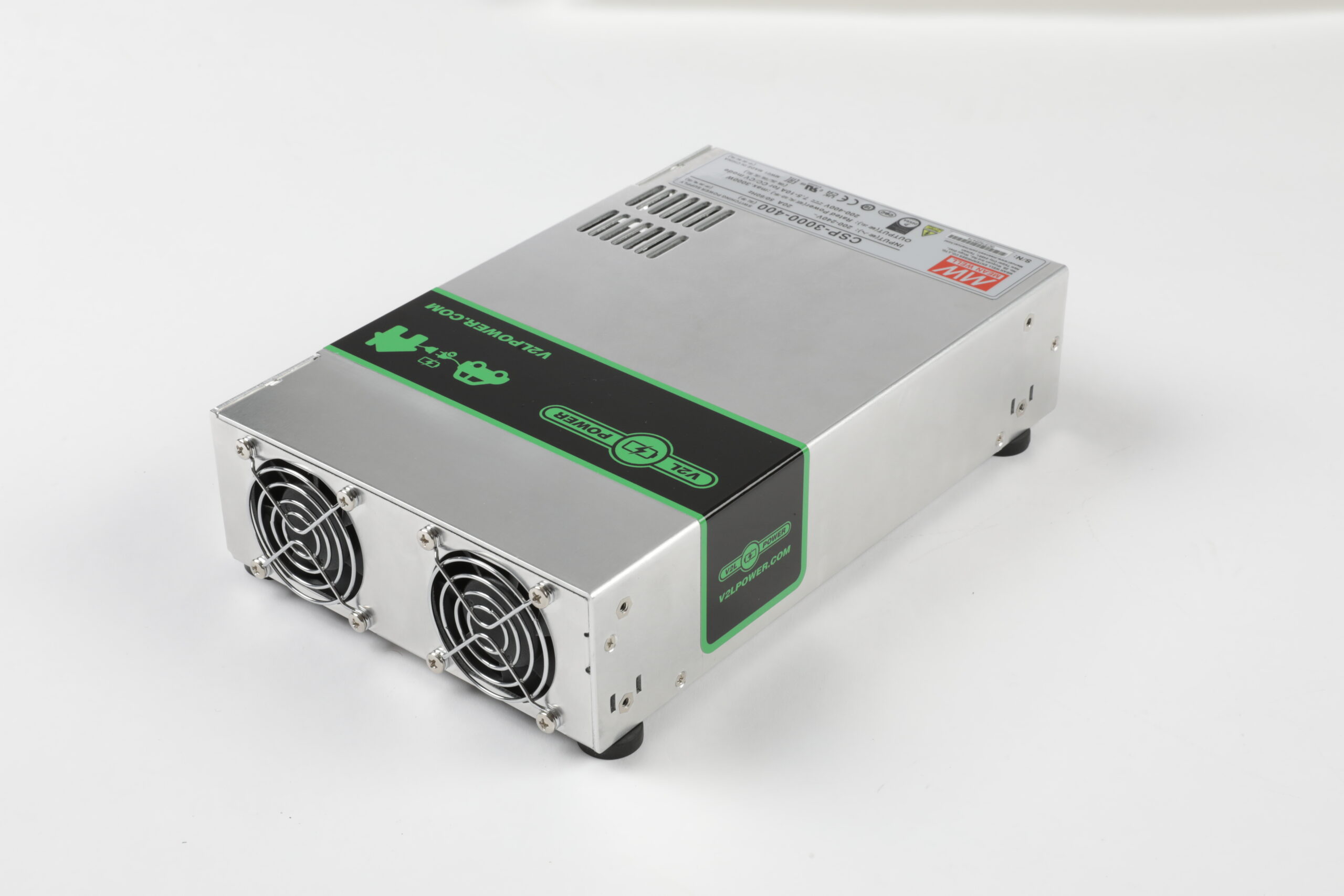
Compatibility is not just about physical fit. It's about your car's software, battery capacity, and electronic control system accepting and allowing the V2L feature. Many electric cars have the technical ability to deliver power, but without proper compatibility, you'll encounter error messages like "V2L conditions not met" or the system refusing to activate the feature.
Before buying a V2L adapter, check three things: your car's make and model, the car software version, and what Type 2 connector your car uses. An adapter designed for a 2023 Hyundai Ioniq 5 won't necessarily work on a 2022 Kia EV6, even if both belong to the same group.
V2LPower specializes in matching exactly which adapter is right for your specific electric car. We produce detailed compatibility guides for each car model so you know exactly what works before you invest.
How does a V2L adapter work 🚗⚡
One V2L adapter is the physical and electronic bridge between your electric car's battery and the equipment you want to power. The power flows from the car's battery through the adapter and out to your devices.
The power flow from car to equipment
When you connect a V2L adapter to your electric car's Type 2 charging port, the following happens:
- The adapter establishes a connection to the car's electronic control system
- The car's software verifies that the V2L function is allowed based on the battery's state of charge, temperature, and safety factors
- If the conditions are met, the car's system closes a two-way charging channel
- Power flows from the battery through the adapter to your external equipment
- A safety button on the adapter or in the car allows you to stop the power at any time
The current always flows out of the car, never enter it during V2L operation. This is a critical difference from charging the car.
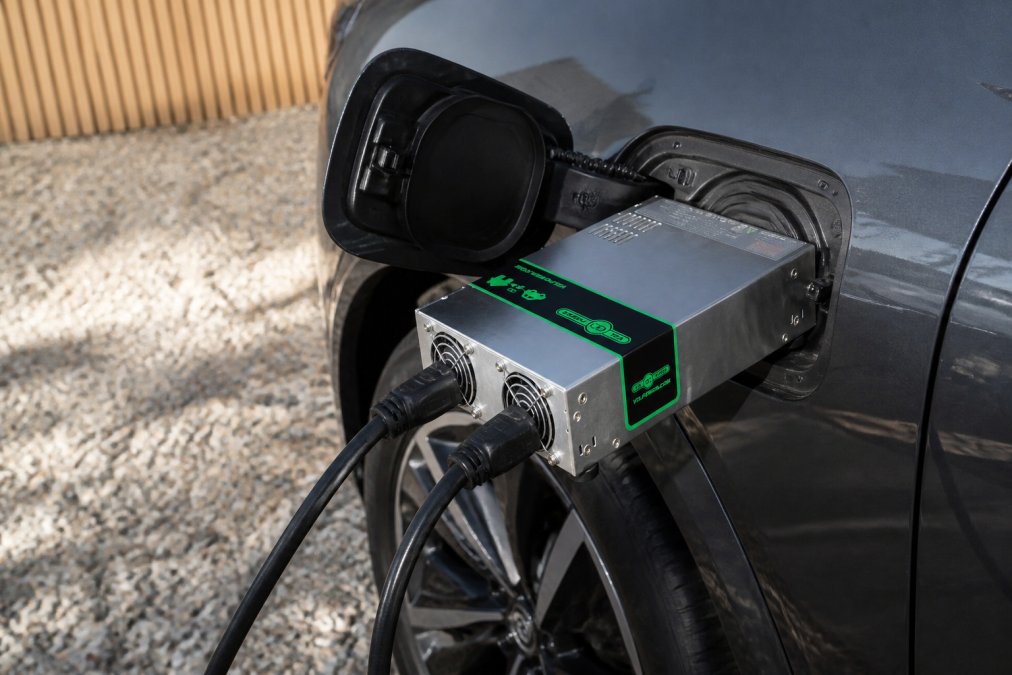
The V2L system is not a simple direct connection. Your car controls everything through its software. If your car does not allow V2L, or if the battery is too cold, too hot, or almost empty, the adapter will not provide power, regardless of whether the connector physically fits.
Type 2 plug and AC power
The Type 2 connector (IEC-62196) is the standard for charging connectors on almost all European electric cars. A V2L adapter uses this same connector type to deliver power back out.
When power flows out through the Type 2 connector, it is converted from the car's internal DC power to AC power (230V in Europe). Most V2L systems deliver around 2-3 kilowatts of AC power, which is enough to power most camping and household appliances. The power output depends on both the adapter and the car's software. A Hyundai Ioniq 5 can deliver up to 3.6 kW through V2L, while an older Nissan Leaf can deliver around 2 kW.
Electric cars with V2L support 🚙
Not all electric cars have the V2L feature. It is primarily available on newer models, and many manufacturers have only enabled it on their latest generations.
What brands and models does V2L have?
V2L technology is primarily available on these car brands:
- Hyundai: Ioniq 5, Ioniq 6, Kona Electric (2023+)
- Kia: EV6, EV9, Niro EV
- BMW: i4, iX (certain versions)
- Mercedes: EQE, EQS, EQA (certain versions)
- Nissan: Leaf+ (2022+), Ariya
- Volkswagen: ID. Buzz (2023+)
- Renault: Scenic E-Tech
- Volvo: EX30, EX30 Cross Country and EX60 (EX30 with software 2.1.2 or later) – not EX90
The V2L feature may be disabled on your car, even if the model technically supports it. This depends on the car's software version, your market, and sometimes the car manufacturer's choice to enable the feature on your specific device. A 2021 Hyundai Ioniq 5 may have V2L, while a 2020 model may not.
Just because your car is on the list of V2L supporting models does not automatically mean that your specific car has V2L enabled. Always check with your dealer or V2LPower before purchasing an adapter.
Checking V2L capability on your car
To check if your car supports V2L:
- Check the car's infotainment system: Search for "V2L", "Vehicle to Load" or "Power Output" in the car's menu
- Contact your dealer: Give them your registration number and ask directly if V2L is activated
- Read your user manual: The official manual will specify whether V2L is an available feature
- Contact V2LPower: We has a database of thousands of car models and can tell you if your car has V2L, simply by giving us the make, model and year
If your car supports V2L, you will also see the maximum power output (typically 2-3.6 kW).
Safety when using V2L equipment ⚠️
V2L systems are designed with multiple layers of security, but if you use a cheap, uncertified adapter or connect the wrong equipment, you could damage your car or electrical system.
CE marking and certification
A certified V2L adapter must have a CE marking, which means it meets European safety standards for electrical equipment. Cheap adapters from unknown manufacturers often do not have a CE marking and may be poorly insulated, without overload protection or without temperature monitoring.
V2LPower adapters are all CE marked and tested. We guarantee that the adapter will not damage your car.
A cheap adapter may save you money on the purchase, but can cost significantly in repairs to your car's electronics or battery. Safety certification is not a luxury, it's insurance.
Protecting the car's battery and system
When you use V2L, you gradually discharge your electric car's battery. Your car has internal safety systems that protect the battery:
- Minimum charge state: If the battery reaches below about 20%, the car's system will stop V2L operation
- Temperature monitoring: If the battery gets too cold or too hot, the system shuts down automatically
- Overcurrent protection: If you try to connect equipment that draws more power than the adapter allows, the connection will be interrupted
- Voltage stabilization: The adapter ensures that the output voltage remains stable at around 230V
Your car will handle all of this automatically. All you have to do is avoid completely discharging your battery. Most experts recommend that you do not use V2L when the battery is below 10-20%.
V2L adapter compatibility: Practical guide to selection 🛠️
Choosing the right V2L adapter means matching three things: your car model, your adapter's output capacity, and the equipment you want to power.
Output capacity and power consumption
Each V2L adapter has a maximum power output (measured in kilowatts). Your car also has a maximum power output. The adapter you buy can never deliver more than the smaller of these two numbers.
A typical V2L adapter delivers 2-3 kilowatts. Here's what you can power with different capacities:
| Power output | Typical appliances | Examples |
|---|---|---|
| 1-2kW | Small household appliances, camping | Electric kettle, portable cooler, LED light |
| 2-3kW | Medium camping, tools | Vacuum cleaner, microwave, small tools |
| 3+ kW | Large appliances, home heating | Heat pump (partial), larger tools |
If you try to connect a device that requires more power than your adapter can deliver, the adapter will not start or will disconnect after a few seconds.
A common mistake is to think that you can run a powerful heat pump or air conditioning from your electric car. Most heat pumps require 7-10 kW. Your electric car can deliver a maximum of 3.6 kW through V2L. You can use V2L to supplement heating, but not as the only power source.
Troubleshooting: "V2L conditions not met" and other issues
If you connect your adapter but nothing happens, you'll likely get an error message. Here are the most common problems and solutions:
""V2L conditions not met"": Your car will not activate V2L because the battery is below 20% charged, the battery is too cold, the car software does not support V2L, or the V2L feature is not activated. Solutions: charge the car, wait or warm up the car, update the software, or contact the dealer.
The adapter works for 5 seconds, then turns off: You are probably connecting a device that draws too much power. Solution: unplug the device, restart the adapter, and then connect a smaller device.
The adapter gets very hot.: You are probably driving the adapter close to its maximum capacity. Solution: reduce the load or let the adapter cool down for 10-15 minutes.
The car battery discharges very quickly: This is normal. V2L operation discharges the battery faster than driving. If you use 2 kW continuously, a 60 kWh battery will be fully discharged in about 30 hours. Therefore, do not plan to use V2L for more than 4-8 hours at a time.
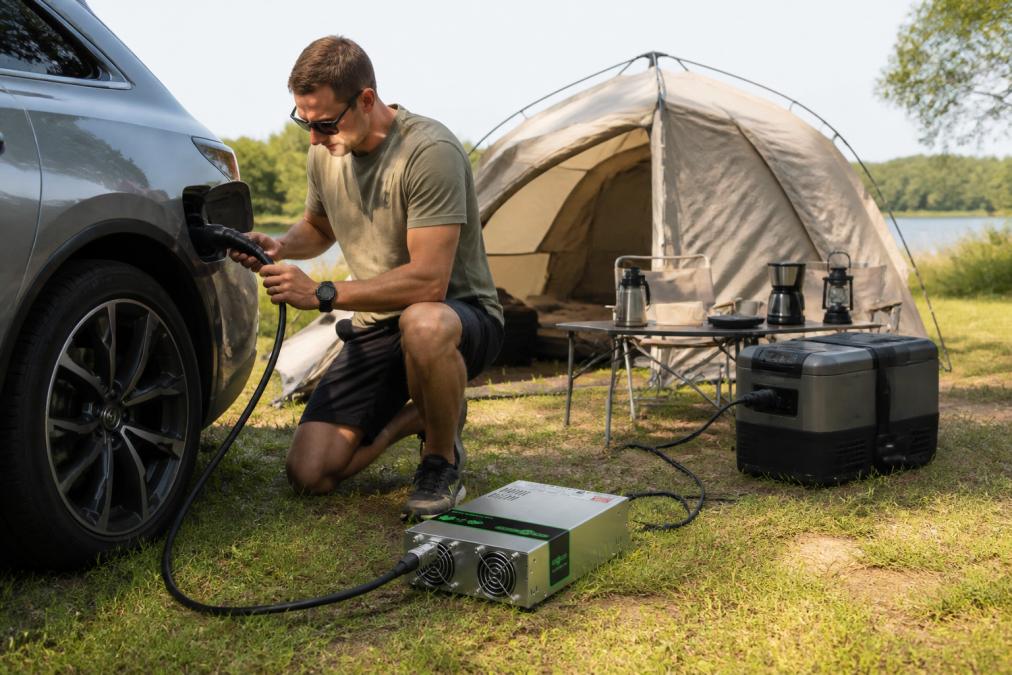
Practical applications and winter use ❄️
V2L operates year-round, but winter conditions affect both availability and performance in ways that many users don't expect.
Summer use: Camping, emergency power and business
The V2L is ideal for three practical uses outside of winter:
Camping and outdoor activities: V2L eliminates the need for a campsite power connection. You can park in a remote spot and still power your fridge, heater, lights and electronics. A typical 2-3 day camping trip uses around 10-15 kWh from your car.
Emergency power in case of power outage: If your area experiences a power outage, your electric car can provide power to essential appliances: refrigerator (around 150-200W continuous), heater (around 1-2kW), lights (around 50-100W), and electronics. A 60kWh car can theoretically provide power to these appliances for 20-30 hours.
Business and crafts: Tradesmen and service companies can use V2L to power tools on job sites without relying on power cables or generators. A typical electric drill uses around 500-800W, which means continuous operation for 50-100 hours from a fully charged car.
Winter use: Limitations and real consequences
Winter affects V2L in three ways: the battery gets cold, the system deactivates itself to protect the battery, and the available power decreases.
How cold affects the battery
A lithium battery works best at around 20-25°C. When the temperature drops below around 10°C, the internal resistance of the battery increases. A Hyundai Ioniq 5, which normally delivers 3.6 kW at 20°C, can only deliver around 2-2.5 kW at 0°C. At -10°C, it can drop to around 1.5 kW or less.
When the system disables V2L completely
If the battery drops below around 5°C, many car brands will completely disable the V2L function. You will get the error message "V2L conditions not met", even if the battery is fully charged. Solution: warm up the car before use. Start the air conditioning or put the car on charge. After 15-30 minutes, the battery will warm up and V2L will be available again.
Practical example: Winter power outage
Suppose your area experiences a power outage on a winter day at -5°C. Your car can normally deliver 3 kW through V2L, but at -5°C it can only deliver around 1.5-2 kW. A typical electric heater uses 2-3 kW, so you can only run it at around 50-70% power. Your battery will discharge faster due to the cold. A 60 kWh car can deliver power for around 15-20 hours at -5°C instead of 20-30 hours at normal temperature.
How to optimize V2L in winter
- Warm up the battery first: Before using V2L, start the air conditioner or put the car on charge for 15-30 minutes
- Use V2L as a supplement, not as the sole power source: If you have a power outage, you need other heat as backup
- Schedule recharging more often: Instead of waiting 24 hours between charges, recharge every 12-15 hours in the winter
- Avoid completely discharging the battery: Stop when the battery reaches around 10-15% to ensure you can drive to a charging station
- Choose smaller appliances: Instead of a 3 kW electric heater, run smaller appliances (1-2 kW) as a supplement
Winter use of the V2L requires planning. If you expect to be able to run a 3 kW electric heater continuously from your electric car during a winter power outage, you will be disappointed. You can run about 1.5-2 kW for about 15-20 hours, after which the car will need to be recharged. If you do not have access to charging during the power outage, you cannot use the V2L as your primary heat source.
V2L will work in winter, but with reduced power and shorter operating time. Plan for around 50% of summer performance, and use V2L as a supplement to other heat, not as a replacement.
Frequently Asked Questions
Can all electric cars use V2L adapters?
No, not all electric cars support V2L. It depends on the car's software and hardware. Hyundai, Kia, BMW, Mercedes-Benz and some other brands have V2L functionality, but even within the same brand, older models may lack this feature. You can check your car's manual or contact the dealer to confirm V2L support. A V2L adapter compatibility requires that your car has the built-in technology to send power out through the Type 2 port.
What is the difference between V2L and V2H?
V2L (Vehicle-to-Load) means you can draw power from your electric car to smaller appliances through an adapter on the Type 2 port. V2H (Vehicle-to-Home) is a permanent installation that connects your car to your home's electrical system, allowing you to power your entire home or store power. V2H requires a dedicated charging station and installation company, while V2L is portable and only requires an adapter. V2L is more flexible for camping and emergency power, while V2H is for long-term backup power at home.
How much power can I draw via a V2L adapter?
Most V2L adapters can deliver up to 3.6 kW (16 amps at 230 V AC). Some newer models can reach up to 11 kW, but this depends on both your car and the adapter. You should always check your car's specifications and the adapter's output capacity. Typical appliances such as camping fridges, electric grills and tools can be run without any problems, but appliances with very high power consumption (such as electric kettles or heat pumps) may exceed the capacity.
What does the 'V2L conditions not met' error message mean?
This error means that your car does not allow power output at that time. Causes may include: the battery is too low (below ~20%), the engine is started, the car software is not updated, or you are using an incompatible adapter. Solutions: Fully charge the car, turn off the engine, check for software updates, and confirm that the adapter is certified for your car model. If the problem persists, contact the car manufacturer or an authorized dealer.
Are V2L adapters safe to use long term?
Yes, certified V2L adapters with CE marking are safe when used correctly. They have built-in protection against overload, short circuit and voltage fluctuations. Your car's software also monitors the power output and automatically stops if any problems occur. Key safety tips: Use only certified adapters, avoid overloading the system and do not run the car on a dead battery. Modern electric cars are designed for V2L and automatically protect both the battery and the electrical system.
Can I use my electric car as backup power during power outages?
With V2L yes, but only if your car supports it. You can run smaller appliances like lights, chargers and cooling equipment through a V2L adapter. For the whole house, you need to install V2H (Vehicle-to-Home), which requires professional installation and a dedicated charging station. V2L is faster to set up and requires no installation, but provides less power. If you want backup power for the whole house, see V2LPower's car-to-home solutions for permanent installation.
How does V2L use affect my car's range?
Every kilowatt-hour you draw from the battery via V2L reduces your range by the same amount. If you draw 3 kWh, you lose about 10-15 km of range (depending on the car model). You can plan around this by charging strategically before long trips. Winter cold also reduces range, so V2L consumption in cold weather affects your plans more. Many electric cars have software that warns you if the battery gets too low for safe V2L use.
Choosing the right V2L adapter means understanding your car's specific capabilities, your power output needs, and what certification and safety are important to you. V2LPower helps you match exactly which adapter is right for your car and your needs. We offer free email support throughout Europe, and if something goes wrong, we can help you troubleshoot or replace it. Read our V2L guide to find the right adapter for your specific electric car model.
This article was written using GrandRanker



 Danish
 English
 Swedish
 German
 Dutch
 Norwegian
 Chinese
 French
 Polish
 Italian
 Greek
 Finnish
 Spanish
 Turkish
 Bulgarian
 Czech
 Portuguese
 Bosnian
 Slovak
 Slovenian
 Romanian
 Hungarian
 Lithuanian
 Latvian
 Estonian
 Serbian
 Ukrainian