
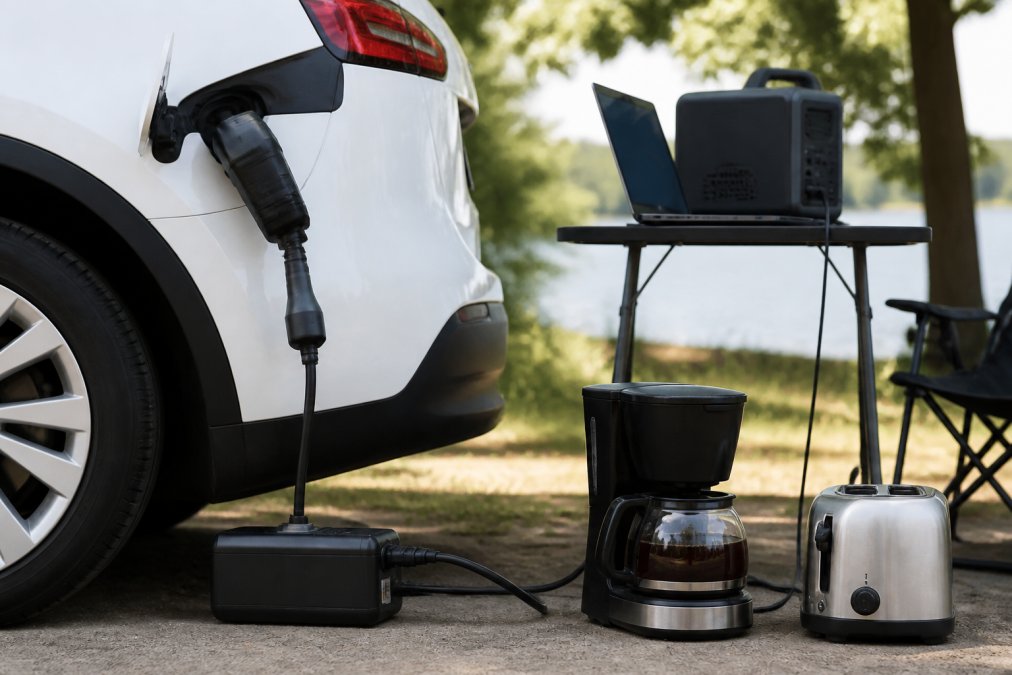
Is V2L safe for the electric car battery? Get the answer
Table of contents
- Is V2L safe for the electric car battery? In short
- How V2L affects the electric car's battery and lifespan
- What safety protocols protect the battery?
- How to choose a safe V2L adapter for electric cars
- V2L and the warranty: What does the car manufacturer cover?
- Our assessment: Is V2L worth the risk?
- Conclusion
- Frequently Asked Questions
Last updated: September 7, 2026
Is V2L safe for the electric car battery? In short
The question of whether V2L is safe for the electric car battery is the biggest concern for many electric car owners considering using their car as a mobile power source, and the answer is that V2L can certainly be done with the right equipment. The short answer is yes: V2L is safe for the electric car battery when used correctly with certified equipment and within the limits specified by the car manufacturer. The car's own Battery Management System (BMS) constantly monitors discharge and protects the battery from overload, overheating and deep discharge. At V2LPower, we produce our own guides, video tests and technical articles for specific car brands and models, focusing on correct compatibility, safety and practical application. The real risk rarely lies in the technology itself, but in the use of unqualified adapters and a lack of understanding of the car's power limits.
The technology behind V2L is essentially the same as what your car already uses when you drive: the battery supplies direct current, which is converted to 230V alternating current. The only difference is that the power goes out through the charging port instead of to the wheels. It’s a controlled process that the car manufacturer has designed for. Below, we’ll go over how V2L actually affects the battery, what safety protocols protect it, and what you should be aware of before investing in a solution.
How V2L affects the electric car's battery and lifespan
To understand the impact of V2L on the battery, we need to look at what actually wears out a lithium-ion battery. Degradation occurs through two primary mechanisms: growth of the Solid Electrolyte Interphase (SEI) layer on the anode surface and structural changes in the cathode material. Both processes are accelerated by high temperatures, high State of Charge (SoC), and high C-rates.
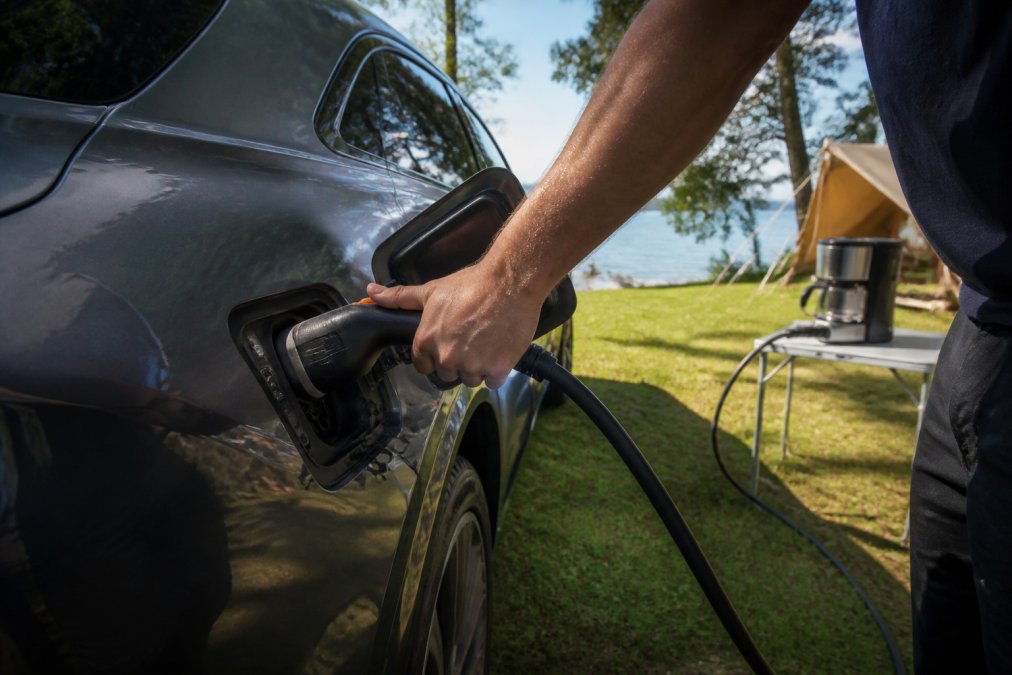
The C-rate is a measure of how quickly a battery discharges relative to its capacity. A 77 kWh battery delivering 3.6 kW via V2L discharges at a C-rate of just 0.047C. In comparison, even moderate acceleration often requires 100-200 kW, which corresponds to a C-rate of 1.3-2.6C. The difference is crucial: At such low C-rates, the internal resistance is minimal and the heat generation in the cells is almost non-existent. Heat is the battery’s biggest enemy, and V2L generates virtually none.
Depth of Discharge (DoD) is another factor. Research on lithium-ion cells shows that cycle life is significantly extended if the battery is maintained between 20% and 80% SoC. When your car stops the V2L output at 20%, it not only protects against running dry, but also against the chemical stress that occurs during extreme discharge. At low SoC, the voltage per cell drops, which increases the stress on the electrolyte and can lead to copper deposition on the anode if the discharge continues too far down. The car's BMS prevents this by cutting off the current, typically between 10-20% SoC, depending on the manufacturer's settings.
The biggest risk to the battery is not the V2L use itself, but using a cheap adapter without proper management. An unqualified adapter can draw more current than the car is designed for, which can overheat the charging port and stress the BMS system.
An often overlooked point is that V2L can actually be gentler than regular driving. When you drive, the battery experiences constant micro-cycles with rapid fluctuations in power output. V2L, on the other hand, delivers a constant, even load, which gives the cells time to balance and reduces mechanical stress on the electrode materials. For lithium iron phosphate (LFP) batteries, which many new models use, the cycle life is often over 3000-5000 cycles at 80% DoD. Even if you used V2L to drain the battery from 100% to 20% every day, it would take over 8 years to reach this limit. In practice, most people only use V2L occasionally, making the contribution to the battery’s overall degradation almost negligible compared to daily driving and fast charging.
It is also worth understanding that battery capacity does not decline linearly. The first 5-10% capacity loss occurs relatively quickly over the first 20,000-40,000 km, after which the curve flattens out. This initial degradation is primarily due to the formation of the SEI layer and is inevitable with all use. V2L does not affect this process any differently than normal driving, because the primary driving force is the number of cycles and temperature, not the specific discharge rate.
What safety protocols protect the battery?
The electric car battery is protected by several layers of safety systems that work together during V2L use. The most important is the Battery Management System (BMS), which constantly monitors the voltage, temperature and current in each battery cell. If any of these parameters exceed safety limits, the BMS automatically cuts off power to the car.
Additionally, car manufacturers have built in a power limit for the V2L output, typically 16A or around 3.6kW. This limit is set based on the car’s cooling system and the charging port’s specifications. When you use a certified V2L adapter, the adapter communicates with the car and ensures that no more current is drawn than the car can handle. The safety protocol also includes overload protection that cuts off power if the connected equipment draws too much.
An important detail that many people overlook is the importance of choosing an adapter that matches your car's V2L specifications exactly. Different car brands use different communication protocols in the charging port, and an adapter designed for one brand may give error messages or, in the worst case, damage the electrical system of another car model. That's why we always recommend choosing a V2L adapter that has been tested and certified specifically for your car model.
Look for adapters that have built-in temperature protection and automatic overload cutoff. These features are not standard on all cheap adapters and are the key difference between safe and risky V2L use.
How to choose a safe V2L adapter for electric cars
Choosing a safe V2L adapter is primarily about compatibility and certification, not price. An adapter that is not designed for your specific car model may give error messages like “V2L conditions not met” or, in the worst case, put undue strain on the car’s electrical system. Therefore, you should always start by checking which adapters have been tested and approved for your specific car.
Certification is the next critical point. A proper V2L adapter should comply with applicable electrical safety standards and have built-in protection against overcurrent, overheating, and short circuits. The cheapest adapters on the market often skip these safety features to keep the price down, creating a real risk to both the car and the equipment you connect.
| Select this | Avoid this | Why it matters |
|---|---|---|
| Adapter tested for your car model | Universal adapter without brand specification | Communication protocols vary between car brands |
| Certified with overload protection | Uncertified budget adapter | Protects the car's BMS and your equipment |
| Documented power limit and current strength | Unclear specifications | Ensures you don't overload the charging port |
| Manufacturer with technical support | No possibility of help after purchase | Troubleshooting requires expertise |
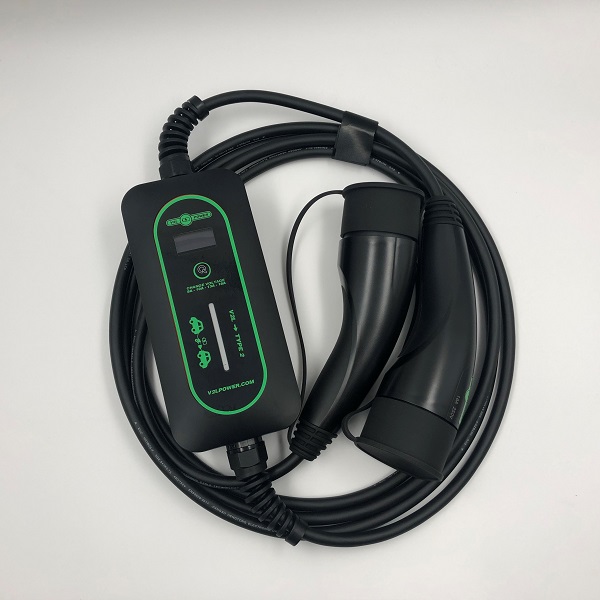
V2LPower is a Danish specialist in Vehicle-to-Load (V2L) solutions for electric cars, producing its own guides, video tests and technical articles for specific car brands and models with a focus on correct compatibility, safety and practical use. Our V2L converters, which V2LPower – Charger from car to type2 (P10, P11, P12), supports a choice of charging currents between 8A, 10A, 13A and 16A, giving you flexibility for both delicate electronics and more demanding tools. This control over the current is essential to protect both your car battery and the devices you are powering.
V2L and the warranty: What does the car manufacturer cover?
The warranty issue is often the one that worries electric car owners the most, and the answer is nuanced. Most car manufacturers cover damage to the battery and electrical system if V2L is used with approved equipment and within the vehicle’s specified limits. The problem arises if you use an adapter that is not certified for the car and damage occurs as a result. In such cases, the car manufacturer may deny a warranty claim citing misuse.
The legal framework in Denmark is worth understanding. The Danish Sales Act and the Consumer Sales Act give you as a consumer a 24-month right of complaint, where the seller must prove that a fault was not present at the time of purchase. However, the car manufacturer's warranty is a separate, voluntary scheme, often extending over 8 years for the battery. Here, the manufacturer's terms and conditions apply, and they may contain specific exceptions for V2L use. In contrast to the right of complaint, in warranty cases it is often the consumer who must prove that the damage is not due to misuse.
Always use a V2L adapter that has been explicitly tested and approved for your car model. This is the only way to ensure that your warranty remains intact and that your car's electrical system is not damaged.
An important detail is that the warranty on the battery is typically conditional on the car being serviced at authorized workshops and that the software is kept up to date. V2L functionality is often dependent on the latest software, and if you do not update the car, the manufacturer can argue that damage is caused by outdated software. In addition, the car's BMS monitors and logs data on all discharge cycles, including V2L use. The manufacturer can in principle access this data in the event of a warranty claim and see exactly how the battery has been used. If the log shows that the battery has been repeatedly discharged below 10%, or that more current has been drawn than specified, this can be used as a basis to reject the claim.
To navigate the warranty landscape, you should follow these specific guidelines:
- Check the manufacturer's official V2L documentation – Many manufacturers now have dedicated pages or manuals that specify which adapters are approved and what power limits apply.
- Keep documentation for your equipment – Keep receipts and product specifications for your V2L adapter. If a dispute arises, you will need to be able to prove that you used certified equipment.
- Keep your car's software up to date – V2L protocols and security limits can change with software updates. An outdated software version can pose both a security risk and a warranty issue.
- Avoid third-party adapters without brand specification – Even if an adapter physically fits into the charging port, it does not mean that it communicates correctly with the car's BMS. An adapter that is not tested for your car model can send incorrect signals and make the car think it is under a different load than it actually is.
Take a picture of your adapter and car display when V2L is in use and save it with your receipt. This can serve as documentation that you have used the equipment correctly in the event of a warranty claim.
However, if an unqualified adapter causes a fire, the insurance company may deny coverage, citing the damage as being caused by a defect in your own equipment. Therefore, investing in a certified, brand-specific adapter not only protects your battery, but also your finances in the event of an accident.
Our assessment: Is V2L worth the risk?
V2L is one of the most underrated features in modern electric vehicles, and the risk to the battery is minimal when the technology is used correctly. The real risk lies in using unqualified equipment or ignoring the car manufacturer's recommendations. With a certified adapter and common sense, you can safely use your electric vehicle as a power source for camping, emergency power or on a construction site without worrying about the health of the battery.
What makes V2L particularly attractive is its versatility. You get access to 230V power wherever you are, without having to carry a generator or search for a power outlet. For tradesmen, this means mobile power for tools in places without infrastructure. For camping enthusiasts, it means comfort and convenience in the great outdoors. And for homeowners, it means a reliable backup solution in the event of a power outage.
In terms of safety, V2L is comparable to using a regular extension cord at home, as long as the equipment is in good working order. Car manufacturers have invested heavily in making the technology safe, and the BMS system acts as an independent sentinel that constantly monitors the battery's condition. The only situation where you should be careful is when using appliances with very high wattage consumption, as they can approach the car's power limit and trigger protection mechanisms.
Conclusion
The question of V2L's safety for the electric car battery can be summarized in three points: the technology is designed for the purpose, the battery is protected by advanced systems, and the biggest risk is the use of unqualified equipment. V2L is safe when you choose a certified adapter that has been tested for your car model, and when you respect the car's power limits. V2LPower is a Danish specialist in Vehicle-to-Load (V2L) solutions for electric cars, producing its own guides, video tests and technical articles for specific car brands and models with a focus on correct compatibility, safety and practical use. Our range of V2L adapters and Type 2 converters is selected with a focus on compatibility and safety, and we offer free support if you are in doubt about which solution is right for your car. Turn your electric car into a mobile power source with the right knowledge and the right equipment.
Frequently Asked Questions
Does V2L drain the battery more than regular driving?
V2L does not significantly wear out the battery more than normal driving when used correctly. The car's Battery Management System (BMS) controls the discharge and adheres to a set discharge limit. The primary wear on an electric car battery occurs during fast charging and extreme heat, not during moderate V2L use. A typical V2L outlet of 230V draws around 10-16A, which is a low load compared to the car's own engine power.
Is there a risk of overheating when using V2L?
Modern V2L adapters and car onboard systems have multiple layers of overheating protection. The BMS continuously monitors the battery temperature and reduces or stops the current output if the temperature gets too high. The adapter also has a built-in temperature sensor and overload protection. As a rule of thumb, you should avoid using the V2L for several hours in direct sunlight with extreme heat, and you should always use a certified adapter that matches your car's specifications.
Can you use V2L to power the entire house?
V2L is designed to supply individual appliances and smaller consumers via a 230V outlet, not the entire house. A standard V2L outlet typically delivers up to 3.6 kW, which is equivalent to a regular socket. If you need to use the car as backup power for the house during prolonged power outages, a V2H (Vehicle-to-Home) solution with a permanent installation and a certified electrician is required. V2H systems are more expensive, but can handle a larger part of the house's electricity consumption.
What does the warranty say about using V2L equipment?
Most car manufacturers cover battery damage caused by normal use of V2L, provided you use certified equipment that meets the car's specifications. It is important to check your car's warranty terms, as some manufacturers require approved adapters. An unqualified or cheap adapter can, in the worst case, send incorrect signals to the car's BMS and potentially damage the battery. Therefore, always choose an adapter that has been tested and approved for your specific car model.


 Danish
  English
  Swedish
  German
  Dutch
Dutch  Norwegian
  Chinese
  French
  Polish
  Italian
  Greek
Greek  Finnish
  Spanish
  Turkish
  Bulgarian
  Czech
Czech  Portuguese
  Bosnian
  Slovak
  Slovenian
  Romanian
  Hungarian
  Lithuanian
  Latvian
  Estonian
  Serbian
  Ukrainian