
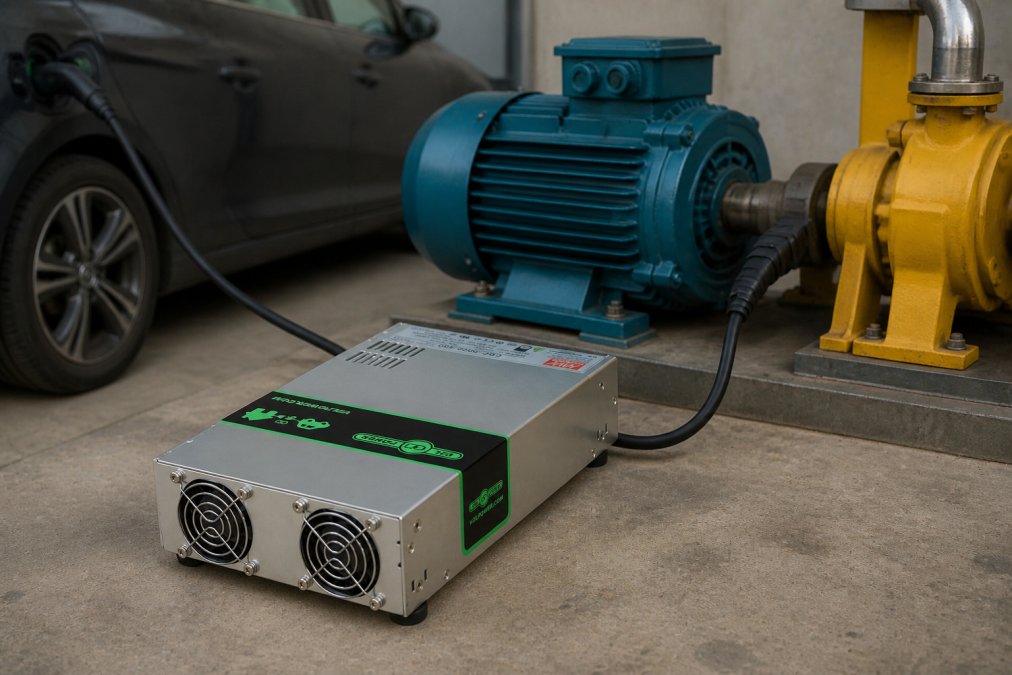
Handling inductive loads with V2L
Table of contents
- What is inductive loading and why does it matter for V2L?
- Safe V2L adapter for electric cars with inductive devices
- Maximum load V2L can handle
- Practical guide: Setup for inductive tools and appliances
- Troubleshooting and error codes for inductive loads
- Which devices should you avoid or handle with caution?
- Conclusion
Last updated: August 24, 2026
What is inductive loading and what does it mean for V2L?
Inductive load is the current that electrical appliances with motors or coils draw during start-up, and it is completely different from what static appliances require. When you turn on a drill, compressor or pump, the starting current can be 3-7 times higher than the normal operating current (peer-reviewed research). This is where the problem arises for V2L systems.
Most people think of V2L as a simple power source: plug in your device and get power out of your car. But inductive loads force the system to handle massive power spikes in fractions of a second. If your V2L adapter or converter doesn't is designed to that, it will either shut down, damage the components, or worse, damage the car's battery pack.
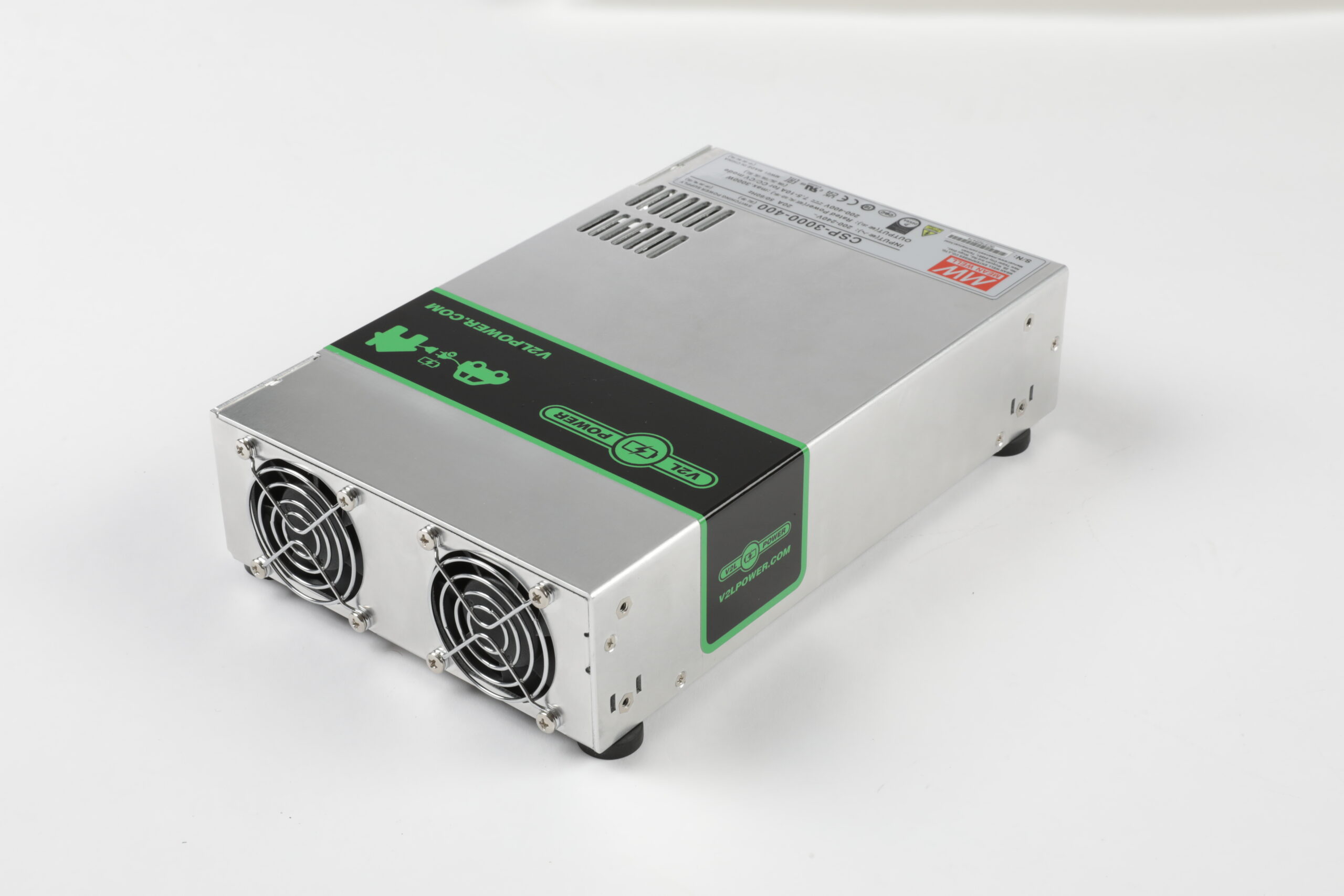
A common mistake is to assume that if an adapter can deliver 3,600 watts continuously, it can also power a 3,000 watt drill. It can't. The inrush current on that drill could be 9,000 watts for 200 milliseconds. Your adapter won't survive that without proper design.
Difference between resistive and inductive load
Resistive load, like a dishwasher, kettle or light bulb, draws the same amount of current all the time. When you turn it on, it immediately draws its rated power. It is predictable and easy to handle.
Inductive load, like a motor, compressor or welding machine, has a completely different characteristic. When you turn it on, the magnetic field in the motor coil must first build up. At that moment, the motor draws a massive starting current before it drops to normal operating current. This starting current can be 5-10 times higher than the normal current (peer-reviewed research).
Example: A 1,500 watt drill might have a running current of around 6.5 amps at 230 volts. But when you press the button, the starting current might be 20-30 amps in the first second. That's the difference between 1,500 watts and 6,900 watts.
If your V2L adapter can’t handle this inrush current, it will trip its fuse or overload protection and you’ll get the error “V2L conditions not met.” Worse yet: without proper protection, the surge can damage your car’s electronics.
Starting current and peak load
Inrush current is the maximum current that the appliance draws the moment it is switched on. Peak load refers to the short-term peak power that the system must be able to deliver without failure.
For V2L systems, this means that the inverter must be sized not for continuous power, but for inrush power. An inverter rated for 3,600 watts continuous must be able to deliver at least 7,000-9,000 watts for 1-2 seconds to safely handle inductive loads (peer-reviewed research).
Battery capacity also plays a role. If your EV has a small battery pack, or if the battery's state of charge (SOC) is low, the system cannot provide the necessary starting current without affecting the battery's integrity. This is why many EVs have limitations on V2L when the battery is below 20% charge.
Safe V2L adapter for electric cars with inductive devices
One safe V2L adapter for electric car Inductive devices must have several important features that cheap or generic adapters do not have. This is not just a question of price, it is about safety for both your car and your equipment.
Why regular adapters fail
Many V2L adapters on the market are designed for resistive loads: charging batteries, powering lamps, or powering small electronic devices. They work fine as long as the current is stable and predictable.
But when you plug in a drill or a compressor, something completely different happens. The starting current hits the adapter like an electric shock. Without proper protection, a cheap adapter will:
- Trigger its overload protection and shut down (you get the error "V2L conditions not met")
- Or worse: it won't shut down fast enough and the peak load could damage the components internally
- Or worst: it will not protect the car's electronics from kickback from the starting current
A typical adapter typically has simple overload protection that measures average current. It doesn't notice quick spikes because they last less than a second. So it lets them pass until it's too late.
A safe adapter for inductive loads should have fast short circuit protection (< 10 milliseconds response time), not just regular overload protection. This is the most important sign that the adapter is designed to handle motors and tools.
Overload protection and fuse
Proper overload protection consists of several layers:
Fast short circuit protection, responds to peak loads within milliseconds. If the inrush current exceeds a safe threshold, the system shuts down immediately.
Thermal protection, monitors the temperature of the inverter. If it gets too hot (typically above 65-70°C), the system shuts down to prevent damage.
Voltage regulation, ensures that the output voltage remains stable even when the input current varies. Without this, peak loads can cause voltage drops that can damage sensitive electronic devices.
Kickback protection, prevents peak loads from the appliance from sending power back to the car's electronics. This is critical to protecting the car's battery pack and control systems.
A safe converter for inductive loads typically has all of these features. Cheap adapters may have one or two of them, but not all four.
Maximum load V2L can handle
How much power can your V2L system actually deliver? It depends on three factors: your car model, your inverter design, and your battery capacity.
Power limits by car model
Different electric cars have different V2L capacities. This is not a random value, it is designed by the car manufacturer to protect the battery and control systems.
Typical V2L capabilities:
- Hyundai Ioniq 5 and 6, up to 3,600 watts continuous (with fast start-up current handling)
- Kia EV6, up to 3,600 watts continuously
- BMW i4, up to 1,500 watts continuously
- Mercedes EQE/EQS, up to 11,000 watts continuous (with Type 2 inverter)
- Volkswagen ID. Buzz, up to 1,500 watts continuously
These numbers are important because they define the maximum that the system can deliver without triggering fuses or error messages.
But note: these are continuous power limits. The starting current may be higher for a short time, typically 1.5-2 times the continuous power for 1-2 seconds.
If you have a Hyundai Ioniq 5 or Kia EV6, you can safely run inductive tools up to around 2,500 watts continuously, with starting current up to 5,000 watts. For other car models, check the manufacturer's specifications.
Battery capacity and state of charge
Battery capacity also affects how much power you can draw. A larger battery pack can deliver more power without being overloaded.
State of charge (SOC), the percentage of the battery that is charged, is even more important. When the battery is below 20%, most electric cars automatically reduce the V2L capacity to protect the battery's lifespan. Some cars reduce it even further at lower SOC levels.
Example: Your Hyundai Ioniq 5 can deliver 3,600 watts when the battery is between 20% and 80% charge. But when the battery drops below 20%, the capacity is reduced to perhaps 1,500 watts. And when it's below 10%, V2L may be disabled entirely.
This means you can't use the V2L to power a 3,600 watt drill if the battery is running low. You need to plan your energy usage based on your battery level.
Practical guide: Setup for inductive tools and appliances
Here are the steps to set up V2L safely for inductive tools and appliances. This guide applies to most electric vehicles with V2L capability.
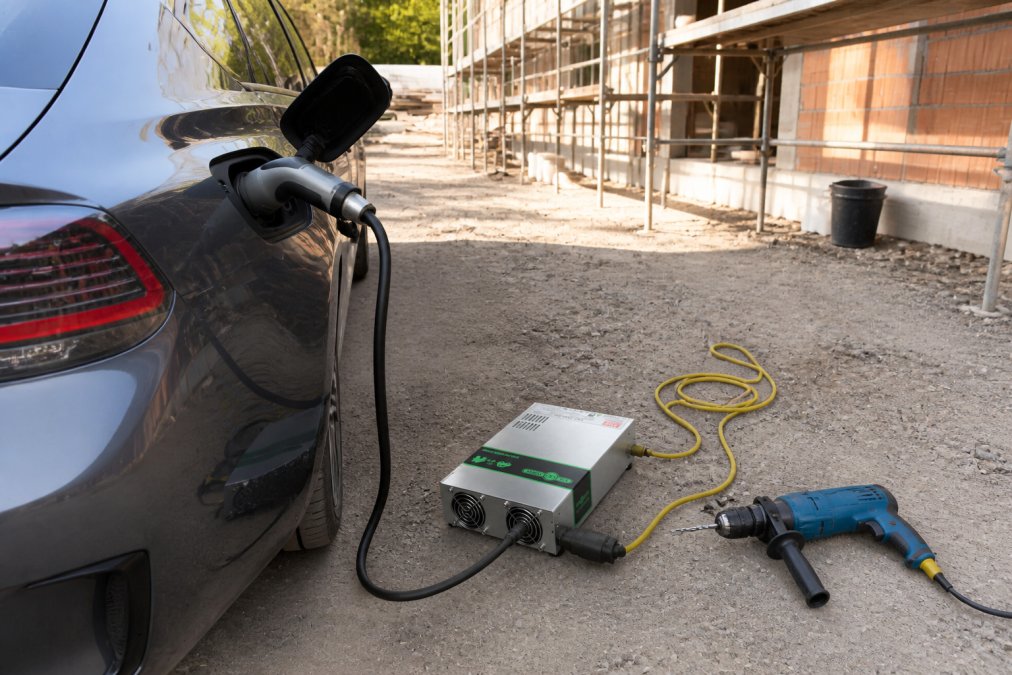
Step 1: Check your car's V2L capability
Before you connect anything, you need to know what your car can deliver.
Find your car's specifications:
- Check your car's user manual or online specifications
- Note the maximum continuous power (typically 1,500-3,600 watts for most models)
- Note any limitations when the battery level is low
Check your current battery level:
- Open your car's infotainment system and find "Battery Status" or "State of Charge""
- Note the percentage.
- If the battery is below 20%, the V2L capacity is reduced
Decide which devices you can use:
- 1,500 watt drill? Yes, if the battery is above 20%
- 2,500 watt compressor? Maybe, depending on starting current
- 4,000 watt welding machine? No, unless you have a Mercedes EQS or similar
Step 2: Choose the correct extension cord and socket
The cable you use matters a lot. A bad cable can cause voltage drops, which reduces the power your device receives.
Cable specifications:
- Minimum cross-section: 2.5 mm² for cables up to 10 meters
- For longer cables (over 10 meters): 4 mm² or larger
- The cable must be rated for at least 16 amps (3,600 watts at 230 volts)
- Only use cables with proper grounding (3-pin plug, not 2-pin)
Socket design:
- Choose a socket with built-in fuse or overload protection
- The fuse must be 16 amps for 230 volts
- If you are using an external inverter (like V2LPower), the socket must be compatible with the inverter
Length and location:
- Keep the cable as short as possible (under 10 meters ideally)
- Avoid winding the cable into a tight spiral, this can cause heat buildup.
- Place the cable away from sharp edges and heat sources.
Step 3: Connect the appliance gradually
This step is critical for inductive loads.
First connect the inverter to the car:
- Open the car's V2L port (typically on the side of the car)
- Connect the Type 2 cable from the converter to the car's V2L port
- Wait for the inverter to start up (typically 5-10 seconds)
- Check that the inverter shows "V2L Active" or similar on its display
Then connect the extension cable:
- Connect the extension cable to the inverter
- Wait 5 seconds
- Check that the voltage at the socket is around 230 volts (use a voltmeter if you have one)
Finally, connect the device:
- Connect the appliance to the socket.
- Turn the appliance on at the lowest setting (if possible)
- Gradually increase to full power over 5-10 seconds
- Listen for unusual sounds or smells from the inverter
If the inverter shuts down or displays an error, stop immediately. See the troubleshooting section below.
Troubleshooting and error codes for inductive loads
When something goes wrong, the most important thing is to know what the error means. Here are the most common error codes and how to fix them.
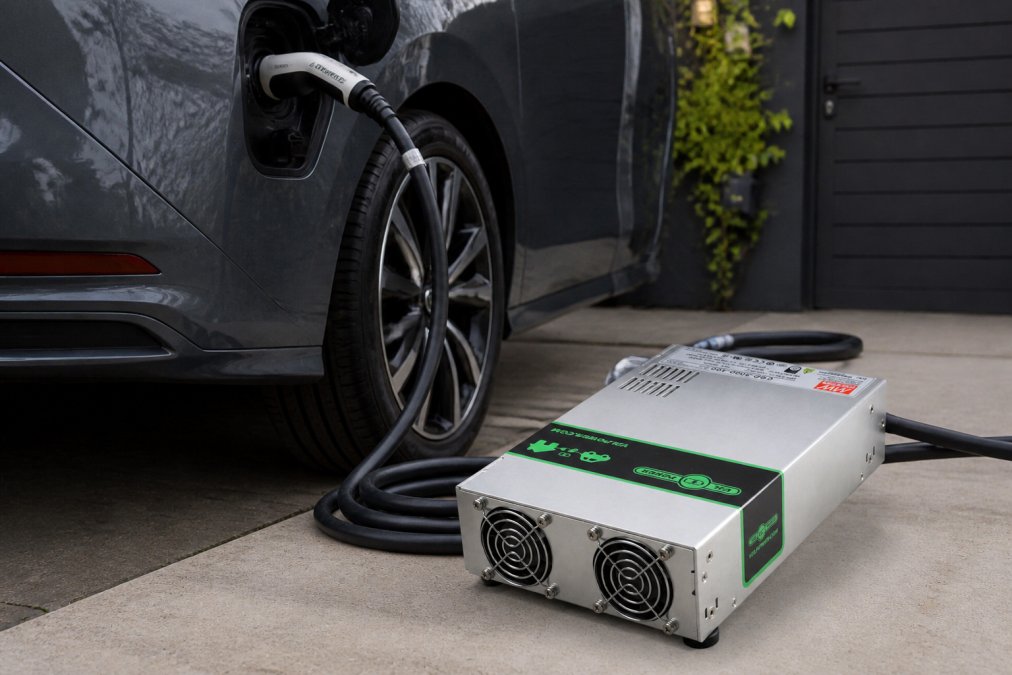
V2L conditions not met error
This error means that the system has detected a condition that makes V2L unsafe or impossible.
Possible causes:
- The battery is under 20% charging
- The car's engine is on (some cars require the engine to be off)
- The battery is too hot or too cold.
- You have connected too much power (the device exceeds the car's capacity)
How to fix it:
- Turn off the appliance immediately.
- Wait 30 seconds
- Check the battery level, if it is below 20%, charge the car
- Check the battery temperature, if the car has been in direct sunlight, wait an hour
- Make sure you have only connected a single device (not multiple at the same time)
- Try again with a smaller appliance first (e.g. a lamp) to test the system
If the error persists, there may be a problem with the V2L port or inverter. Contact V2LPower support.
Voltage drops and amperage problems
If the appliance works but not at full power, there is probably a voltage drop in the cable or inverter.
Signs of voltage drop:
- The drill rotates slower than normal
- The lamp is weaker than expected
- The inverter becomes very hot (over 60°C)
Reasons:
- The cable is too long or too thin.
- There is a loose connection somewhere in the system.
- The inverter is overloaded.
How to fix it:
- Measure the voltage at the socket with a voltmeter, it should be around 230 volts.
- If it is below 220 volts, there is a voltage drop
- Check all connections, unplug and replug all plugs
- If the cable is over 10 meters, change to a thicker cable (at least 4 mm²)
- If the voltage still drops, the inverter may be defective, contact support
Which devices should you avoid or handle with caution?
Not all devices are safe to use with V2L. Here's a guide to what to avoid and what you can use with caution.
Motors and pumps with high starting current
Motors are among the worst inductive loads. An electric motor can have a starting current of 5-10 times the normal operating current.
Devices to avoid completely:
- Large circular saw (over 2,000 watts)
- Belt sander or belt sander
- Handheld compressor (over 1,500 watts)
- Electric pumps for water (over 1,000 watts)
Devices you can use with caution:
- Small drill (under 1,500 watts), start on lowest setting
- Small grinder (under 1,000 watts), start on lowest setting
- Electric screwdriver, typically OK as it has low starting current
If you are unsure, start with the lowest setting and increase slowly. If the inverter shuts down, the appliance is too powerful.
Compressors and air conditioners
Compressors are particularly problematic because they have both high starting current AND high continuous current.
A typical 2,000 watt compressor may have:
- Operating current: about 8-10 amps (1,800-2,300 watts)
- Starting current: about 25-30 amps (5,750-6,900 watts)
This means that even if your inverter can deliver 3,600 watts continuously, it cannot handle the starting current from the compressor without shutting down.
Air conditioners are even worse. An air conditioner has both a compressor AND a fan, both of which start at the same time. The combined starting current can be 40-50 amps.
Recommendation: Avoid compressors and air conditioners altogether unless you have a very powerful inverter (over 6,000 watts) and a large battery pack.
Conclusion
Handling inductive loads with V2L requires more than just plugging a device into an adapter. You need to understand inrush current, peak load, and system limitations. A cheap adapter will fail, or worse, damage your car.
V2LPower is designed specifically to handle inductive loads safely. With fast short circuit protection, thermal monitoring, and voltage regulation, it can The V2LPower inverters power tools and appliances that cheap adapters can't handle. Our solutions are tested with specific car models to ensure compatibility and safety.
Read our V2L guide to learn more about how to use your electric car as a safe, reliable power source, at home, on the go, or in nature.
Frequently Asked Questions
What is an inductive load in the context of V2L?
An inductive load is an electrical device that uses a motor or coil to operate, such as drills, pumps, compressors, and fans. These devices require a high starting current (several times their normal consumption) when they are turned on, which can overload the V2L system. Unlike resistive loads such as heaters and lamps, which require a constant current, inductive devices suddenly draw much more current in the first second when the motor starts.
Why can inductive loads damage a V2L adapter or the electric car?
When an engine starts, the starting current can be 5-10 times higher than normal operating current. A regular V2L adapter without proper overload protection cannot handle this sudden current surge, which can trip fuses in the car or damage adapters with insufficient capacity. A safe V2L adapter for electric vehicles should have built-in overload protection and be designed to handle these current surges without affecting the car's electrical system.
What is inrush current and why is it critical for V2L?
Starting current (or inrush current) is the high current that a motor or inductive device draws in the first moment when it is switched on. For example, a 1000 W drill may draw 30-50 A at the moment of starting, although it normally only uses around 4-5 A during operation. The V2L system must be sized to handle these short-term peaks without interrupting the power or triggering faults. If the maximum load the V2L can handle is lower than the starting current, the system will report 'V2L conditions not met' or disconnect.
What electrical appliances are considered inductive and can I use them with V2L?
Inductive appliances include drills, grinders, pumps, compressors, fans, air conditioners and power tools with motors. You can use them with V2L, but be aware of their starting current. Smaller tools (under 1000W) can often be handled if your electric vehicle has sufficient V2L capacity and you use an adapter with proper overload protection. Larger appliances or multiple motors at the same time can be problematic. Resistive appliances such as heaters, lamps and portable stoves are considerably easier to operate and place fewer demands on the V2L system.
This article was written using GrandRanker

 Danish
 English
 Swedish
 German
 Dutch
 Norwegian
 Chinese
 French
 Polish
 Italian
 Greek
 Finnish
 Spanish
 Turkish
 Bulgarian
 Czech
 Portuguese
 Bosnian
 Slovak
 Slovenian
 Romanian
 Hungarian
 Lithuanian
 Latvian
 Estonian
 Serbian
 Ukrainian