
Electric car V2L compatibility: Check guide 2026
Table of contents
- V2L function explanation: what is Vehicle-to-Load and how does it work?
- Electric cars with V2L 2026: which models support the feature?
- Electric car V2L compatibility check: how to find out if your car can do it
- V2L adapter for electric car: types, safety and certification
- What can you use V2L for? Practical applications and power consumption calculator
- V2L pros and cons: is it right for you?
- Troubleshooting: electric car V2L compatibility not working – what do you do?
- Conclusion
Last updated: August 2, 2026
Many electric car owners discover too late that their car actually supports V2L, but that they lack the right adapter or don't know how to activate the feature. This guide to checking electric car V2L compatibility gives you exactly the overview you need. Below we show you step by step which cars will support V2L in 2026, how to check your own car, and what to watch out for to avoid the mistakes that stop most people.
The most overlooked fact: V2L is not For tech enthusiasts only. A fully charged electric car with a 77 kWh battery can power an average Danish household for over two days during a power outage. This is not a niche feature. This is real emergency power.
V2L function – explained: what is Vehicle-to-Load and how does it work?
Vehicle-to-Load (V2L) is a technology that makes it possible to use the electric car's battery as an external power source to supply electrical appliances directly from the car. V2L converts the car's high-voltage direct current to 230 V alternating current, which ordinary plugs and appliances can use.
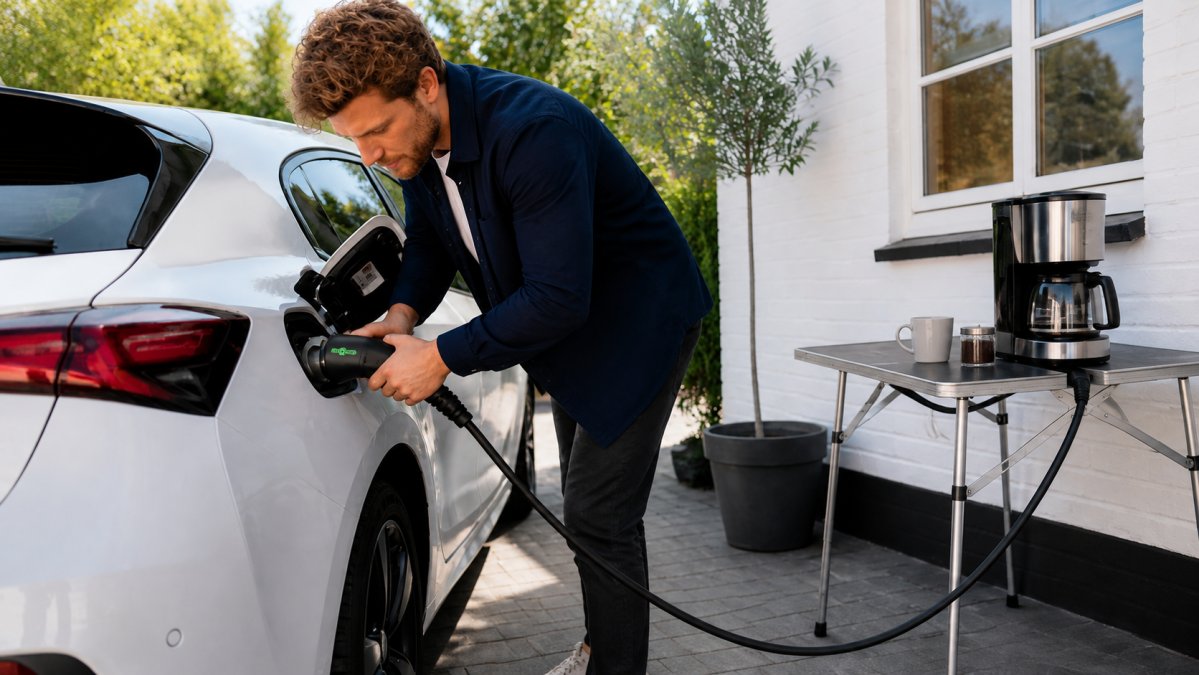
This is where V2L differs from regular charging. The car doesn't just send power in, it sends power out. You can plug in a coffee maker at the campsite, power a circular saw on a construction site, or keep your fridge running during a power outage.
DC-to-AC conversion: the technology behind V2L
The electric car's battery stores power as direct current. The V2L system contains a built-in inverter that converts this direct current to alternating current with 230 V and 50 Hz, which corresponds to the Danish electricity grid. The conversion is typically done via the charging port's CCS or Type 2 connector, depending on the car model.
The power limit varies from model to model. Many cars deliver between 1.8 kW and 3.6 kW, while some models like the Kia EV9 can deliver up to 3.6 kW via the rear charging port. In practice, this means that you can power most household appliances, but not an electric kettle and an oven at the same time.
V2L vs. V2H vs. V2G: what's the difference?
These three terms are often confused, but they cover very different functions:
- V2L (Vehicle-to-Load): Power directly from the car to devices via adapter. No installation required.
- V2H (Vehicle-to-Home): The car is connected to the house's electrical installation and can supply the entire house. Requires special equipment and authorized electrical installation.
- V2G (Vehicle-to-Grid): The car communicates with the power grid and can sell surplus power back. Requires special charging stations and agreements with the power company.
V2L is the simplest and most accessible solution for most Danish EV owners today. V2H and V2G are still being rolled out in Denmark and require infrastructure that is not yet widely available. As documented by the Danish Energy Agency on bidirectional charging in Denmark, V2G standards and regulation are still under development in the Danish context.
Electric cars with V2L 2026: which models support the feature?
Not all electric cars have V2L. The feature is primarily prevalent in Korean and European models, while many German manufacturers have not yet implemented it widely. Below you will find an updated list of models with V2L support in 2026.
Comparison table: V2L capacity and power limit per model
| Model | Battery capacity | V2L effect | Connector type | V2L location |
|---|---|---|---|---|
| Hyundai Ioniq 5 | 77.4 kWh | 3.6kW | Type 2 (via adapter) | Loading door + interior |
| Hyundai Ioniq 6 | 77.4 kWh | 3.6kW | Type 2 (via adapter) | Charging port |
| Kia EV6 | 77.4 kWh | 3.6kW | Type 2 (via adapter) | Loading door + interior |
| Kia EV9 | 99.8 kWh | 3.6kW | Type 2 (via adapter) | Loading door + luggage compartment |
| Genesis GV60 | 77.4 kWh | 3.6kW | Type 2 (via adapter) | Charging port |
| BYD Atto 3 | 60.5 kWh | 2.2kW | Type 2 (via adapter) | Charging port |
| Ford F-150 Lightning | 131 kWh | 9.6kW | Schuko (built-in) | Bodywork |
| Volkswagen ID.4 | 77 kWh | Not supported | – | – |
| Tesla Model Y | 75 kWh | Not supported (default) | – | – |
The table shows that the Hyundai-Kia group dominates the V2L market in Denmark in 2026. The Volkswagen ID series and Tesla still lacks native V2L support, although third-party solutions exist for certain models.
Electric car V2L compatibility check: how to find out if your car can do it
Here's the part most guides skip: it's not enough to know that your car model theoretically supports V2L. You need to confirm that your specific car is configured for it and that you have the right equipment. Follow these three steps.
Step 1: Check the car's software and charging port
Start in your car's infotainment system. On the Hyundai Ioniq 5 and Kia EV6, you'll find the V2L option under "Charge" or "Power" in the menu. If the feature doesn't appear, your car may be missing a software update or have an older firmware version that doesn't support V2L.
Also, physically check the charging port. Cars with V2L via charging port typically have a small mechanism inside the CCS or Type 2 connector that is activated by the adapter. If the inside of the port looks identical to a standard charging port without any additional contacts, the model may not support V2L.
Step 2: Identify the plug type and charging standard
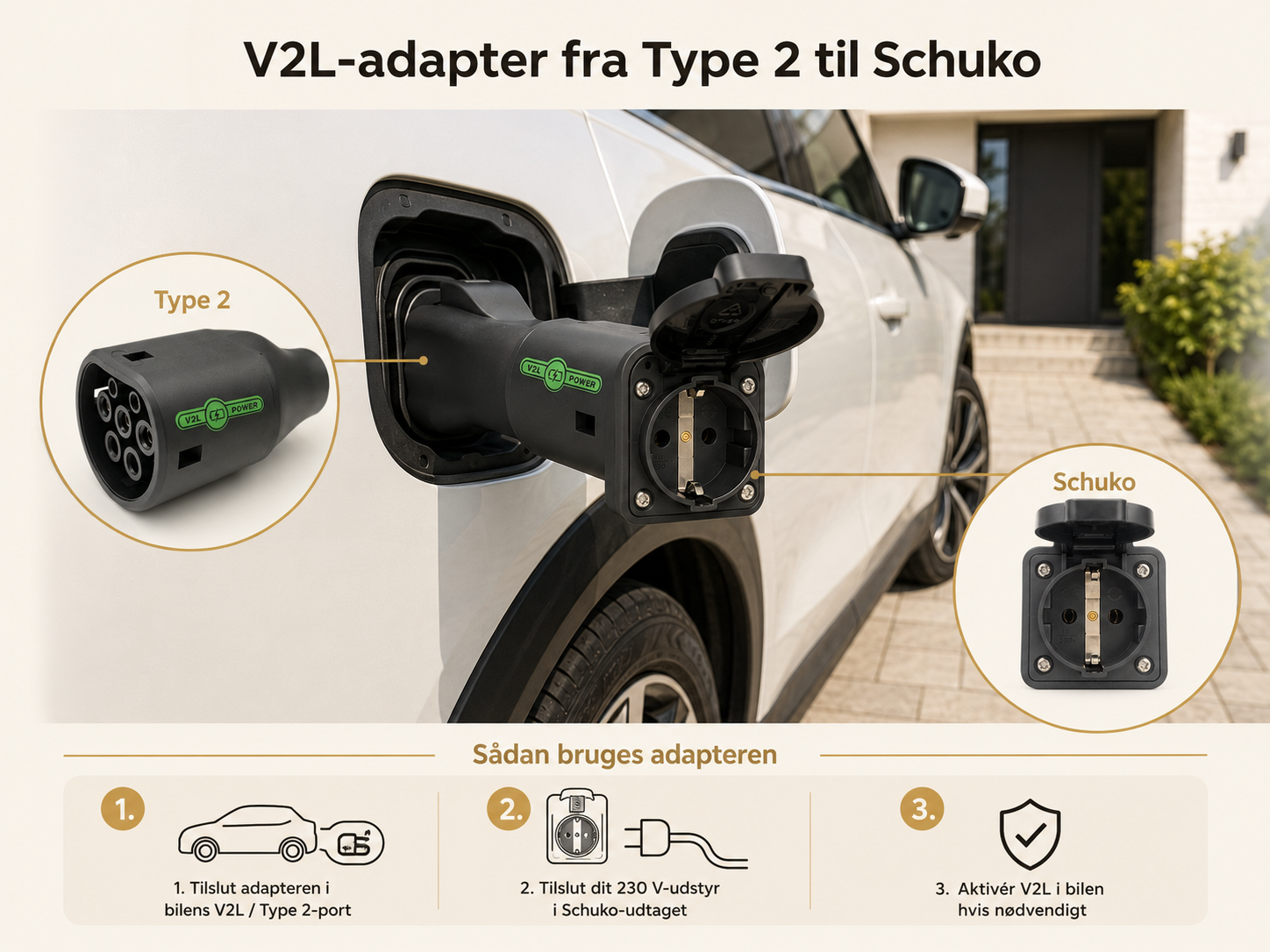
The next check for electric car V2L compatibility is about the plug type. European electric cars primarily use Type 2 (Mennekes) as the AC charging standard. The V2L adapters for these cars have a Type 2 plug on one end and one or several Schuko plugs in the other.
The Schuko plug is the standard Danish 230 V plug that you find in most appliances and extension cords. Make sure your adapter matches your car's plug type exactly. An adapter designed for the CCS2 port will not work in a Type 2 port and vice versa.
Step 3: Confirm power limit and battery capacity
The power limit determines which devices you can power. A limit of 3.6 kW is sufficient for most purposes: camping equipment, small power tools, coffee machines, refrigerators and lamps. The battery capacity determines how long you can use the V2L.
A simple calculation:
Available energy = Battery capacity (kWh) x Charge level (%) Operating time (hours) = Available energy / Device consumption (kW)
Example: Ioniq 5 with 77 kWh battery at 80 % charge = 61.6 kWh available. A 0.15 kW refrigerator can run for over 400 hours. A 1.5 kW circular saw can run for approx. 41 hours. That is real, usable power.
V2L adapter for electric car: types, safety and certification
A V2L adapter is not just a cable. It is an active electronic component that communicates with the car's control system to activate V2L mode. This is exactly where cheap, unknown adapters fail and potentially damage the car's electronics.
Built-in adapter vs. external V2L converter
There are two general approaches to V2L:
Built-in adapter: Plugs directly into the car's charging port and activates the car's own inverter. The car supplies the power. The adapter is just an interface. This solution is model-specific and requires an adapter designed for your exact car model.
External V2L converter: A standalone device that plugs into the car's charging port and contains its own inverter. Used primarily for cars that do not have native V2L support. The effectiveness and safety vary significantly depending on the quality of the manufacturer.
At V2LPower we always recommend choosing certified adapters, that have been tested and approved for the specific car model.
Type 2 plug, Schuko plug and compatibility with your equipment
The Type 2 plug is the European standard for AC charging and the starting point for V2L in most European electric cars. The V2L adapter converts this to one or two Schuko plugs, which correspond to the sockets you have in your home.
Important compatibility points:
- The Schuko plug is compatible with most Danish sockets and appliances
- Extension cords with Schuko plugs can be connected directly
- Devices with grounding plugs require that the adapter is properly grounded
- Medical equipment and sensitive electronic equipment should never be powered via V2L without UPS buffering
According to The IEC standard for vehicle charging and V2X V2L equipment must meet specific requirements for insulation voltage and grounding to ensure user safety.
What can you use V2L for? Practical applications and power consumption calculator
The V2L function covers four primary application areas for Danish users. Here is a practical overview with typical power requirements:
| Application | Typical equipment | Power requirement | Operating time (77 kWh, 80 %) |
|---|---|---|---|
| Camping | Coffee maker, lamps, charger | 0.3-0.8kW | 75-200 hours |
| Emergency power at home | Refrigerator, router, lights | 0.2-0.5kW | 120-300 hours |
| Crafts/professions | Circular saw, drill/screwdriver | 1.0-2.5kW | 25-60 hours |
| Car-to-car charging | Second electric car via Type 2 converter | 2.0-3.6kW | 17-30 hours |
Car-to-car charging is one of the most underrated uses. With a Type 2 charging converter, you can charge another electric car from your own, which is extremely useful in places without charging infrastructure.
V2L – pros and cons: is it right for you?
V2L is not perfect for all situations. Here's an honest assessment:
Advantages:
- No external generator needed for camping or outdoor work
- Real emergency power during power outages without additional installation
- Can charge other electric cars in emergency situations
- Quiet operation compared to gasoline generators
- No fuel costs
Disadvantages:
- Discharge reduces the car's range for subsequent driving
- The power limit of 3.6 kW excludes heavy appliances such as heat pumps and electric ovens.
- Not all car models support the feature
- Incorrect adapters can give error messages or, in the worst case, damage the car.
- V2H and V2G require additional equipment and installation
The biggest misconception is that V2L drains the battery quickly. With sensible consumption and a car with a large battery, this is rarely a problem in practice.
Troubleshooting: electric car V2L compatibility is not working, what do you do?
It's frustrating to be stuck with an adapter in your hand and a car that doesn't respond. Here are the most common causes and solutions, compiled from experiences with Danish electric car owners.
The error message ”V2L conditions not met”: causes and solutions
This error message is the most frequently reported V2L error on the Ioniq 5, EV6, and Genesis GV60. It typically occurs for these reasons:
- The battery level is too low: Most cars require a minimum of 20-30 % charge to activate V2L. Charge the car and try again.
- The car is not in proper condition: V2L is normally only activated when the car is parked and turned on. Check that the car is in P and turned on, but not in a ready-to-drive state.
- The adapter is not communicating correctly: A non-certified adapter may send incorrect signals to the car's control system. Switch to a model-specific, certified adapter.
- Software error: Restart the car completely by pressing and holding the power button, wait 30 seconds, and press again.
- The temperature is too low or high: V2L is automatically deactivated at extreme temperatures to protect the battery. Wait until the vehicle has warmed up the battery.
As described in Hyundai Motor Group's technical documentation for the E-GMP platform, the V2L system is designed with multiple safety layers that can trigger conditional stops to protect the battery and the user.
Battery degradation and V2L: when does it affect performance?
This is the topic that almost no V2L guides touch on. Repeated deep discharge via V2L affects the battery in the same way as any other discharge cycle. The battery's capacity gradually decreases over time, reducing the energy available to V2L.
It's important to put this into perspective though. An electric car with 100,000 km and 10 % capacity loss still has 69.7 kWh available on a 77 kWh pack. That's still massive for most V2L purposes.
Best practices to minimize battery degradation when using V2L:
- Avoid discharging below 20 % via V2L
- Avoid combining V2L use with charging for 100 % daily
- Use V2L primarily in moderate temperature conditions
- Monitor battery health via the car's own diagnostics system or an OBD2 scanner
A good starting point for understanding the condition of the battery is to consult the Danish Electric Vehicle Alliance's guidance on the lifespan and maintenance of electric vehicle batteries, which continuously updates guidance for Danish electric vehicle owners.
The reality is that an average Danish electric car owner who uses V2L sensibly for camping and occasional emergency power will not notice any meaningful difference in the battery over the life of the car.
Frequently Asked Questions
Which electric cars will have V2L functionality in Denmark in 2026?
Several models are sold in Denmark with V2L as standard or optional, including the Hyundai IONIQ 5 and IONIQ 6, Kia EV6 and EV9, Genesis GV60 and certain versions of the BYD Atto 3 and MG4. The feature and power limit vary from model to model, so always check the car's specification sheet or contact the dealer. An updated comparison table can be found in the guide above.
What is a V2L adapter for electric cars and how is it used?
A V2L adapter for electric cars converts the car's direct current (DC) from the electric car battery into 230 V alternating current (AC), which is used by ordinary electrical appliances. The adapter is plugged into either the Type 2 connector of the charging port or into a dedicated V2L socket inside the car. You can then connect equipment via a Schuko plug. Make sure to use a certified adapter that matches your specific car model to avoid error messages and safety risks.
What is the difference between V2L, V2H and V2G?
V2L (Vehicle-to-Load) supplies power directly to electrical appliances via an adapter. V2H (Vehicle-to-Home) connects the car to the house's electrical installation as an external power source and requires special equipment and approval according to Danish installation regulations. V2G (Vehicle-to-Grid) sends excess energy back to the electricity grid and requires a compatible charging infrastructure and an agreement with the grid operator. V2L is the simplest solution and does not require a permanent installation.
How much power can an electric car deliver with V2L?
Most electric cars with V2L deliver between 1.8 kW and 3.6 kW, while some models like the Kia EV9 can deliver up to 3.68 kW. This is equivalent to powering a coffee machine, laptop, lighting or refrigerator without any problems. For heavy appliances such as kettles or fan heaters near the power limit, you should check against the car's maximum kW output before connecting them.
Can V2L be used to charge another electric car?
Yes, car-to-car charging is possible with V2L, but only via an external V2L converter with Type 2 output and low power, typically 1.4-3.6 kW. It is not a replacement for fast charging, but can provide emergency power to another electric car if it runs out of power. Compatibility depends on the charging standard of both cars and the car's software, so check the specifications of both models before trying.
Are there security risks when using V2L, and what do the regulations say in Denmark?
A certified V2L adapter with proper grounding and overload protection is generally safe for outdoor and indoor use. Never use uncontrolled third-party equipment without documented certification. If you want to connect V2L to the house's fixed electrical installation (V2H), it requires an authorized electrician and must comply with the High Current Ordinance and the Danish Safety Technology Authority's regulations. For camping and loose equipment, the requirements are less, but always use approved equipment.
This article was written using GrandRanker

 Danish
  English
  Swedish
  German
  Dutch
Dutch  Norwegian
  Chinese
  French
  Polish
  Italian
  Greek
Greek  Finnish
  Spanish
  Turkish
  Bulgarian
  Czech
Czech  Portuguese
  Bosnian
  Slovak
  Slovenian
  Romanian
  Hungarian
  Lithuanian
  Latvian
  Estonian
  Serbian
  Ukrainian