
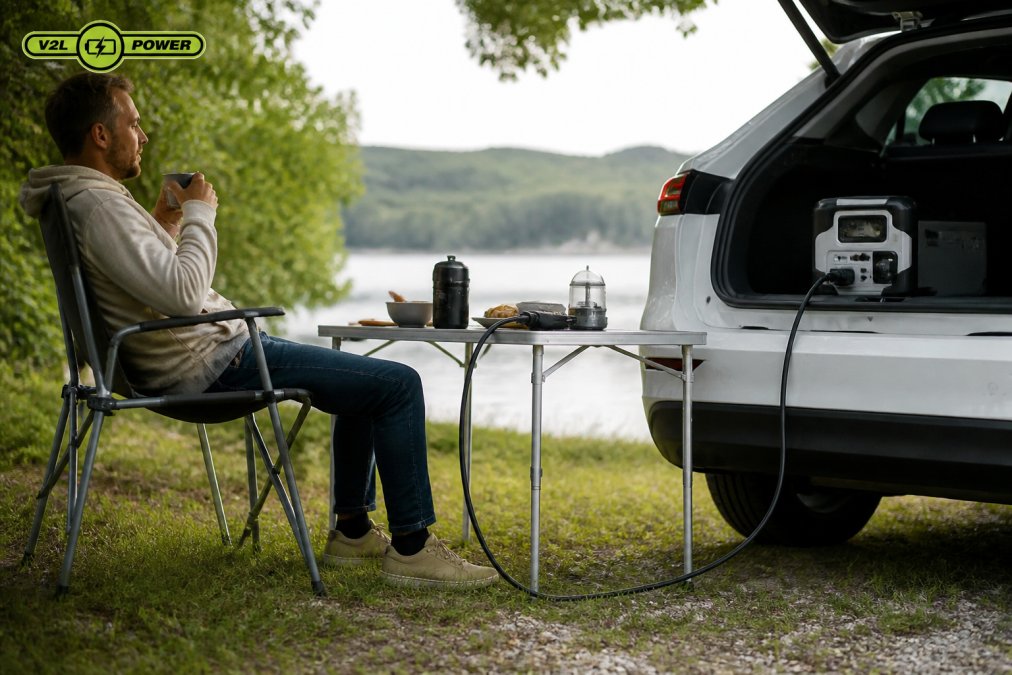
Power from electric car for camping: How to do it
Table of contents
- What is V2L and how does power from electric car to camping work?
- What V2L adapters and equipment do you need for your caravan?
- Power consumption for camping equipment: What can your electric car power?
- Step-by-step: How to connect power from electric car to caravan
- Safety when using V2L for camping and home
- Planning a camping trip with V2L: Route, charging infrastructure and tips
- Conclusion
Last updated: August 12, 2026
What is V2L and how does power from electric cars to camping work ⚡🏕️
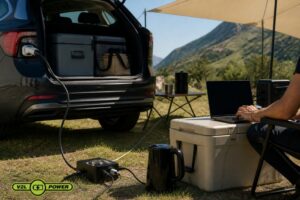
Vehicle-to-Load (V2L) is the technology that allows your electric car to power external devices. The power flows from the car's battery through an adapter to your camping appliances, tools or home equipment. You suddenly have a mobile power source of 230V that can run everything from refrigerators to electric heaters, without being dependent on traditional gas or the mains.
How power from the electric car to your camping appliances works
Your electric car has a built-in on-board charger, which usually converts alternating current from a charging station to direct current to charge the battery. V2L technology reverses this process: it takes energy from the car's battery and converts it back to 230V alternating current that your regular appliances can use.
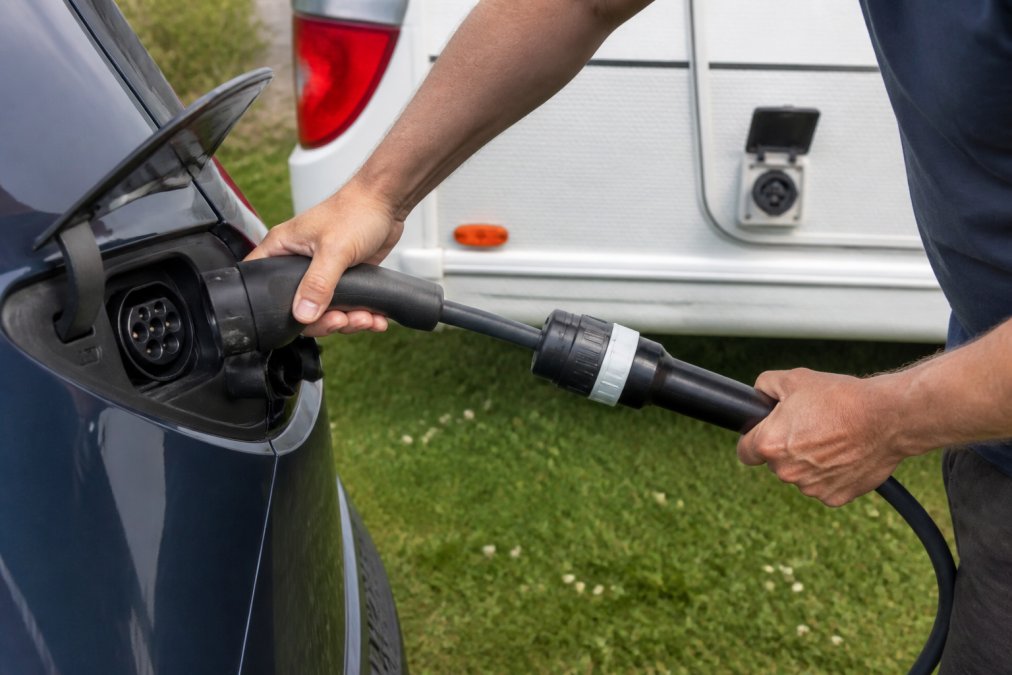
The power flows through a V2L adapter that plugs into the car's Type 2 charging point. The adapter contains electronics that ensure correct voltage, frequency and safety. This process requires the car to be on or in standby mode with V2L enabled. Many electric cars have a dedicated menu where you need to enable the V2L feature before use. V2LPower provides guides for specific car brands so you know exactly how to enable it on your model.
Most electric cars limit the V2L output to around 3.6 kW (16 amps at 230V). This is enough to run several camping appliances simultaneously, but not all at full power. Plan your consumption around this figure.
What V2L adapters and equipment do you need for a caravan 🔌
Adapter types and compatibility with your car model
Not all V2L adapters fit all electric cars. Your car model determines which adapter you need, as the plug type on the charging point varies.
Type 2 connector is the standard in Europe and on most newer electric cars (Tesla Model 3, Volkswagen ID series, Hyundai Ioniq, Kia EV6, BYD, XPeng, etc.). V2L adapters for Type 2 are available in several variants:
-
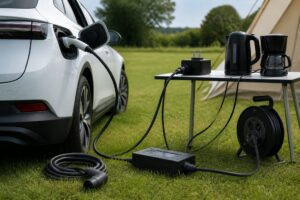
V2L adapter cable (hardwired cable): Connects directly to the Type 2 connector. These are the most common and reliable. V2LPower offers adapter cable for various car brands, such as the models P06, P10, P11 and P12, each designed for specific manufacturers.
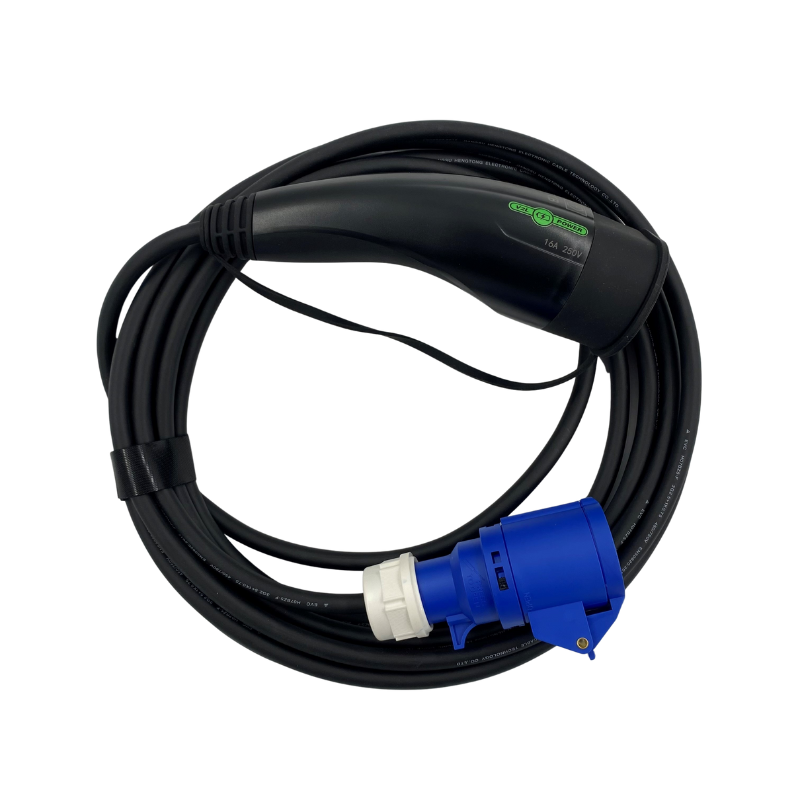
V2LPower – Adapter cable from car to caravan -
Loose V2L cable with adapter: Some solutions consist of a separate cable that you plug into an adapter. These are less stable and more prone to misconnection.
Compatibility is critical. An adapter designed for a Hyundai may not work optimally on a Tesla, even though both use Type 2. Before purchasing, you can check if your car is on V2LPower's compatibility list, this will save you from mistakes.
Cheap V2L adapters from unknown sources can give the error “V2L conditions not met” or even damage the car’s electrical system. Certified adapters like V2LPower’s are tested for safety and work without error messages.
Cables and accessories you need
In addition to the adapter itself, you need the right accessories to use power from your electric car for camping safely.
230V socket or shield: A solid, earthed socket is important. Many campers buy a weatherproof socket that can be mounted on the caravan or left on the ground. It should be rated for outdoor use and have a good degree of protection (at least IP44).
Extension cables: If you cannot park close to the caravan, you will need a strong extension cable. Choose a conductor cross-section of at least 2.5 mm² to avoid voltage drops. A 25-50 meter cable is typically sufficient for most camping situations.
Residual current circuit breaker (RCCB): A residual current device between the adapter and the socket protects you from electric shock. Some adapters have it built in, but it's a smart safety measure.
V2LPower sells complete kits with adapters, cables and accessories so you don't have to assemble parts from different sources.
Power consumption for camping equipment: What can your electric car power 📊
How much electricity does common camping equipment use?
To use EV power for camping smartly, you need to know how much power your appliances use. The V2L output on most EVs is limited to around 3.6 kW (16 amps). Here are typical consumptions for common camping equipment:
| Apparatus | Power consumption (W) | Duration typical |
|---|---|---|
| Refrigerator (12V/230V) | 150-300 | Constant |
| Electric heater | 1.000-2.000 | Hours |
| Water heater | 2.000-3.000 | 30-60 minutes |
| Hotplate | 2.000-3.000 | 30-60 minutes |
| Coffee maker | 1.000-1.500 | 10-15 minutes |
| Laptop/charging | 100-200 | Hours |
| LED light | 10-30 | All night |
| Fan | 50-100 | Hours |
You can't run a 3,000W water heater and a 2,000W refrigerator at the same time, that would exceed the 3.6kW limit. Instead, you should prioritize: turn on the heater first, let it run, turn it off, then the refrigerator can run at full capacity. Many electric cars automatically reduce output if you overload the system.
Battery consumption and range when camping
A typical electric car with a 60 kWh battery (realistic capacity around 55 kWh) has a range of around 300-350 km. If you use 10 kWh for camping overnight, you lose around 30-35 km of range.
Example of energy accounting for a camping night:
- Refrigerator: 5 hours × 200W = 1 kWh
- Charging phones/tablets: 2 × 50W × 4 hours = 0.4 kWh
- LED light: 20W × 8 hours = 0.16 kWh
- Total: about 1.6 kWh for the night
You can camp for about 30-40 nights on a full battery without driving anywhere. If you are going to drive and camp, plan to charge at charging stations along the way.
V2L is perfect for weekend camping where you have time to charge between days. For longer trips without access to charging stations, you need a backup plan.
Step-by-step: How to connect power from electric car to caravan 🔧
Preparation and check before first use
Before you use power from an electric car for camping for the first time, you need to make some important preparations.
Steps 1-4: Check V2L capability, purchase adapter, inspect equipment, and prepare outlet
Not all electric cars support V2L. Most newer models do (Tesla Model 3/Y, Volkswagen ID series, Hyundai Ioniq 5/6, Kia EV6, BYD, XPeng), but check your car's manual or V2LPower's compatibility list. Buy an adapter that suits both your car and your needs. Check for physical damage to the adapter and cables. Prepare an external 230V socket that is grounded and suitable for outdoor use.
Connecting and starting the power supply
Steps 5-10: Parking, activation, connection and testing
Park as close to the caravan as possible. Turn on the car or go to standby mode and find the V2L function in the car's infotainment system (Tesla: Controls > Charging > Power Sharing; Volkswagen ID: Charging > V2L mode; Hyundai/Kia: Charging > Vehicle to Load). Activate V2L. Insert the adapter into the car's Type 2 charging point, it should click into place. Connect the extension cable to the adapter and the socket to the end of the cable. Activate the power by pressing the button on the adapter. Test with a lamp or phone charger first to confirm that power is flowing.
Common errors and error messages
""V2L conditions not met""
This error means that the car does not currently allow V2L. Reasons may include: the car is not in Park/Neutral, the handbrake is not on, the battery is below 20%, V2L is not enabled in the menu, or the adapter is not fully connected. Check each condition and try again.
No power from the socket
Check that the extension cable is fully connected to both the adapter and the socket. Check that the socket itself is not defective. Try activating V2L again in the car menu.
Low power or constant disconnection
You may be using too much power at once, turn off some appliances. The extension cord may be too long or have too small a cross-section, use a shorter or thicker cord.
If the adapter becomes very hot (more than you can hold your hand on), turn off the V2L immediately, let it cool down and contact V2LPower support.
Safety when using V2L for camping and home 🛡️
Protecting your electric car and battery
Your electric car is an expensive investment. V2L technology is safe when used correctly, but there are some important rules to follow.
Do not let the battery run completely flat. If you are using the V2L for camping or home power, do not let the battery go below 10-15%. Using the battery all the way will chemically stress it and shorten its life.
Avoid V2L in extreme heat or cold. Very cold weather reduces battery performance and may prevent V2L from functioning completely. Very hot weather may cause the battery to overheat. Use V2L under normal temperatures (5-35°C).
Monitor the battery condition. If you use V2L regularly, check the battery health status regularly. Most electric cars display the battery health status in the menu.
Use certified adapters. Cheap or unknown V2L adapters can damage the car's electronics or battery. V2LPower's adapters are certified and tested.
Safe operation of camping equipment and appliances
Check the device's voltage tolerances. Most European appliances are designed for 230V, 50 Hz, which is exactly what V2L delivers. Check the manual for the appliance or test it first.
Avoid high-efficiency heating appliances at the same time. Two 2,000W heaters at once = 4,000W, which exceeds the V2L limit of 3,600W. Your system will shut down.
Use a grounded socket. All camping appliances must be connected through a grounded (3-pin) socket. Grounding is important to prevent electric shock.
Protect cables from weather. If you are camping in the rain, make sure the socket and cables do not get wet. Use weatherproof covers around the socket.
Monitor the temperature of the adapter. If the adapter becomes hot during use, it may indicate overload or an internal error. Turn off the V2L and let it cool down.
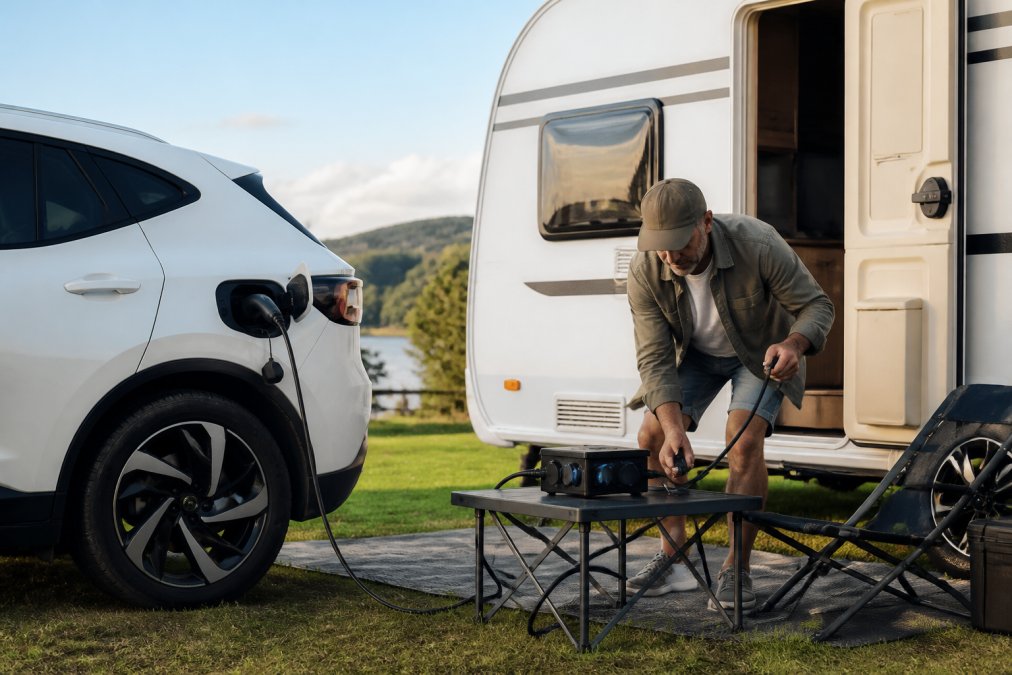
Planning a camping trip with V2L: Route, charging infrastructure and tips 🗺️
Find campsites with charging options
A successful V2L camping trip requires good planning of where to charge the battery. You can't rely on V2L alone for long trips, you need access to charging stations.
Use charging infrastructure apps. Apps like Plugshare, A Better Route Planner (ABRP), and the Danish ChargeGO show all public charging stations in Europe. Plan your daily journeys so that you pass at least one fast charger (22-50 kW) or a slower charger (11 kW) where you can rest for a few hours.
Choose campsites with charging options. Many modern campsites have installed 230V sockets directly at the campsites. Look for campsites that offer "EV charging" or "Type 2 charging". Danish campsites are gradually being equipped with charging stations.
Plan to have 20-30% battery left. When you arrive at a campsite, you should have at least 20-30% battery left. This gives you a safety margin and means the battery is not completely dead if you have to drive away quickly.
Energy accounting and battery strategy for longer trips
For trips longer than 2-3 days, you need to have a strategy for how you will use the battery both for driving and for camping.
Calculate your daily consumption. Make a budget for how much power you use per day for camping: refrigerator (5-8 kWh), charging electronics (0.5-1 kWh), lights and small appliances (0.5-1 kWh). Total about 6-10 kWh per day. If your car has a net capacity of 60 kWh, this means that a day of camping uses about 10-15% of the battery.
Plan charging sessions. For each day of camping, you need at least half a day where the car can charge. A fast charger (50 kW) can give you 30-40 kWh in 30 minutes.
Winter camping challenges. In winter, the range of the 15-20% is less. If you are winter camping: plan shorter daily stages, charge more frequently, use less V2L consumption, and park in places with sun exposure. V2LPower has detailed winter camping guides for different car brands.
Power from your EV to your camping trip is a game-changer for EV owners who love the freedom of being tied to gas or the grid. With the right V2L adapter, proper planning, and an understanding of safety, you can camp for weeks without relying on traditional infrastructure. V2LPower specializes in making V2L technology accessible and safe. Start with a short weekend trip to gain experience, then scale up to longer adventures. Your EV isn’t just transportation, it’s your mobile power source.
Plugshare's guide to EV camping
A Better Route Planner (ABRP) for European EV trip planning
ChargeGO – Danish charging infrastructure guide
Frequently Asked Questions
Can you draw power from an electric car for camping?
Yes, if your electric car supports V2L (Vehicle-to-Load). Power from electric car to camping works by flowing electricity from the car's battery through a V2L adapter to 230V sockets, which can power camping appliances such as a fridge, heating and lights. Not all electric car models have V2L functionality, so check your car model first. With the right V2L adapter for electric cars, you can get reliable power supply without being dependent on the campsite's electricity.
How much power consumption can my electric car handle for camping?
It depends on the battery capacity of your electric car and the power consumption of camping equipment. A typical camping fridge uses 40-100W, heating 500-2000W, and lighting 10-100W. An electric car with a 60 kWh battery can theoretically power small appliances for many hours. However, you should always reserve power for driving. Calculate your needs by adding up power needs and planning charging stops. Power consumption for camping equipment varies greatly, so check the specifications of your appliances before buying.
Which electric cars support V2L technology?
V2L technology is still relatively new. Many newer electric car models from brands like Hyundai, Kia, XPeng, and BYD support V2L. Older models and some other brands do not. You can check your car model on the manufacturer's website or in your owner's manual. If your car doesn't have built-in V2L, some external V2L converters may work with the Type 2 charging connector, but compatibility varies. Check with the manufacturer or a V2L specialist to confirm that your specific model is compatible before investing in equipment.
Is it safe to use power from the electric car battery for camping?
Yes, when you use certified V2L equipment and follow safety guidelines. Modern electric cars have built-in protection that stops V2L operation if the battery gets too low. Certified V2L adapters are designed to protect both your car and your appliances. Avoid running your battery completely flat while camping. Make sure you have power to reach the next charging station. Use only certified equipment offered by V2LPower to ensure safe operation without damaging your car's electrical system.
This article was written using GrandRanker
 Danish
  English
  Swedish
  German
  Dutch
Dutch  Norwegian
  Chinese
  French
  Polish
  Italian
  Greek
Greek  Finnish
  Spanish
  Turkish
  Bulgarian
  Czech
Czech  Portuguese
  Bosnian
  Slovak
  Slovenian
  Romanian
  Hungarian
  Lithuanian
  Latvian
  Estonian
  Serbian
  Ukrainian