
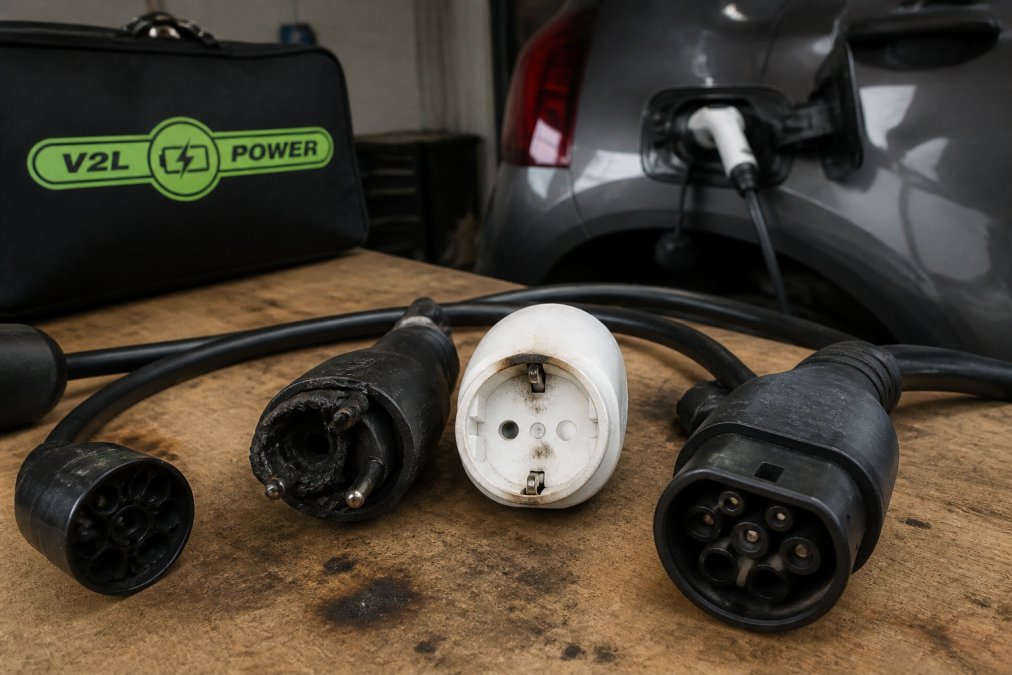
Safety of non-original V2L adapters: What you need to know
Table of contents
- What is V2L and why safety matters
- Risks of cheap V2L adapters: Short circuit, overheating and fire hazard
- CE marking of V2L equipment: How to verify certification
- Original vs. non-original adapter: Quality differences that matter
- Insurance consequences of using non-original equipment
- Compatibility and car manufacturer specifications
- How to choose a secure V2L adapter
- Conclusion
Last updated: August 7, 2026
What is V2L and why safety matters
Vehicle-to-Load (V2L) is the technology that allows you to get power directly from your electric car's battery to external devices. Power flows from the car to the equipment you need, everything from camping gear to tools or emergency power for your house.
Safety of non-original V2L adapters is crucial. A cheap adapter without proper certification can lead to short circuits, overheating or fire hazards. Your car's electrical system is designed to work with specific electronics and safety systems. Non-original equipment risks bypassing these protection mechanisms entirely.
An adapter without CE marking or proper electronic fuse can permanently damage your car's battery or cause an electrical fire. The cost of repairing the electric car's battery system can easily exceed the price of a certified solution.
V2LPower focuses on safe, certified solutions, because this technology is only worth using when you can be sure that your vehicle and your equipment are protected. A certified adapter is not a luxury, it is a necessity.
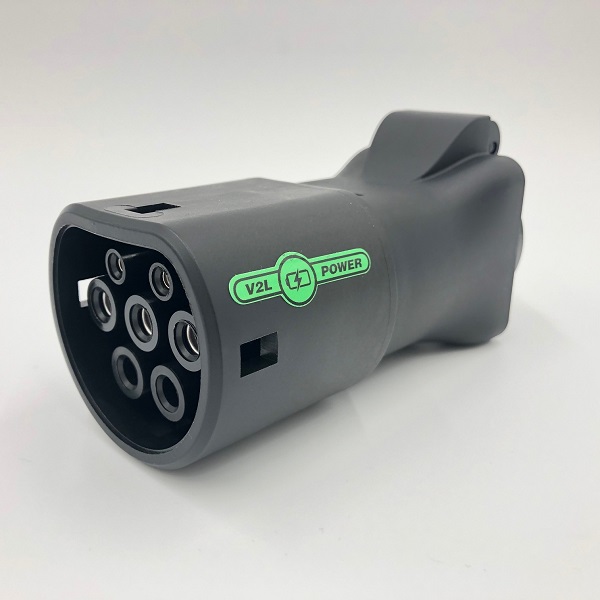
Risks of cheap V2L adapters: Short circuit, overheating and fire hazard
Cheap V2L adapters without proper certification pose real risks. It's not just that they might not work, but that they could damage your vehicle or cause dangerous situations.
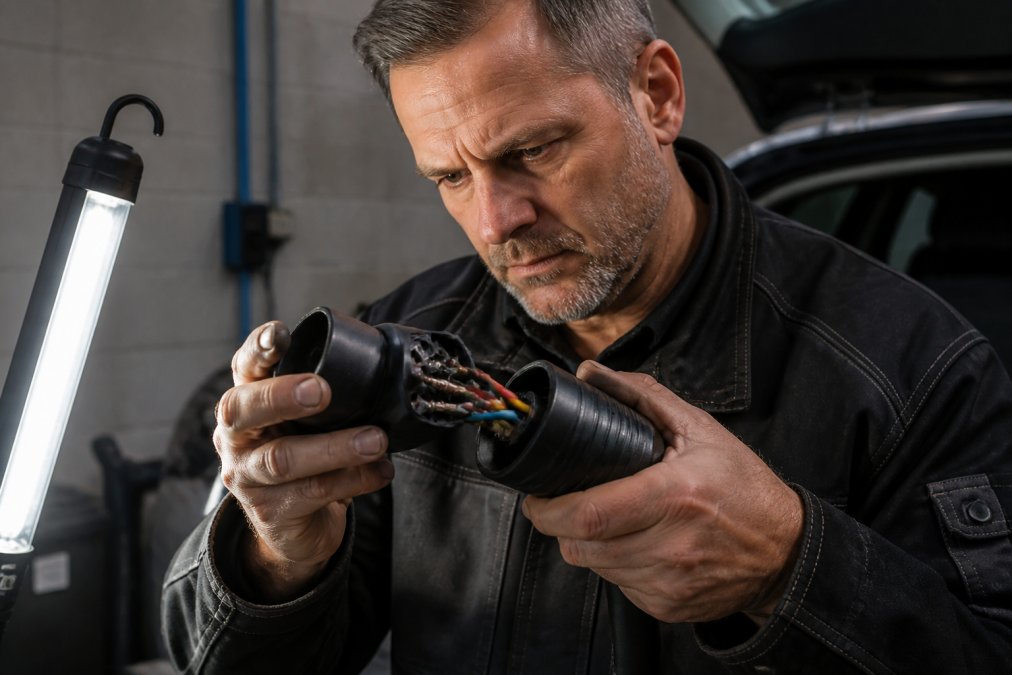
Weakness in fuse vs. electronic fuse
Many cheap adapters use simple fuses as their only protection. A fuse is passive and only blows when the current gets too high, after the damage has already occurred.
Original and certified adapters use electronic fuses that react in milliseconds before problems can occur. Electronic fuses can also reset themselves, whereas a fuse must be replaced. A non-original adapter without electronic fuses is like driving without airbags.
Insulation resistance and short circuit protection
Cheap adapters often use cheaper insulation materials. Over time, especially in humid environments, the insulation can become damaged, leading to short circuits between live parts and a fire hazard. A certified adapter with proper insulation resistance is designed to withstand these conditions for years.
Electronic fuses react in milliseconds faster than fuses and prevent damage before it happens. Cheap adapters without electronic fuses are a fire hazard.
CE marking of V2L equipment: How to verify certification
The CE marking means that the product has been tested and meets European safety standards, including EN 61851-1 and EN 61010-1. However, the CE marking is only as valuable as the notified body that approved it.
The problem: CE marks are not difficult to counterfeit. Many cheap adapters claim to have the CE mark without having undergone testing. A fake CE mark may be printed on the packaging without supporting documentation and approval from a notified body.
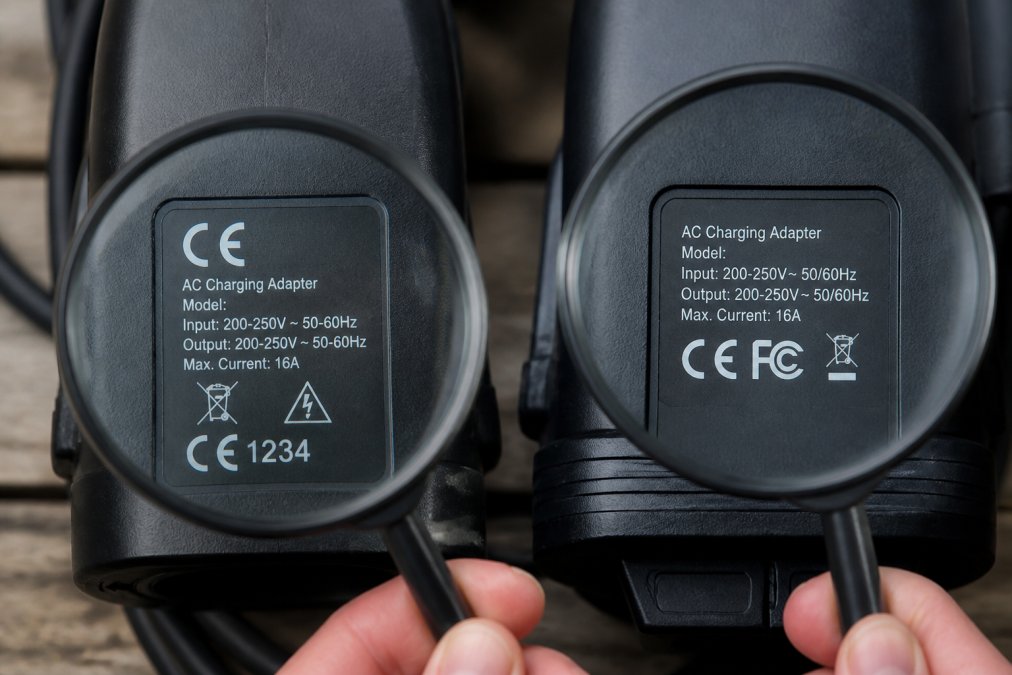
How to identify a genuine Notified Body code
A genuine CE mark must have a notified body code, a 4-digit number that identifies the testing laboratory that approved the product. This code is registered with NANDO (New Approach Notified and Designated Organisations), the official database of all notified bodies in the EU.
Examples of notified bodies that test electrical equipment:
- DEKRA (Germany, code 0344)
- TÜV Rheinland (Germany, code 0197)
- Intertek (UK/EU, code 0359)
- DNV GL (Norway/EU, code 0434)
If the adapter has a CE mark without a 4-digit code, or if the code cannot be found in the NANDO database, the mark is fake.
Concrete signs of false or missing certification
Counterfeit CE marks often have these characteristics:
- The label is printed on the packaging, but not physically printed on the adapter itself.
- There is no notified body code or the code is unknown.
- The label is poorly printed or blurry.
- The manufacturer cannot provide technical test reports or EU declaration of conformity
- The adapter is sold from unknown online marketplaces without customer support
Genuine certification includes:
- The CE mark is permanently printed on the adapter
- A 4-digit Notified Body code is visible
- The manufacturer has a EU Declaration of Conformity accessible
- The user manual is in Danish or English with safety warnings.
- There is a physical address and contact information for the manufacturer or importer in the EU
How to verify a Notified Body code
If the adapter has a 4-digit code, you can verify it on the NANDO database. Search for the code and see which directives the body in question is notified to. If the code is not found or if the body is not notified for electrical safety, the certification is not valid.
A genuine CE mark must have a Notified Body code which can be verified in the NANDO database. If the code is missing or cannot be found, the adapter is not certified.
Requirements for documentation from the manufacturer
A serious manufacturer must be able to demonstrate:
- EU Declaration of Conformity (in Danish or English)
- Technical specifications for voltage, current, fuse and temperature limits
- Test reports from the notified body
- Instructions for use with warnings
- Warranty conditions and customer support contact
If the manufacturer cannot present these documents, the product is not properly certified.
Original vs. non-original adapter: Quality differences that matter
The difference between an original and a non-original adapter is about craftsmanship, component quality and fuse.
An original or certified third-party adapter is built with:
- Quality components: Cables with proper insulation, connectors with gold plating
- Electronic fuse: Microcontroller-based protection that monitors current, voltage and temperature
- Thermal design: Cooling through proper ventilation
- Redundant protection: Multiple layers of security
A cheap non-original adapter typically has:
- Simple fuses: Passive protection that only works when it's too late
- Cheap cables: Thin, poorly insulated
- No thermal design: Adapter gets hot without cooling
- No redundancy: If the fuse fails, there is nothing to stop the current
Plug connections and long-term durability
The plug connections are where many cheap adapters fail first. The Type 2 plug should handle many insertions without losing contact or getting corrosion.
An original connector has gold-plated or nickel-plated contacts, tight tolerances and proper mechanical design. A cheap adapter often has bare copper, loose tolerances and a weak locking mechanism.
Over time, this means that a cheap adapter becomes less reliable, while a certified adapter maintains its quality for years.
A connector that feels loose or cheap probably is. A good adapter feels solid and well-made.
Insurance consequences of using non-original equipment
If something goes wrong using a non-original adapter, it could affect your car insurance and your compensation rights.
Most Danish car insurance policies cover faults under normal operating conditions. However, if you use non-original or non-certified equipment and damage occurs, the insurance company may have grounds to deny or reduce coverage.
How insurance companies assess V2L-related damages
When you file a claim for electrical fire or battery damage, the insurance company will investigate the cause. If the damage was caused by a cheap, uncertified adapter without proper fuse protection, the insurance company may deny coverage based on unapproved equipment or negligent use clauses.
Specific examples of insurance denial
Scenario 1: Electrical fire caused by poor insulation
A cheap V2L adapter without proper insulation causes a short circuit and fire in the engine compartment. The insurance company finds that the adapter was not CE marked and denies coverage.
Scenario 2: Battery damage from improper voltage regulation
A cheap universal adapter does not communicate properly with the car's control system and causes permanent loss of capacity. The insurance company reduces the compensation by 40%.
Scenario 3: Fire risk and liability insurance
If a cheap adapter causes a fire that spreads to the neighboring car, you could be personally liable. Your liability insurance may refuse to cover it.
What insurance companies are looking for
When the insurance company investigates a V2L-related claim, they will:
- Physically inspect the adapter for CE marking and Notified Body code
- Request a receipt and product information
- Contact the manufacturer
- Compare with original equipment
- Assess electronic security
How to protect yourself
Use certified equipment from well-known manufacturers: An adapter with a CE mark from a reputable manufacturer meets European safety standards. This makes it difficult for the insurance company to deny coverage.
Save documentation: Keep the receipt, product description, CE certification and instructions for use.
Contact your insurance in advance.: Ask if they cover V2L equipment and what requirements they have for certification.
Avoid universal adapters: Adapters that claim to work with "all cars" are often not designed to communicate properly with specific car systems.
A cheap, uncertified adapter can not only damage your vehicle, it can also make you personally liable for damages and cause your insurance to deny coverage. A certified adapter is an investment in both safety and legal protection.
Compatibility and car manufacturer specifications
Not all electric cars support V2L. Among those that do, there can be important differences in how the system works.
A V2L adapter must be specifically designed for your car model. If the adapter does not match car manufacturer specifications for voltage output, current limitation, connector type and communication protocol, it will either not work or may damage the car's electronics.
Cheap universal adapters often claim to work with "all cars." This is almost never true. A universal adapter without proper electronics to communicate with the car's control system can cause error messages or cause the car's safety system to shut down completely.
V2LPower produces its own guides, video tests and technical articles for specific car brands and models with a focus on correct compatibility, safety and practical use, because compatibility requires knowledge of each car's electrical architecture.
How to choose a secure V2L adapter
When choosing a V2L adapter, look for:
1. Certification first: Look for CE marking from a notified body.
2. Specific car compatibility: The adapter must be designed for your specific car model, not "universal".
3. Electronic fuse: Electronic fuse with temperature monitoring and current limitation, not just fuses.
4. Quality materials: Cables with proper thickness, connectors with metal coating.
5. Documentation and support: A reputable manufacturer can provide technical specifications, instructions for use, and customer support.
6. Manufacturer reputation: Check reviews and customer feedback for complaints about overheating or errors.
7. Value for money: A safe, certified adapter costs more than a cheap one. It's worth it.
Frequently Asked Questions
What are the biggest risks of using non-original V2L adapters?
Counterfeit V2L adapters often lack proper short circuit protection, which can lead to overheating, plug failure and potential fire hazards. Many cheap alternatives have insufficient insulation resistance and weak fuses that cannot handle surges. This can damage both the adapter and the car's charging port, as well as pose a risk to the user.
How do I verify CE marking on a V2L adapter?
Genuine CE marking must be physically printed on the adapter or in the accompanying documentation. Check that the marking is spelled correctly (CE, not ce) and that a European declaration of conformity is included. Contact the manufacturer directly if you are in doubt. Original adapters from car manufacturers or certified specialists like V2LPower always have documentation ready.
Can a non-original V2L adapter damage my car's battery management system?
Yes. Non-genuine adapters without proper electronic fuses and power management can send irregular voltages to the vehicle's control systems. This can trigger fault codes, permanently disable the V2L function or, in the worst case, damage the battery management system (BMS). Certified adapters have built-in protection against such problems.
What does it mean for my insurance if I use non-original V2L equipment?
Many Danish insurance companies consider the use of non-original accessories as self-inflicted damage, which may result in a denial of compensation. If a fire or electrical damage occurs due to non-original equipment, the insurance may refuse to cover it. Always check your insurance company's conditions and only use certified equipment to maintain full coverage.
Choosing a V2L adapter is ultimately about protecting your investment in your electric vehicle. A certified, original adapter, or a high-quality certified third-party adapter, gives you peace of mind. You can use your car to power equipment without worrying about short circuits, fire hazards, or insurance issues. This is not an area where you should skimp on money. Read our V2L guide to learn more about safe V2L use and find the right solution for your specific electric vehicle.
This article was written using GrandRanker



 Danish
  English
  Swedish
  German
  Dutch
Dutch  Norwegian
  Chinese
  French
  Polish
  Italian
  Greek
Greek  Finnish
  Spanish
  Turkish
  Bulgarian
  Czech
Czech  Portuguese
  Bosnian
  Slovak
  Slovenian
  Romanian
  Hungarian
  Lithuanian
  Latvian
  Estonian
  Serbian
  Ukrainian