
Best V2L Adapter for Electric Car: Complete Guide 2026
Table of contents
- What is Vehicle-to-Load (V2L)?
- How does V2L technology work in practice?
- Best V2L Adapters: Choices by Car Brand and Needs
- Power from electric car for camping: Practical applications
- V2L vs V2H: Key Differences and Choices
- Security, battery drain, and compatibility
- How to choose the best V2L adapter for your electric car
- Conclusion
Last updated: August 6, 2026
What is Vehicle-to-Load (V2L)?
Vehicle-to-Load (V2L) is the technology that allows you to draw electrical power directly from your electric vehicle to external appliances and equipment. Instead of charging the battery, the energy flows out of the vehicle through an adapter or converter to your tools, camping gear, household appliances or other electrical devices.
V2L transforms your electric car into a mobile power source. It is not the same as V2H (Vehicle-to-Home), which connects your car to your house's electrical system. With V2L you get flexibility without installation - you can use the power anywhere, as long as you have an adapter and a socket.
V2L does not require any modification to your home electrical system. It is a plug-and-play solution that works with your car's existing battery and charging port.
For electric car owners, this means virtually unlimited access to power while camping, at work, or when you need backup power. The technology is suitable for everything from caravans to handyman tools – as long as your appliance consumption does not exceed your adapter’s maximum output.
The Danish Energy Agency's guidance on electric cars and home charging
How does V2L technology work in practice?
The V2L system consists of three main elements: your electric car's battery and charging port, the adapter or converter, and the external device you want to power.
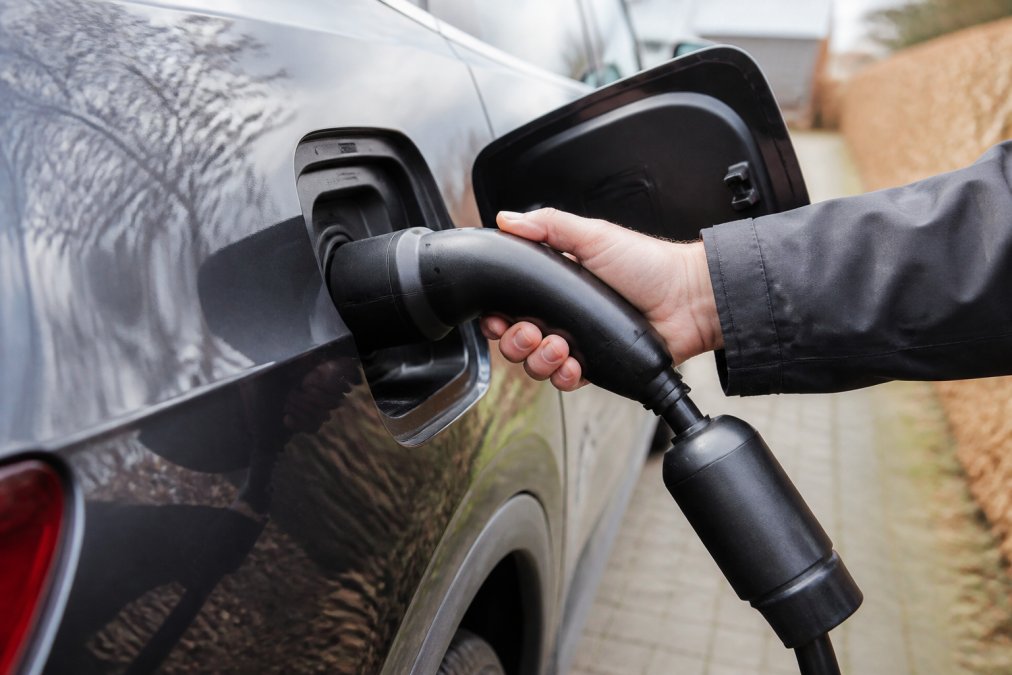
When you plug a V2L adapter into your car's Type 2 charging port, you activate a one-way power path. The battery in your car sends electrical current through the adapter, which converts it to 230V AC power – exactly the same as a regular wall socket at home. This power can then power everything from coffee makers to power tools.
The process is safe because it is controlled by the car’s own electronic control system. The car constantly verifies that the conditions for V2L are met – including that the engine is off, the battery has sufficient charge, and the temperature is within safe limits. If something goes wrong, the system automatically cuts off the power.
V2L only works when your car is parked. Power flows from the car battery through the adapter to your devices – never the other way around.
The power is drawn from your EV battery, meaning that every kilowatt-hour you use for external devices reduces your range. A typical EV can deliver between 3.6 kW and 11 kW, depending on the adapter type and the vehicle's capacity. Most V2L adapters you buy separately max out at around 3.6 kW (16 amps at 230V).
Best V2L Adapters: Choices by Car Brand and Needs
V2LPower solutions: Flexibility for all electric cars
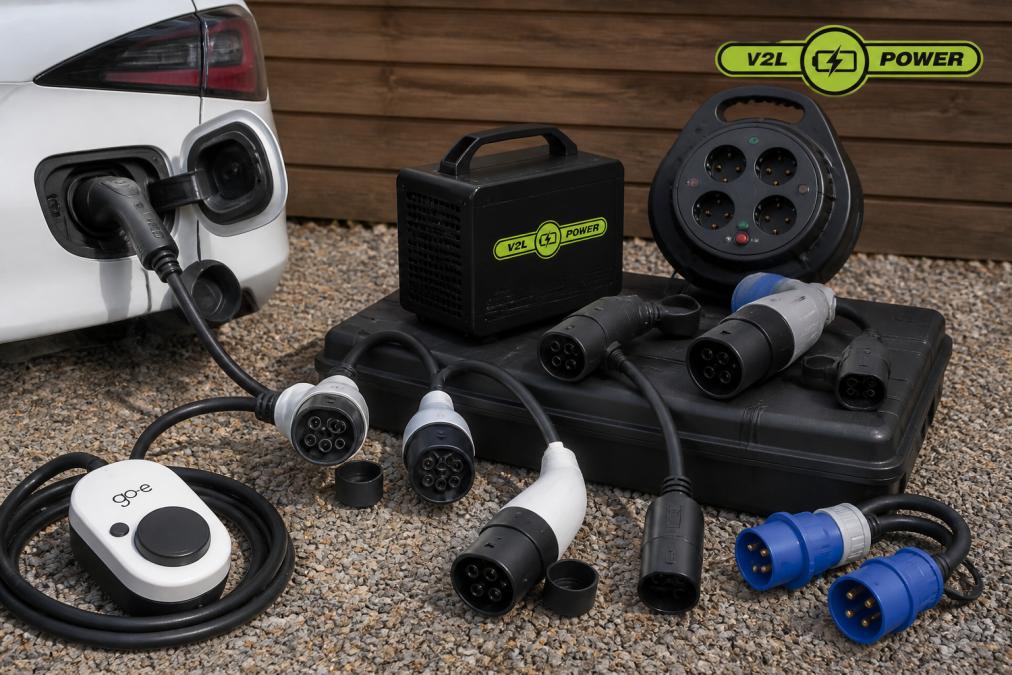
V2LPower offers specialized V2L converters designed to work safely across different electric vehicle brands. Their solutions include both external converters and Type 2 adapters, allowing you to use your electric vehicle as a power source, no matter what car you own.
The main advantages of the V2LPower systems are the precise focus on compatibility and certification. Each adapter is tested against specific car models to ensure that it works without error messages such as "V2L conditions not met". V2LPower also produces guides and video tests for specific car brands.
Their Type 2 adapters start at 799 kr, making them a cheap entry point for those who want to test V2L. If you want a complete car-to-home solution with higher power, V2LPower also offers inverters for around DKK 10,000-13,000, depending on the model.
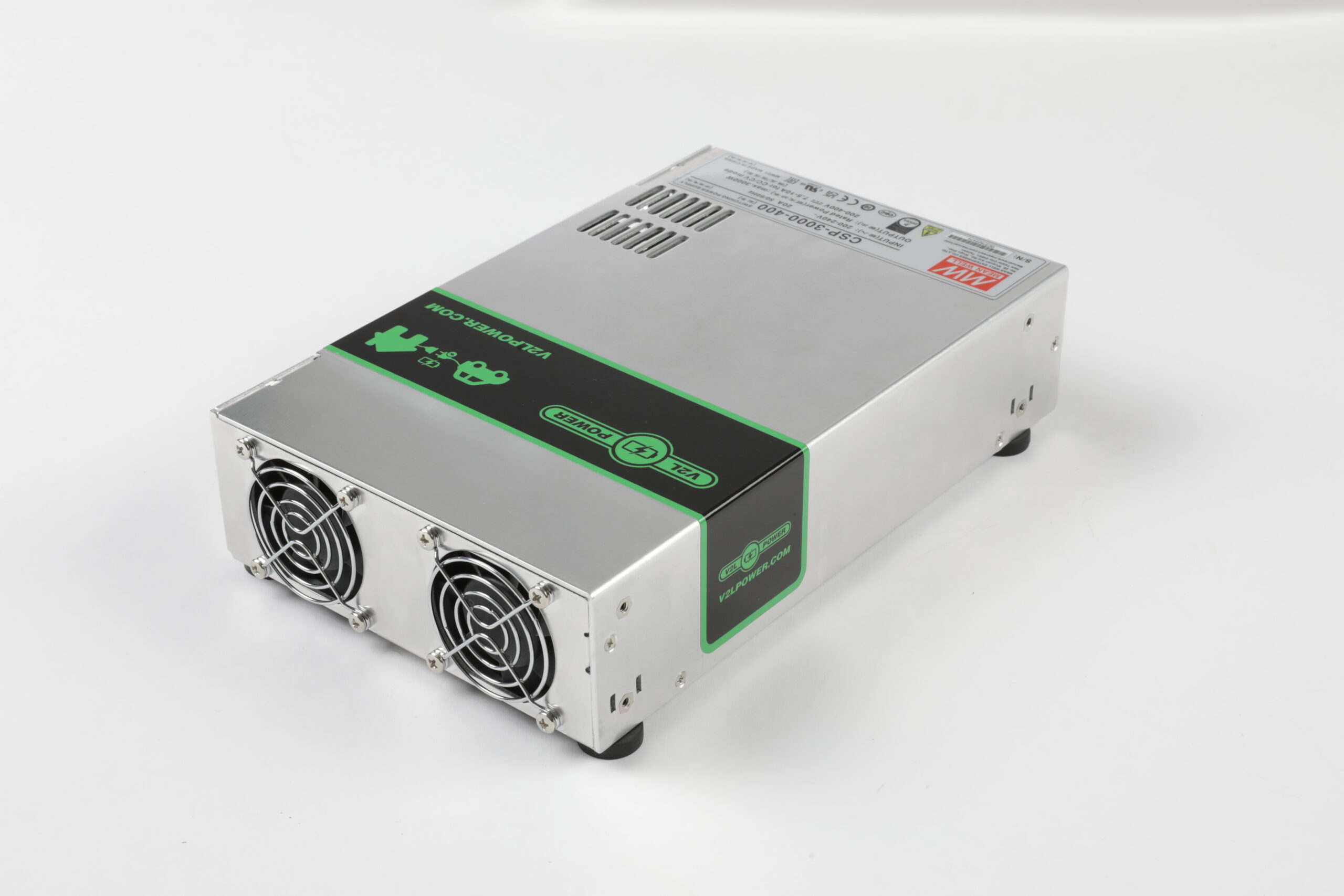
V2LPower is best suited for electric car owners who want certified compatibility without guesswork, as well as for those who require technical support at a Danish or European level.
Type 2 Adapters: Cheap Entry to V2L
A Type 2 adapter is the most economical way to get started with V2L. It plugs directly into your car's Type 2 charging port and converts the power to a standard 230V Schuko plug.
These adapters typically cost between 700-1,200 DKK and deliver around 3.6 kW (16A) of power. The advantage is simplicity – you plug it in and you get power. The disadvantage is that compatibility can be uncertain across car brands. Some cars accept all Type 2 adapters without problems; others display error messages or refuse to deliver power.
Type 2 adapters work best if your car has a known, well-tested adapter type. For Kia EV6, Hyundai Ioniq 5 and similar models with standardized V2L functionality, they are reliable. For less common models or older cars, you may run the risk of compatibility issues.
Cheap generic Type 2 adapters from unknown manufacturers can be risky. If the adapter does not communicate properly with the car's control system, it can result in malfunctions or even damage to the charging port's electronics.
Original factory-fitted adapters: Safety and warranty
Some car brands such as Kia, MG and Hyundai offer official V2L adapters designed specifically for their models. The Kia EV6's original adapter costs around DKK 2,500, while MG's V2L adapter is around DKK 4,900.
The advantage of original adapters is guaranteed compatibility and a full warranty. The manufacturer has tested the system thoroughly, and if something goes wrong, there is a warranty. In addition, the quality and safety standards are typically higher than generic solutions.
The downside is the price. Original adapters are significantly more expensive than Type 2 adapters, and they only work with the specific car model they are designed for. If you change cars, you cannot reuse the adapter.
Power from electric car for camping: Practical applications
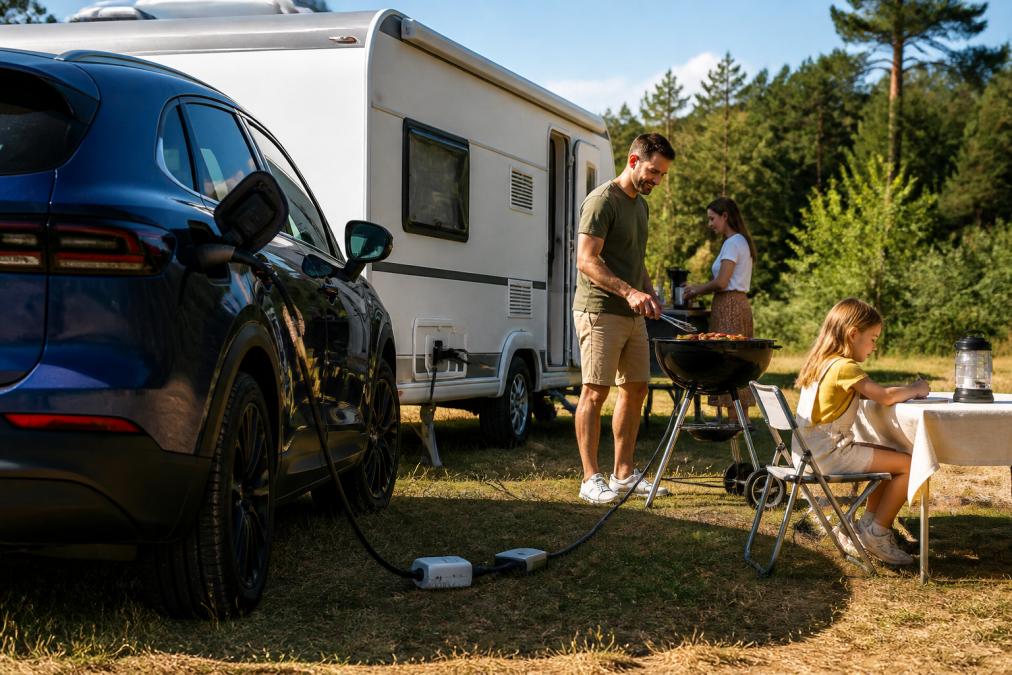
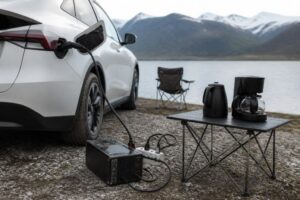
V2L opens up completely new possibilities for campers, motorhome owners and outdoor enthusiasts. Instead of being dependent on the campsite's power connection or a noisy petrol engine, you can use your electric car's battery to power everything from a fridge to lamps.
A typical camping trip could look like this: You arrive at the campsite, plug in your V2L adapter, and can now run a 2,000W electric grill, charge your devices, and run a smaller electric heater without relying on the campsite infrastructure. An electric car with a 60 kWh battery can theoretically power a caravan for several days, depending on consumption.
Craftsmen and service companies use V2L to power electric tools on construction sites without access to fixed power. A drill, grinder or other craftsman equipment can be run directly from the car battery, making the workflow more flexible.
Homeowners use V2L as backup power during power outages. If the grid goes down, you can use your electric car to power critical appliances like a refrigerator, internet router, or medical equipment for hours or days.
The main limitation is power consumption. An electric furnace or large air conditioner uses more power than the V2L can supply. However, for most camping appliances, tools and household equipment under 3,600W, the V2L is perfectly adequate.
V2L vs V2H: Key Differences and Choices
V2L (Vehicle-to-Load) means that power flows from your car to external devices wherever you are. You use an adapter, plug it into the car's charging port, and get power from a regular outlet. It requires no installation and works anywhere.
V2H (Vehicle-to-Home) means that your car is permanently connected to your home's electrical system. Power can flow from the car's battery to your home during power outages or to take advantage of cheap night-time electricity. V2H requires professional installation, a dedicated wallbox, and communication between the car, home, and utility company.
| Aspect | V2L | V2H |
|---|---|---|
| Installation | None – plug and play | Professional installation required |
| Price | 800-13,000 DKK. | 25,000-50,000+ kr. |
| Flexibility | Can be used anywhere | Only at home |
| Effect | Typically 3.6 kW | Up to 11kW |
| Guarantee | Often covered by adapter manufacturer | Often covered by installer |
| Complexity | Simple – plug and play | Complex – requires an electrician |
For most electric car owners, V2L is the right choice if you need mobile power for camping, tools or backup. V2H is relevant if you want to fully integrate your car's battery into your house's energy system and save on electricity costs.
The Danish Energy Agency's guidance on V2H and smart charging
Security, battery drain, and compatibility
Safety is the most important thing to understand when using V2L. Your electric car battery is designed to deliver power in a controlled manner. When you connect a V2L adapter, the car's management system automatically verifies several parameters: battery temperature, remaining charge, engine status, and system health.
If something is wrong – for example, if the battery is too cold, if the charge is below a critical threshold, or if an error is detected – the car will simply refuse to supply power. The system is designed to be fail-safe. You cannot accidentally damage your battery by using V2L incorrectly.
Excessive use of V2L can affect your battery in the long term. Constantly using V2L to completely discharge the battery, or using it in extreme temperatures, can reduce battery life. Use V2L in moderation – do not let the battery drop below 10-20% charge.
Battery drain is another important consideration. Every kilowatt-hour you use for external devices comes from your electric car battery. A camping trip where you use 5 kW over several hours can reduce your range by 50-100 km. This is completely normal and not harmful – it’s just energy you’re using.
Compatibility can be tricky. Not all electric cars support V2L. Tesla, BMW i3, and older Nissan Leaf models do not have V2L functionality. Among the cars that do support it are the Kia EV6 and EV9, Hyundai Ioniq 5 and Ioniq 6, MG4, BYD Yuan Plus, and several others. Each model has its own adapter type and amperage requirements.
A bad adapter can cause error messages or even damage the charging port electronics. That's why it's important to buy adapters from manufacturers that have thoroughly tested compatibility. V2LPower's Type 2 adapters are tested against specific car models - this gives you the assurance that the adapter will work properly without damaging your car.
How to choose the best V2L adapter for your electric car
Step 1: Check if your car supports V2L. Check your car's manual or manufacturer's website. If your car is not on the list of V2L-compatible models, you won't be able to use V2L - no matter which adapter you buy.
Step 2: Find your car's adapter type. Most electric cars use the Type 2 charging port standard, but some (notably Tesla) use other plug types. If you're not sure, contact your car manufacturer or read your manual.
Step 3: Assess your power needs. If you will primarily be using the V2L for camping and small appliances, a standard 3.6kW Type 2 adapter will suffice. If you will be powering larger tools or entire caravans, consider a higher-capacity inverter.
Step 4: Choose between Type 2 adapter and complete converter. Type 2 adapters are cheap (800-1,200 DKK) but can have compatibility issues. Complete converters from V2LPower or other manufacturers are more expensive (10,000-13,000 DKK) but offer higher power and better compatibility.
Step 5: Buy from a manufacturer that offers support. Choose a supplier that offers technical support, video tutorials for your specific car model, and has thoroughly tested the adapter. V2LPower is among the few manufacturers that offer Danish support and model-specific tutorials.
Step 6: Test the adapter at home first. When you receive the adapter, test it on a known device – such as a lamp or charger – before using it for camping or work. If error messages occur, contact the manufacturer immediately.
| Selection criterion | If you want | Recommendation |
|---|---|---|
| Lowest price | Cheapest possible solution | Type 2 adapter from a well-known manufacturer |
| High capacity | 6-11 kW power | Complete V2L converter from V2LPower |
| Best compatibility | Safety without fail | V2LPower tested for your car model |
| Mobile flexibility | Use V2L in many places | Type 2 adapter – takes up minimal space |
| Professional use | Tools on construction sites | Higher-capacity converter |
Danish Electric Vehicle Union's guidance on V2L and practical use
Conclusion
V2L technology allows you to use your electric car as a mobile power source – whether you’re camping, working on a construction site, or needing backup power during power outages. The technology is safe when used correctly, and it opens up completely new possibilities for electric car owners.
Choosing the best V2L adapter depends on your car, your power needs, and how often you plan to use it. Type 2 adapters are cheap and simple for hobby users. If you want higher capacity, better compatibility, or professional use, a complete inverter from V2LPower is a safer choice.
V2LPower specializes in helping Danish electric car owners get the most out of their V2L options. With certified adapters, model-specific guides and free European support, you can be sure that your V2L solution will work safely and reliably. Whether you want a cheap Type 2 adapter to test or a complete car-to-home converter, V2LPower offers solutions designed for your exact car model. Read our V2L guide to find the right adapter for your electric car.
Frequently Asked Questions
Can all electric cars use a V2L adapter?
No, not all electric cars support the V2L feature. Only newer models from brands such as Kia, Hyundai, MG, BYD, Xpeng, Smart, Renault and Peugeot have built-in V2L capability. Before purchasing a V2L adapter, check your car's manual or contact the manufacturer to confirm compatibility. V2LPower offers model-specific guides and support to ensure proper setup.
What is the difference between V2L and V2H?
V2L (Vehicle-to-Load) supplies power from your electric vehicle to external devices via an adapter or cable, typically up to 3.6 kW. V2H (Vehicle-to-Home) is a permanent installation that connects your electric vehicle to your home's electrical system and can provide significantly higher power to your entire home during power outages. V2H requires professional installation and is more expensive, while V2L is portable and flexible.
How much power can a V2L adapter deliver?
Most V2L adapters deliver between 3.6 kW and 4 kW (16-18 amps at 220V). This is enough to power camping equipment, tools, coffee makers, and other common electrical appliances. Some solutions, like V2LPower's car-to-home systems, can deliver higher power. Always check your electric vehicle's specifications and the adapter's maximum output power before purchasing.
Does V2L use affect my electric car's battery and range?
Yes, when using V2L, your electric car battery will gradually discharge. A typical day of camping with moderate power consumption can reduce range by 10-20 percent, depending on how much power you draw. Modern electric cars have safety circuits that prevent overdischarge. V2LPower recommends keeping at least 20 percent battery remaining to ensure sufficient range to reach a charging station.
Are V2L adapters universal or do I need to buy one for my specific car model?
It depends on the adapter type. Type 2 adapters work on most electric cars with a Type 2 charging port and V2L support, but not all. Original factory-fitted adapters from car manufacturers (like Kia or MG) are only compatible with their own models. V2LPower offers both universal solutions and model-specific adapters. Always check compatibility before purchasing, or contact V2LPower support for guidance.
This article was written using GrandRanker


 Danish
  English
  Swedish
  German
  Dutch
Dutch  Norwegian
  Chinese
  French
  Polish
  Italian
  Greek
Greek  Finnish
  Spanish
  Turkish
  Bulgarian
  Czech
Czech  Portuguese
  Bosnian
  Slovak
  Slovenian
  Romanian
  Hungarian
  Lithuanian
  Latvian
  Estonian
  Serbian
  Ukrainian