
V2L Converter for Business: The Complete Guide 2026
Table of contents
- What is a V2L converter and how does it work for businesses?
- V2L compatible electric cars list: which models support commercial outlets?
- Industry-specific use cases: who benefits most from V2L?
- Security when using V2L: what business customers need to know
- Setting up V2L converter for business: step by step
- Financial ROI calculation: what does your company save with V2L?
- Legislation, insurance and liability for commercial V2L use in Denmark
- Conclusion: V2L as a mobile power source is an obvious business choice
Last updated: August 5, 2026
What is a V2L converter and how does it work for businesses?
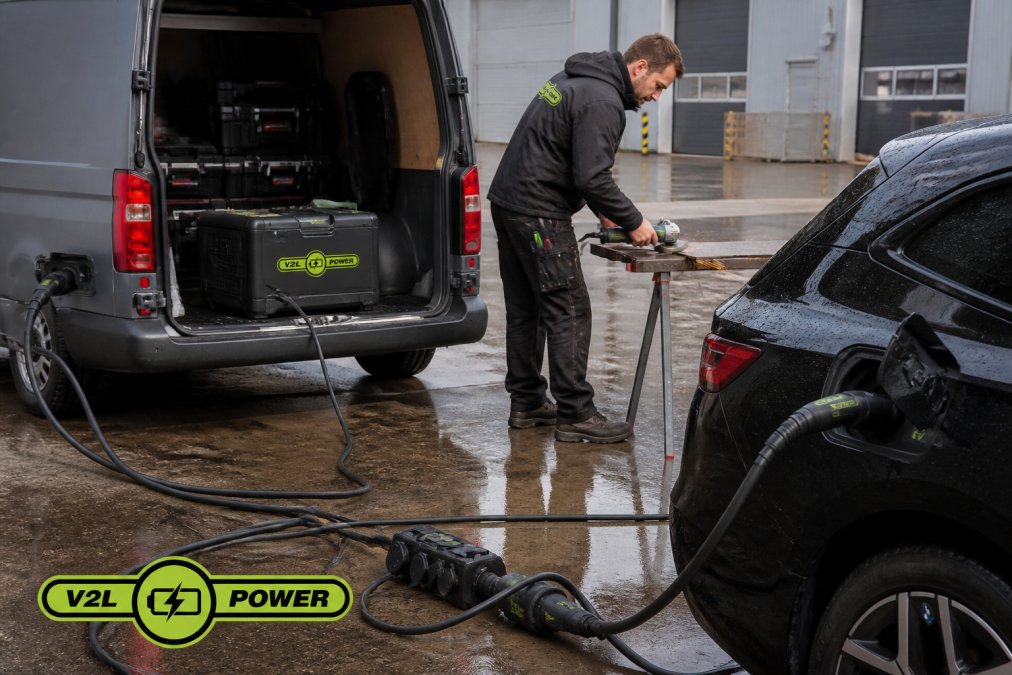
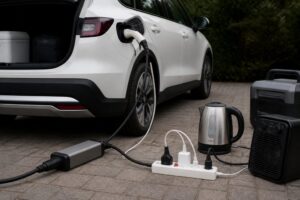
One v2l converter is an adapter or external device that converts the high-voltage current from an electric car's high-voltage battery into usable 230V alternating current, which can power standard electrical equipment directly from the car. V2L stands for Vehicle-to-Load, and the principle is simple: power flows from the car's battery to the connected equipment, never the other way around. At V2LPower, we have specialized in this particular field and daily help Danish companies understand what the technology can do for them in practice.
This is where many business customers discover a crucial advantage: instead of rolling a heavy diesel generator out to the job, you can use the electric car that still fits in the space.
From high-voltage battery to 230V outlet: the technical process
The high-voltage battery of electric vehicles typically delivers direct current at high voltage. A V2L converter contains an integrated inverter, which converts this direct current into 230V alternating current at 50 Hz, just like the sockets in a building. The result is one or more standard sockets to which power tools, household appliances and professional equipment can be connected directly.
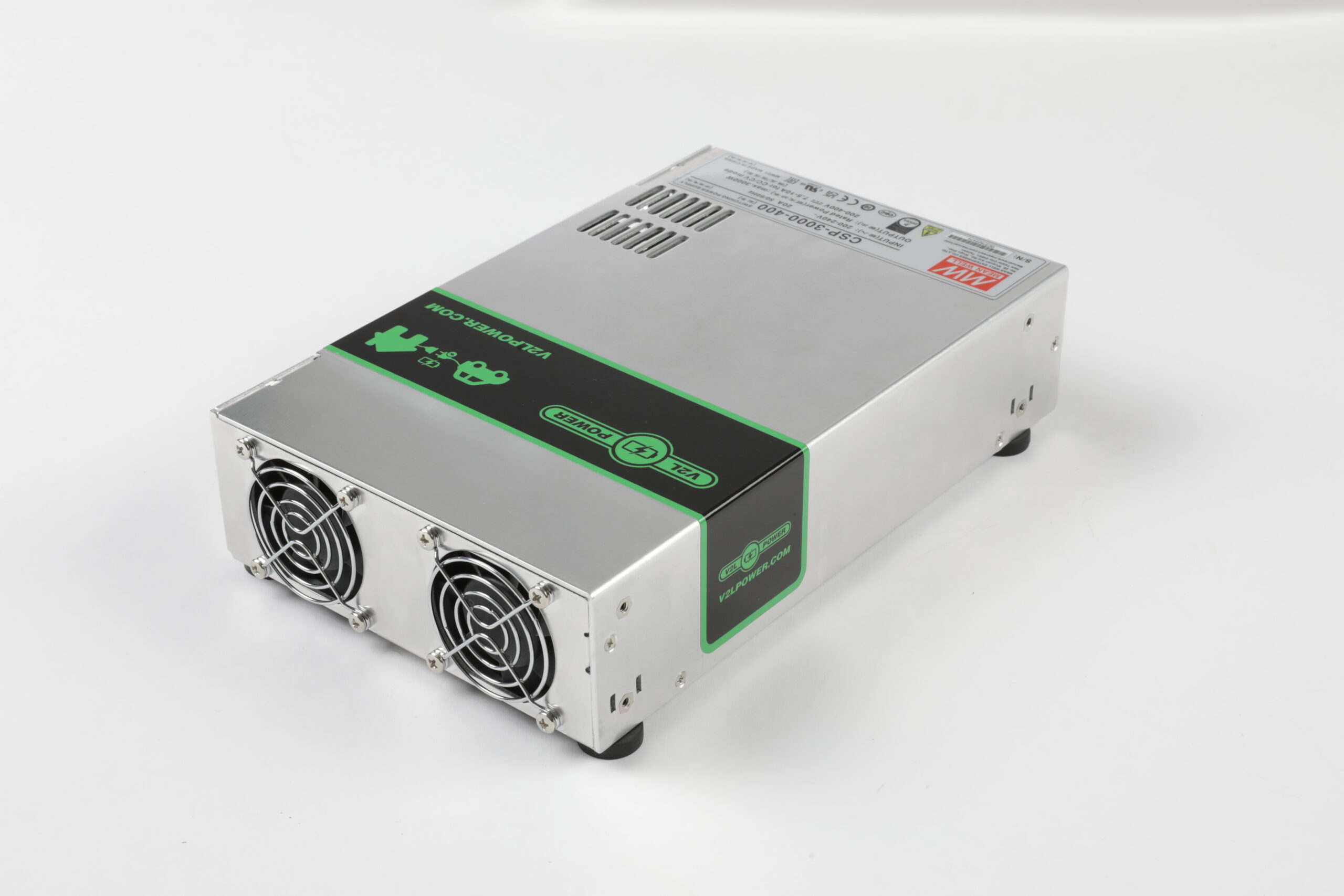
The power output varies depending on the car model and inverter type. Most systems deliver between 2.2 kW and 3.6 kW, while some models reach 5 kW or more. This is a kW limitation that you need to know before planning which devices to run simultaneously. An angle grinder, a compressor and a construction site lamp can easily be within the limit, while a large welding machine requires careful calculation.
V2L vs. V2H – what's the difference, and when is which relevant for businesses?
V2L and V2H are often confused, but they cover two very different needs. V2L sends power from the car to loose, connected equipment via an adapter in the charging port's plug or the car's own outlet. V2H sends power from the car into a house's electrical installation via a special bi-directional charging system and requires an approved installation.
For business customers, V2L is by far the most accessible choice in 2026. It requires no permanent installation, no approval from an electrician, and no changes to the building's electrical panel. You plug in the inverter and you're good to go. V2H is relevant for businesses with a fixed address that want emergency power for the entire building, but it's a completely different investment with different requirements.
List of V2L-compatible electric cars: which models support commercial outlets?
Not all electric cars support V2L, and this is one of the questions V2LPower receives most often. The answer depends on the car manufacturer, model and year of manufacture.
In general, the list of V2L-compatible electric cars is dominated by Korean and Japanese manufacturers who were early adopters of the technology. The Hyundai IONIQ 5 and IONIQ 6, Kia EV6 and EV9, Genesis GV60 and G80 Electric are all known to have V2L as a factory-fitted feature. The KIA Niro EV and Hyundai Kona Electric also support it in newer models.
For European brands, the uptake is more limited but growing. The Renault Megane E-Tech and Renault Scenic E-Tech support V2L on selected configurations. BYD has introduced V2L on several models in the European market, including the BYD Atto 3 and BYD Seal. Chinese brands such as NIO and Xpeng are on the way.
Tesla does not support V2L in the traditional sense via charging port, but it is possible to use an external V2L converter via a Type 2 adapter on selected models, depending on software version.
Technical compatibility matrix: plug type, power output and kW limitation
| Car model | Connector type | Max power output | Internal/external V2L |
|---|---|---|---|
| Hyundai i30 | CCS2 + dedicated V2L connector | 3.6kW | Internal + external adapter |
| Kia EV6 | CCS2 + dedicated V2L connector | 3.6kW | Internal + external adapter |
| Kia EV9 | CCS2 + dedicated V2L connector | 3.6kW | Internal + external adapter |
| BYD Atto 3 | CCS2 | 2.2kW | External adapter |
| Renault Megane E-Tech | Type 2 | 3.0kW | External adapter |
| Hyundai i10 | CCS2 + dedicated V2L connector | 3.6kW | Internal + external adapter |
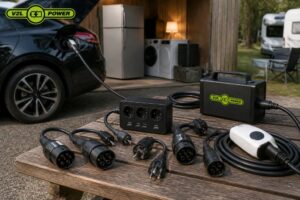
The type of connector determines which converter you need. Models with a dedicated V2L connector in the charging base or trunk can use a simple adapter directly. Models without this connector require an external V2L converter via the Type 2 charging port connection. Always check compatibility with your specific EV model before investing.
Not sure if your electric car model supports V2L? V2LPower offers free email support where you can verify compatibility with your specific car before you buy. It typically takes less than 24 hours to get a response.
Industry-specific use cases: who benefits most from V2L?
Craftsmen, event organizers and mobile service companies are the segments that derive the most tangible value from a v2l inverter for commercial use. What they have in common is the need for reliable power in places where there is no wall outlet.
Craftsmen and service companies: power tools without a generator
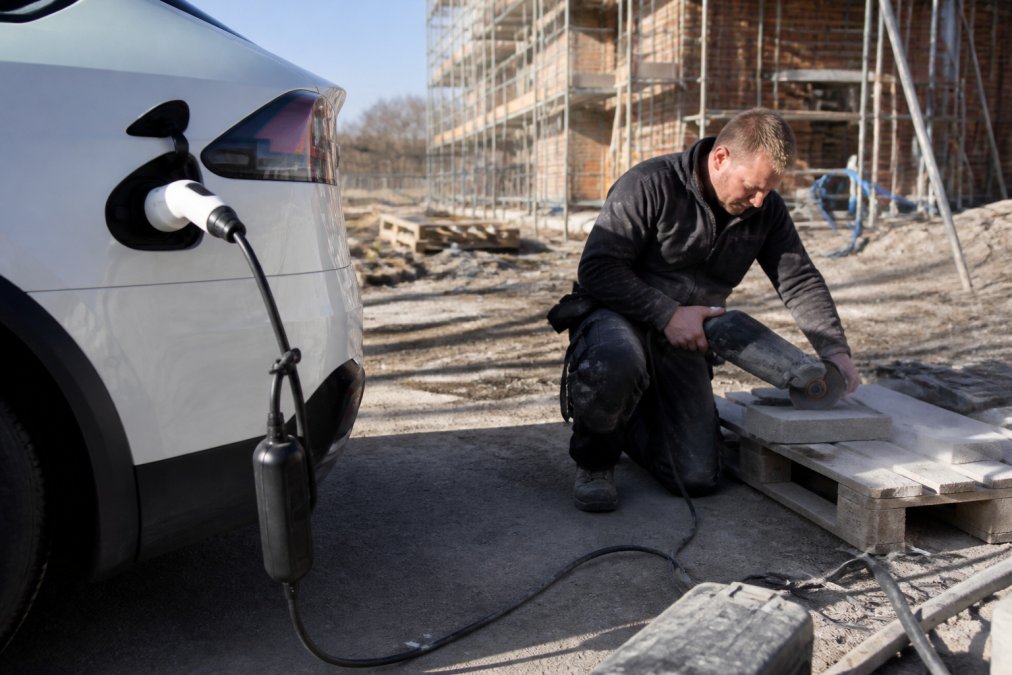
A carpenter, plumber or painter working on a renovation in an area without power knows the problem. The diesel generator is heavy, noisy, expensive to run and requires fuel. An electric car with V2L functionality solves all four problems at once.
With a power output of 3.6 kW, you can power:
- A circular saw (typically 1.2-1.8 kW)
- An impact drill (typically 0.8-1.2 kW)
- A construction site lamp (typically 0.1-0.5 kW)
- A small compressor (typically 1.0-1.5 kW)
It's not necessarily all at once, but with a sensible work schedule it's entirely realistic to run a single power tool at a time throughout the workday. Many tradespeople report that they rarely need more than 2 kW at a time in practice.
The power supply from the car battery is stable and clean, without the voltage fluctuations that can damage sensitive electronic equipment. This is an advantage that diesel generators can rarely match.
Event, catering and mobile service units
The event industry knows the scenario: a pop-up stand in a square, a catering truck without fixed power, a mobile hair salon or a trade fair booth in a hall that doesn't have enough sockets. Here, a mobile power source like V2L is a direct solution.
Catering companies can operate coffee machines, warming cabinets and lighting. Event organizers can provide sound systems, lights and charging stations for guests' devices. For mobile service units that travel from address to address, it is a competitive advantage to be able to offer services independent of local power supply.
Off-grid capacity is particularly valuable at outdoor events, festivals and temporary installations where charging infrastructure is limited or absent.
Security when using V2L: what business customers need to know
Safety when using V2L comes down to three things: the right adapter for the right car, proper load calculation, and understanding the system's built-in safety protocol. Business customers who use V2L professionally should be familiar with all three.
Modern V2L systems are designed with automatic overload protection. If the connected equipment exceeds the vehicle's kW limit, the system automatically cuts off the power. This is an important safety protocol that protects both the vehicle and the equipment. The "V2L conditions not met" error message typically occurs when an incompatible adapter is used or when the inverter is not communicating properly with the vehicle's control unit. Certified adapters from a specialist like V2LPower are designed to handle this communication correctly.
According to the Danish Safety Technology Authority, it is essential that electrical equipment used professionally is CE marked and complies with applicable low voltage directives. This also applies to converters and adapters for V2L.
Certification, safety protocols and Danish regulations
For commercial use in Denmark, a number of considerations apply that private users rarely encounter.
First, the converter and adapter must meet the requirements of EU Low Voltage Directive (2014/35/EU), which has been implemented in Danish legislation. CE marking is not optional, it is a legal requirement for electrical equipment on the European market.
Secondly, companies that use V2L equipment in connection with employees should ensure that the equipment is covered by the workplace assessment and meets the requirements of the Danish Working Environment Authority's regulations on electrical equipment in the workplace. This means that the equipment must be fit for purpose and properly maintained.
Never use a non-certified V2L adapter from unknown suppliers for commercial use. A cheap adapter without the correct CE marking can fail under load, damage the car's electrical system and, in the worst case, void the car's warranty and your company's insurance coverage.
Setting up V2L converter for business: step by step
Setting up a v2l inverter for commercial use is simpler than most people expect. It requires no electrician, no fixed installation and no special technical knowledge. Here is the practical procedure:
Step 1: Verify compatibility
Check that your electric car model supports V2L. Check your car's manual or contact V2LPower to confirm. Note the car's V2L connector type (dedicated V2L connector or via Type 2 charging port).
Step 2: Choose the correct converter
Choose a converter specifically designed for your car model. A generic adapter may not work because the communication protocol varies between car manufacturers.
Step 3: Turn off the car's air conditioning and unnecessary systems
To maximize the available power output for your equipment, you should turn off the air conditioning and other large consumers in the car before activating V2L.
Step 4: Connect the inverter
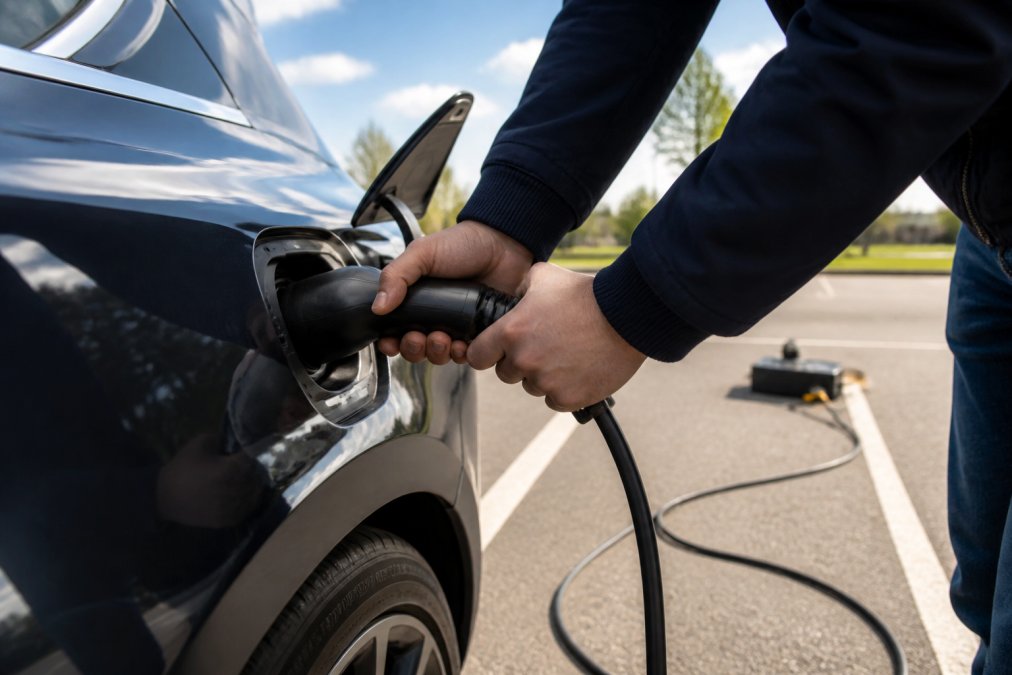
Plug the adapter into your car's V2L connector or Type 2 charging port. Follow your car manufacturer's instructions to activate the V2L feature, typically via your car's infotainment system or a physical button.
Step 5: Connect the equipment and check the load
Plug in your power tools or equipment. Start with one appliance at a time and monitor the car display to ensure you stay within the kW limit.
Step 6: Monitor the battery level
Set a lower limit for the car's battery level before you start. Many business customers set the limit at 20% so that the car can always drive to the next charging point. The car's battery capacity is your "fuel tank" for power.
A fully charged electric car with a 77 kWh battery can theoretically deliver power for many hours at 3.6 kW. In practice, you are limited to the top 60-70% of the battery, but that is still a significant energy utilization for a full working day.
Financial ROI calculation: what does your company save with V2L?
The direct comparison is against the diesel generator, and here the math is clear. A portable diesel generator with similar output typically costs from DKK 5,000-15,000 to purchase, but it is the operating costs that make it expensive over time: fuel, maintenance, service and transport.
A V2L converter is a one-time expense. The power comes from the car's battery, which is charged anyway, typically at night on a cheap electricity tariff. Many companies finds that the marginal electricity price per working day is minimal compared to the fuel costs for a similar generator.
In addition, there are the indirect savings to include in the calculation:
- No fuel costs at the workplace itself
- No maintenance by a separate generator
- No noise nuisance, which may limit working hours or require noise barriers
- Reduced CO₂ footprint, which may be relevant for companies with ESG reporting or green procurement requirements
For companies that have already invested in an electric vehicle for their fleet, a v2l converter is a relatively modest additional cost to unlock a capability that is integrated into the vehicle. It is essentially using something you have already paid for.
As Dansk Energi's analyses of the overall operating economy of electric cars show, the operating costs of electric cars are generally lower than for similar fossil-fueled alternatives, and this advantage is reinforced when the V2L capacity is also utilized commercially.
Legislation, insurance and liability for commercial V2L use in Denmark
This is an area that many business customers overlook, and that is a mistake. Legislation and insurance are not complicated, but it does require asking the right questions.
Insurance: Contact your insurance company and specifically ask if commercial use of the V2L is covered under your existing commercial insurance or the car's comprehensive insurance. Most standard insurance policies cover the car under normal use, but "normal use" is defined differently by different companies. Using the car as a mobile power source could theoretically fall outside of coverage if not explicitly mentioned.
Working environment: The Danish Working Environment Authority's regulations on electrical equipment requires that electrical equipment in the workplace is suitable and safe. A certified V2L converter with CE marking meets these requirements, but the employer is responsible for ensuring that the equipment is used correctly.
Warranty conditions: Using uncertified adapters can void your car's warranty. This is not a hypothetical scenario, it is a real risk. Make sure the converter you are using is approved by or compatible with the car manufacturer's specifications.
VAT rules: Commercial purchases of V2L equipment can in many cases be deducted as an operating expense. Contact your accountant to clarify the specific rules for your type of business under Danish tax law.
It's not a field that requires a lawyer to navigate, but it does require making a few phone calls before rolling out on your first assignment with V2L as a power source.
Summary: V2L as a mobile power source is an obvious business choice
Many companies invest in electric cars to reduce operating costs and CO₂ footprint, but only use a fraction of the car's total capability. V2L fundamentally changes that equation: the car doesn't just become transportation, it becomes infrastructure.
Frequently Asked Questions
Which electric cars support V2L technology in Denmark?
A number of popular electric vehicles support V2L, including the Hyundai IONIQ 5 and IONIQ 6, Kia EV6 and EV9, Genesis GV60, and Ford F-150 Lightning. Some models have a built-in 230V outlet, while others require an external V2L converter via the vehicle’s charging port. It is crucial to check your specific model’s compatibility and kW limitation before investing in V2L equipment for commercial use.
Are there any restrictions on power consumption via V2L for businesses?
Yes. Most V2L systems deliver between 2.2 kW and 3.6 kW of AC power, depending on the vehicle manufacturer and model. This is sufficient for power tools such as angle grinders, drills/drivers and lighting, but heavy machinery with high inrush currents may exceed the limit. Always check the power requirements of the equipment against the vehicle's kW limit and the maximum load of the V2L inverter before connecting.
What should you be aware of when using V2L for professional tools?
Safety when using V2L requires that you use certified V2L equipment that is suitable for your specific electric car model. Avoid cheap, untested adapters as they can trigger error messages or, in the worst case, damage the car's electrical system. Make sure that connected equipment does not exceed the power output of the inverter, always use a grounded extension cord, and monitor the car's battery capacity during extended use.
Can V2L be used legally for commercial purposes in Denmark?
V2L is legal to use commercially in Denmark, but there are conditions to take into account. The insurance on the company car should be reviewed to ensure that commercial use of the car as a mobile power source is covered. In addition, electrical installations connected to the V2L outlet should comply with the High Current Ordinance. Contact your insurance advisor and possibly an authorized electrical installer if in doubt.
The challenge for most business customers is not the technology, it is finding the right solution for their specific car and use case. V2LPower offers certified V2L inverters and adapters specifically tailored to your electric car model, free email support and fast delivery throughout Europe. The equipment is CE marked and designed for professional use. Get started with V2LPower and use the full potential of your electric car as a mobile power source for your business.
This article was written using GrandRanker

 Danish
  English
  Swedish
  German
  Dutch
Dutch  Norwegian
  Chinese
  French
  Polish
  Italian
  Greek
Greek  Finnish
  Spanish
  Turkish
  Bulgarian
  Czech
Czech  Portuguese
  Bosnian
  Slovak
  Slovenian
  Romanian
  Hungarian
  Lithuanian
  Latvian
  Estonian
  Serbian
  Ukrainian